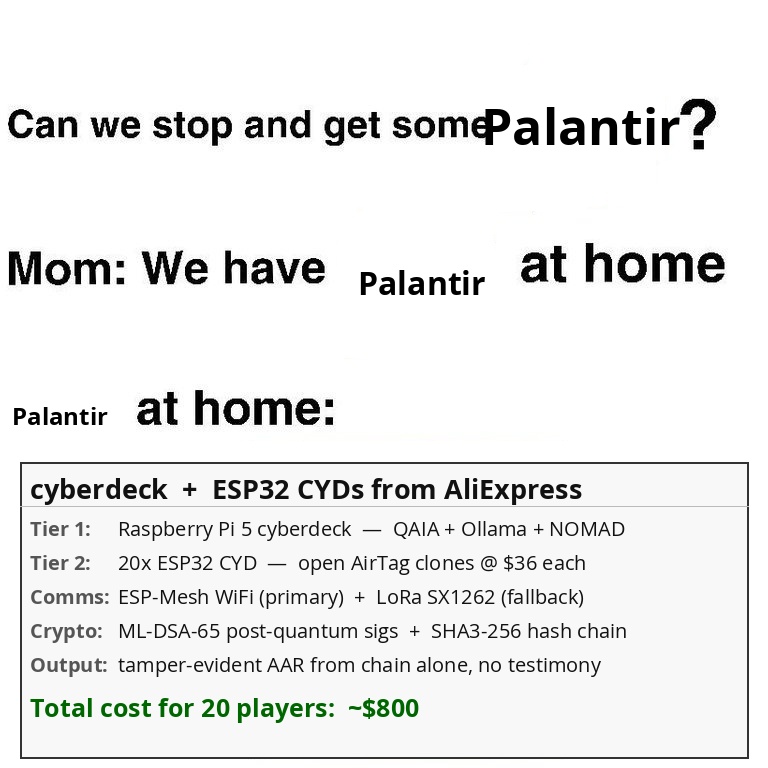
— Can we get Palantir?
— We have Palantir at home.
Palantir at home: a cyberdeck and some ESP32s from AliExpress.
A quantum-anchored flight recorder for AI and field ops — runs over LoRa when the internet is gone, on ~$650 of commodity hardware.
PHANTOM is what you'd get if a flight data recorder, a notary public, and a LoRa mesh had a baby — and the notary used physics instead of a stamp. Every AI output, every position broadcast, every tactical order gets cryptographically signed and hash-chained to a quantum event that existed before your system booted. No cloud. No cell tower. No trust required. Fits in a backpack. Survives a quantum computer.
| Property | Status | Standard / Mechanism |
|---|---|---|
| Post-internet | ✅ Phase 1+ | LoRa SX1262 + ESP-NOW — no cell towers, no cloud, no DNS |
| Post-quantum secure | ✅ Phase 1+ | NIST FIPS 203 (ML-KEM-768) + FIPS 204 (ML-DSA-65) — lattice-based, Shor-resistant |
| Quantum-seeded entropy | ✅ Now (beacon) / Phase 5 (on-chip) | NIST/CURBy/ANU beacons → IDQ/Quside hardware QRNG |
| Tamper-evident audit | ✅ Phase 1+ | SHA3-256 hash chain + ML-DSA-65 signatures + SQLite |
| Inference privacy + speed | ✅ Phase 5 | Tailslayer fork: QRNG DRAM XOR lowers p99 latency + prevents memory layout prediction |
Prove what your AI said, when it said it, and that nobody picked the answer. Prove what your hardware is doing, which memory it's touching, and that nobody predicted the layout. Prove what your operator said, when they said it, and that nobody faked the order.
Anyone with your public key can verify all of it — independently, offline, forever.
Why now? Three things converged in 2024–2026:
- AI output is increasingly unverifiable. C2PA [9] exists for images but is cloud-anchored and PRNG-seeded — provenance breaks the moment the internet does. There is no tamper-evident, offline, quantum-anchored AI attestation system for field use. PHANTOM is the first attempt.
- Post-quantum cryptography just standardized. NIST finalized ML-DSA-65 and ML-KEM-768 (FIPS 203/204, August 2024). Production C implementations exist in liboqs today. Almost nobody has deployed them on ESP32-class embedded hardware yet. PHANTOM does.
- The Tailslayer dual-use insight is new. Applying QRNG-seeded DRAM channel randomization to embedded LLM inference — simultaneously hardening memory layout against side-channel prediction and measurably lowering p99 inference tail latency — is original to this document.
The composition is novel. The parts are not. That's a strong place to be.
Inspired by Laurie Kirk's (@LaurieWired) video "Your RAM Has a 60 Year Old Design Flaw. I Bypassed It." [34] and her Tailslayer project — which demonstrated that DRAM channel placement is predictable and exploitable, and reduces tail latency by issuing hedged reads across multiple channels with uncorrelated refresh schedules. Her findings broke the assumption that modern hardware is trustworthy at the physical layer. If your RAM is lying to you, your OS is lying to you, your cloud provider is lying to you — and the internet as a trust anchor stops making sense. That's what inspired this network: build something that doesn't need the internet to be trustworthy. PHANTOM extends that insight into a full post-quantum, post-internet attestation mesh. In Phase 5, PHANTOM will fork Tailslayer directly, feeding its channel offset selection from a hardware quantum chip rather than software — making the Hub's LLM inference both faster and physically unpredictable.
--- Every component exists and ships today. NIST/CURBy quantum beacons are live production APIs. ML-DSA-65 and ML-KEM-768 are NIST FIPS 203/204 standards (finalized August 2024) with production C implementations in liboqs. The ESP32 + LoRa SX1262 combo powers tens of thousands of Meshtastic nodes globally right now. llama.cpp runs quantized 7B models on a Raspberry Pi 5 at 1–3 tokens/sec — slow by cloud standards, fast enough for tactical queries offline. PHANTOM (Phase 5) forks Laurie Kirk's Tailslayer [34] to run on a hardware quantum chip (IDQ/Quside), XOR-seeding DRAM channel offsets at the CPU with true quantum entropy — making the Hub's LLM inference measurably faster (lower p99 tail latency) and cryptographically unpredictable simultaneously. Tailslayer's p99 reduction on DRAM-bandwidth-bound models is empirically benchmarked. Certificate Transparency already runs hash-chained append-only logs at internet scale. Post-internet: the LoRa + ESP-NOW mesh operates entirely without internet infrastructure — no cell towers, no cloud, no DNS — by design, not by workaround. Post-quantum secure: ML-DSA-65 and ML-KEM-768 are NIST FIPS 203/204 lattice-based algorithms selected specifically to withstand attacks from quantum computers. Shor's algorithm breaks RSA and ECDSA. It does not break these. The integration is novel. The parts are not.
Modern computing stacks have a systemic trust problem: every layer that depends on a pseudo-random number generator (PRNG) — memory layout randomization (ASLR), DRAM channel assignment, LLM token sampling, session key generation — is theoretically predictable by a sufficiently motivated adversary. PHANTOM proposes a unified architectural response: replace PRNG seeds with quantum random number generator (QRNG) entropy at every security-critical layer, and anchor every seeding event in a post-quantum-signed, hash-chained attestation record that can be independently verified by anyone with the public key.
PHANTOM extends QAIA (Quantum-Attested Inference Architecture) — a pipeline for constructing tamper-evident attestation chains anchored to quantum randomness [1, 2, 3] — into a decentralized, offline tactical mesh. The system composes quantum random number generation [1, 2, 3], post-quantum digital signatures [4, 5], hash-chained audit logs [13], DRAM channel randomization via Tailslayer [34], and a tiered ESP32 WiFi/LoRa mesh to provide non-repudiation, temporal binding, sampling integrity, and hardware-level unpredictability in infrastructure-denied environments. When on-chip QRNG hardware arrives, the same QRNG-seeded Tailslayer channel offsets that make DRAM layout physically unpredictable also measurably reduce LLM inference tail latency — security and performance from the same mechanism, no protocol changes required.
The proof-of-concept is deliberately minimal: a ~$15–25 ESP32 and a cyberdeck built from commodity parts, tested on an airsoft field with zero cell coverage. PHANTOM is post-internet by design — every critical operation runs over a LoRa mesh with no internet infrastructure required — and post-quantum secure by specification — ML-DSA-65 and ML-KEM-768 are NIST FIPS 203/204 lattice-based algorithms designed to withstand quantum computer attacks. No quantum chip required to start: the architecture uses public quantum randomness beacons [1, 2] over the internet today, and is designed so that when quantum chips become commodity (embedded in NUCs, MacBooks, or microcontrollers), every layer upgrades in place without protocol changes.
Every PRNG seed in a modern system is a potential attack surface. ASLR is only as strong as its entropy source. DRAM channel placement — as demonstrated by Tailslayer [34] — follows deterministic XOR offsets that can be reverse-engineered, making Rowhammer targeting [31] tractable. LLM inference samples tokens from a seeded distribution that can be replayed. Session keys are generated from algorithmically predictable state.
PHANTOM's thesis is that quantum entropy closes all of these gaps simultaneously, and that attestation makes the closure verifiable:
| Layer | Current entropy source | PHANTOM upgrade | Attestation |
|---|---|---|---|
| ASLR / pointer auth | getrandom() CSPRNG |
On-chip QRNG seed per boot | Signed boot event in chain |
| DRAM channel XOR (Tailslayer) [34] | Fixed deterministic offset | QRNG-seeded per session | Channel seed pulse ID in |
| chain | |||
| LLM token sampling (QAIA) | PRNG seed | NIST beacon / on-chip QRNG | quantum_entropy field per block |
| Mesh node session keys | Static keypair | QRNG-seeded ephemeral keys | ML-KEM-768 wrapped, logged |
| TLS / comms | CSPRNG | QRNG-seeded, ML-DSA-65 signed | Every handshake attested |
The chain is the key insight: not just "we used quantum entropy" as a marketing claim, but a signed, hash-chained, publicly verifiable proof that every seeding event was anchored to a specific quantum pulse — one that existed before the system booted, that no attacker could have predicted, and that anyone can independently verify against the public beacon record.
This works today using public beacon APIs. The qaia.entropy module abstracts
the entropy source behind a hardware driver interface: swap the HTTP beacon client
for a local QRNG IC driver and every other layer is unchanged. The attestation
schema already includes an entropy_source field: beacon | hardware | cached.
Pseudo-random number generators are deterministic given their seed. This is not a theoretical concern:
- Rowhammer on inference: DeepHammer [31] demonstrated targeted DRAM bit flips that degrade DNN classification accuracy to near-zero. No kernel exploit, no quantum computer. The attack works because DRAM channel placement follows predictable deterministic offsets — reverse-engineered by Laurie Kirk (LaurieWired) for AMD, Intel, and Graviton in Tailslayer [34]. QRNG-seeded channel offsets remove the predictability that makes targeting possible.
- Selective re-sampling: An operator running LLM inference can replay the same prompt until a favorable output is produced and selectively attest only that result. There is no mechanism to detect this without a sequential, externally anchored attestation chain with gap-detectable block IDs.
- Harvest-now-decrypt-later: Adversaries collect signed traffic today to decrypt retroactively when quantum hardware matures [8]. Classic ECDSA and RSA are broken by Shor's algorithm [32]; the timeline is uncertain but contracting [33].
Tactical operators and first responders face a structural auditability failure. Current tools (Discord, ATAK, Zello) provide no cryptographic non-repudiation and are vulnerable to future quantum adversaries [8].
- Infrastructure Dependency: Communication fails when cell towers or cloud servers are unavailable. There is no fallback with integrity guarantees.
- Auditability Gap: No immutable record of "who said what and when" exists in offline environments. After-action reports rely on human memory and screenshots.
- Inference Integrity: AI outputs with life-safety consequences (medical triage, tactical advisories) are unsigned plaintext with no proof of provenance. Content provenance standards such as C2PA [9] address this in media pipelines, but provide no offline, radio-transportable equivalent for tactical operations.
| Threat | Vector | Timeline |
|---|---|---|
| Rowhammer on inference | Predictable DRAM channel placement enables targeted bit flips [31, 34] | Now |
| Unsigned API responses | MITM or selective disclosure of plaintext LLM outputs | Now |
| Harvest-now-decrypt-later | Collect signed traffic today, decrypt when quantum hardware matures [8] | |
| Near-future | ||
| Shor's algorithm breaks PKI | Quantum computer attacks RSA/ECDSA signing infrastructure [32] | **Uncertain — but |
| contracting [33]** |
Quantum random number generators exploit fundamental quantum mechanical processes — typically vacuum fluctuations or photon detection — to produce bits whose randomness is guaranteed by physical law rather than computational assumptions [10]. Public randomness beacons such as the NIST Randomness Beacon [1] and the CURBy quantum randomness beacon at the University of Colorado [2] broadcast timestamped, signed random pulses at regular intervals, creating a publicly auditable source of unpredictable entropy available today over HTTP.
NIST standardized three post-quantum cryptographic algorithms in 2024. PHANTOM utilizes two:
- ML-DSA-65 (Dilithium) [4] — Module-Lattice-Based Digital Signature Standard (FIPS 204). Signs every mesh message and every attestation block. Security grounded in the hardness of Module Learning With Errors (Module-LWE) [12].
- ML-KEM-768 (Kyber) [5] — Module-Lattice-Based Key-Encapsulation Mechanism Standard (FIPS 203). Quantum-resistant key exchange for encrypted mesh sessions.
Classic ECDSA and RSA are broken by Shor's algorithm on a sufficiently powerful quantum computer [8]. ML-DSA and ML-KEM provide durability against this threat.
Tamper-evident logging via hash chains was introduced by Haber and Stornetta [13]
and formalized in the Merkle tree structure [6]. Certificate Transparency [14]
demonstrated append-only hash-chained logs at internet scale. PHANTOM applies the
same pattern to every security-critical seeding event: each block embeds
SHA3-256 [15] of the previous block's canonical serialization, making any
retroactive modification detectable by any node holding the chain.
Tailslayer [34] is a C++ library by Laurie Kirk (LaurieWired) that exploits undocumented CPU address XOR/scrambling bits to force data onto specific DRAM channels, then hedges reads across replicas with uncorrelated refresh schedules to reduce tail latency. The same mechanism that enables this — deterministic, reverse-engineerable channel offsets on AMD, Intel, and Graviton — is what makes Rowhammer targeting tractable. PHANTOM proposes feeding QRNG entropy into these offsets: the channel layout changes every session, seeded from a quantum event no attacker could have predicted, with the seed pulse ID attested in the chain. The hedged-read latency benefit of Tailslayer is preserved; the attack surface collapses.
This dual-use property is significant for the Hub. LLM inference with llama.cpp on a Raspberry Pi 5 is DRAM-bandwidth bound during autoregressive decoding (~1 FLOP/byte arithmetic intensity), making it directly sensitive to DRAM refresh stalls. Those stalls are invisible in average latency but clearly visible as p99 spikes in time-to-first-token and inter-token intervals. Tailslayer's hedged reads across channels with uncorrelated refresh schedules suppress those stalls — meaning QRNG-seeded Tailslayer delivers both physically unpredictable memory layout (security) and measurably lower token generation tail latency (performance). Same mechanism, two benefits.
PHANTOM uses a tiered mesh strategy, drawing on the LoRa mesh ecosystem [28] as prior art. The primary transport is a WiFi mesh formed by ESP32 nodes using ESP-NOW and ESP-Mesh (Espressif proprietary mesh protocol over 802.11 b/g/n). ESP-NOW provides ultra-low-latency peer-to-peer communication (~200m range) without a central access point. ESP-Mesh extends this into a self-healing routed network where each node is a relay — more players means better coverage, not worse.
LoRa (SX1262) is retained as a fallback transport for nodes outside WiFi mesh range, providing multi-kilometer range at sub-watt power levels. LoRa activates automatically on mesh loss. The attestation chain is transport-agnostic: blocks delivered over LoRa and WiFi are verified identically.
Quantum Entropy Sources           Inference Engine (Cyberdeck)
(NIST Beacon / CURBy / ANU)      (llama.cpp [7] + QRNG sampling)
        │                                   │
        ▼                                   ▼
┌───────────────────────────────────────────────────────┐
│              QAIA Block Builder                        │
│                                                       │
│  block_id          — sequential index                 │
│  timestamp         — ISO-8601                         │
│  quantum_entropy   — beacon pulse hash + pulse ID     │
│  entropy_source    — beacon | hardware | cached       │
│  input_hash        — SHA3-256(prompt)                 │
│  output_hash       — SHA3-256(completion)             │
│  model_id          — SHA3-256(model file)             │
│  prev_block_hash   — SHA3-256(prev canonical block)   │
│  signature         — ML-DSA-65 over all fields        │
└───────────────────────────┬───────────────────────────┘
                            │
              ┌─────────────▼──────────────┐
              │    ESP-Mesh (WiFi primary)  │
              │    LoRa (automatic fallback)│
              │    ML-DSA-65 signed msgs    │
              └──────┬──────────┬──────────┘
                     │          │
          ┌──────────▼──┐  ┌────▼────────────┐
          │  Cyberdeck   │  │  ESP32 CYD ×N   │
          │  (Tier 1)    │  │  (Tier 2)       │
          │              │  │                 │
          │  Full chain  │  │  Verify sigs    │
          │  SQLite      │  │  GPS + map UI   │
          │  NOMAD KB    │  │  WiFi + LoRa    │
          └─────────────┘  └─────────────────┘
A portable, hand-built SBC enclosure (Raspberry Pi 5 or equivalent) running local LLMs and the NOMAD offline knowledge stack [29]. Battery-powered. No cloud. No cell signal. Fits in a backpack. Participates in the ESP-Mesh WiFi network directly as a peer node.
- QAIA Block Builder: Generates signed attestation blocks for every inference
event, containing
input_hash,output_hash,quantum_entropypulse IDs,entropy_source, andmodel_id. - Mesh Peer: Joins ESP-Mesh directly; serves the QAIA HTTP API to all nodes.
- Offline Knowledge: Local mirrors of Wikipedia, medical databases, and OpenStreetMaps via NOMAD.
- Chain Authority: Maintains the canonical SQLite attestation chain; exports JSON-LD blocks for independent verification.
~$15–25 ESP32 CYD units [30] with GPS (BN-220) and LoRa (SX1262). Each one is functionally an open, hackable AirTag — except every transmission it receives is verified against ML-DSA-65 signatures from the Hub, works fully offline, and doesn't phone home to anyone. Private keys never leave the Hub; edge nodes hold only public keys.
- Primary transport: ESP-NOW / ESP-Mesh WiFi — nodes relay for each other.
- Fallback transport: LoRa (SX1262) activates automatically on mesh loss.
- Signature Verification: Verifies ML-DSA-65 blocks from the cyberdeck.
- Offline-First: No internet required at any point in the verification path.
| Property | Mechanism | Security Assumption |
|---|---|---|
| Tamper-evidence | SHA3-256 hash chain [15] | Collision resistance of Keccak sponge [16] |
| Non-repudiation | ML-DSA-65 signature per block [4] | Signer maintains exclusive control of private key |
| Temporal binding | NIST beacon pulse ID embedded in block [1] | Beacon operates honestly (publicly auditable, |
| signed pulses) | ||
| Sampling integrity | QRNG seeds token selection [10] | Entropy source randomness guaranteed by quantum mechanics |
| DRAM unpredictability | QRNG seeds Tailslayer channel offset [34] | Same quantum entropy guarantee |
| Post-quantum durability | ML-DSA + SHA3 [4, 15] | Hardness of Module-LWE [12] |
| Message attribution | ML-DSA-65 per mesh transmission | Key custody maintained per node identity |
| Offline verifiability | Cached beacon pulses + embedded signatures | Local copy of public key and pulse cache |
| sufficient |
| Threat | Impact | Mitigation |
|---|---|---|
| Signing key compromised | Attacker forges valid attestations or mesh messages | Key rotation policy; revocation list |
| propagated over mesh; HSM storage [25] | ||
| NIST beacon downtime | Temporal binding weakened | Multi-source entropy (CURBy [2], ANU [3]); cached pulses; |
entropy_source flagged in block |
||
| Model weights poisoned | QAIA faithfully attests poisoned output | Out of scope — QAIA is an integrity layer, not a |
| safety layer. See [26]. | ||
| Rowhammer / bit-flip attack | DRAM bit flips corrupt model weights or output buffer [31] | output_hash captured |
| immediately post-inference; QRNG-seeded channel offsets [34] remove targeting predictability | ||
| Host machine compromised | Attacker intercepts data before attestation | Trusted Execution Environment (Intel SGX/TDX |
| [27]) — future work | ||
| Selective attestation | Operator attests only favorable inference outputs | Mandatory sequential block numbering; gaps |
in block_id are detectable |
||
| LoRa replay attack | Stale signed message rebroadcast as current | Block timestamp + prev_block_hash binding; |
duplicate block_id detection |
||
| Node impersonation | Attacker injects unsigned messages | All mesh messages require valid ML-DSA-65 signature |
- No computational speedup. Quantum entropy adds latency, not performance. No quantum advantage is claimed.
- No model safety guarantees. A poisoned model produces attested-but-incorrect output. PHANTOM is an integrity layer, not a safety layer.
- No anonymity. PHANTOM attributes messages to signing identities.
- No distributed consensus. The hash chain is a tamper-evident append-only log, not a blockchain. Chain authority lies with the Hub node.
- LoRa bandwidth constraints. ML-DSA-65 signatures are ~3.3 KB. LoRa's low bandwidth requires fragmentation; lightweight (hash + sig) messages are the default edge-node protocol.
- On-chip QRNG not yet commodity. Current implementation uses public beacon
HTTP APIs. The architecture is designed for hardware swap-in when chips arrive.
The
entropy_sourcefield in every block makes the transition transparent and auditable.
Goal: Establish the QAIA chain and PQC signing primitives.
- Integrate
qaia.entropymodule (NIST Beacon [1] + CURBy [2] + ANU [3] fallback). - Implement SHA3-256 [15] hash-chaining for the transport layer.
- Port ML-DSA-65 verification to ESP32 via liboqs [20]. Signing runs on the Hub only; edge nodes hold public keys and verify received blocks. ML-DSA-65 secret key (4,032 bytes) and signing stack pressure make signing impractical on constrained ESP32 SRAM alongside WiFi, LoRa, GPS, and display drivers.
- Deliverable:
qaia.pycore module andphantom-meshESP32 firmware.
Goal: Field-usable edge node with map rendering and peer verification.
- Integrate GPS (BN-220) and LoRa (SX1262) with the CYD hardware.
- Render offline map tiles from SD card with PQC-verified teammate icons.
- Display signature validity indicator per received message.
- Deliverable: CYD-Tactical-Interface firmware (~$15–25 hardware target).
Goal: End-to-end attested inference accessible from edge nodes over the mesh.
- Integrate Ollama with the QAIA block builder wrapper.
- ESP32 nodes submit inference queries via the WiFi mesh; Hub responds with QAIA-signed blocks.
- Cache NIST Beacon pulses locally for offline temporal anchoring.
- Deliverable: Hub inference service with full QAIA chain output.
Goal: Stress-test the architecture on the cheapest possible hardware. If it holds here, it holds everywhere.
- Hub: One cyberdeck (Raspberry Pi 5, custom enclosure, battery-powered) running QAIA, Ollama, and NOMAD. Joins ESP-Mesh directly.
- Edge nodes: 20× ESP32 CYD units — open AirTag clones with GPS, LoRa, WiFi mesh, and ML-DSA-65 signing. ~$15–25 each.
- ESP-Mesh (WiFi) — primary: sub-second updates, full HTTP to cyberdeck
- LoRa fallback — activates automatically when a node leaves mesh range
- 20+ players, 2 km terrain, 0% cell coverage
- Each node broadcasts ML-DSA-65-signed GPS position over the mesh
- Cyberdeck renders live tactical map; fields AI queries via HTTP
- Full attestation chain accumulates in SQLite
- Real-time map sync while in WiFi mesh range
- Graceful LoRa degradation at mesh boundary — no data loss
- AAR reconstructable from the chain alone — no human testimony required
- Total cost: ~$450–650 (cyberdeck ~$150 + 20× CYD @ ~$15–25)
Goal: Prove the architecture on dedicated quantum hardware as it becomes commodity — no protocol changes required, only entropy source swap.
- Abstract
qaia.entropybehind a hardware driver interface. - Integrate with available QRNG ICs (IDQ, Quside) as drop-in beacon replacement.
- Implement QRNG-seeded Tailslayer [34] channel offsets on Hub hardware: DRAM channel placement becomes physically unpredictable per session, with the seed pulse ID attested in the chain. Rowhammer targeting requires predicting a quantum event.
- Extend attestation schema to include
entropy_source: hardware|beacon|cached. - Target platforms: NUC with QRNG PCIe card, future ESP32 variants with on-chip quantum noise source.
Goal: Transition the stack to humanitarian and SAR operational contexts.
- Repackage as a Rapid Response Case: cyberdeck + 6 CYD nodes, deployable in under 10 minutes.
- Adapt use-case from "objective capture" to "shelter/triage management."
- Document chain export and AAR generation for incident command handoff.
oqs-python          # ML-DSA-65 signatures via liboqs [20]
fips203             # ML-KEM-768 key exchange [5]
llama-cpp-python    # Local LLM inference [21]
httpx               # Async HTTP client for beacon APIs
rich                # Terminal dashboard [24]
sqlite3             # Attestation chain storage (Python stdlib)
liboqs (C)          # ML-DSA-65 verify [20]
TinyGPS++           # GPS NMEA parsing
RadioLib            # SX1262 LoRa driver
LovyanGFX           # CYD display rendering
[1] NIST. "NIST Randomness Beacon." https://beacon.nist.gov/home
[2] Leibrandt, D. et al. "CURBy — Colorado Ultrastable Random Beacon." JILA, University of Colorado Boulder. https://random.colorado.edu/
[3] Symul, T., Assad, S.M., and Lam, P.K. "Real time demonstration of high bitrate quantum random number generation with coherent laser light." Applied Physics Letters, 98(23), 231103 (2011). https://doi.org/10.1063/1.3597793
[4] NIST. "FIPS 204: Module-Lattice-Based Digital Signature Standard (ML-DSA)." Federal Information Processing Standards Publication 204 (2024). https://doi.org/10.6028/NIST.FIPS.204
[5] NIST. "FIPS 203: Module-Lattice-Based Key-Encapsulation Mechanism Standard (ML-KEM)." Federal Information Processing Standards Publication 203 (2024). https://doi.org/10.6028/NIST.FIPS.203
[6] Merkle, R.C. "A Certified Digital Signature." CRYPTO '89. https://doi.org/10.1007/0-387-34805-0_21
[7] Gerganov, G. "llama.cpp." https://github.com/ggerganov/llama.cpp
[8] Mosca, M. "Cybersecurity in an Era with Quantum Computers." IEEE Security & Privacy, 16(5), pp. 38–41 (2018). https://doi.org/10.1109/MSP.2018.3761723
[9] C2PA. "C2PA Technical Specification." https://c2pa.org/specifications/
[10] Herrero-Collantes, M. and Garcia-Escartin, J.C. "Quantum random number generators." Reviews of Modern Physics, 89(1), 015004 (2017). https://doi.org/10.1103/RevModPhys.89.015004
[12] Langlois, A. and Stehlé, D. "Worst-Case to Average-Case Reductions for Module Lattices." Designs, Codes and Cryptography, 75(3) (2015). https://doi.org/10.1007/s10623-014-9938-4
[13] Haber, S. and Stornetta, W.S. "How to Time-Stamp a Digital Document." Journal of Cryptology, 3(2), pp. 99–111 (1991). https://doi.org/10.1007/BF00196791
[14] Laurie, B., Langley, A., and Kasper, E. "Certificate Transparency." RFC 6962, IETF (2013). https://doi.org/10.17487/RFC6962
[15] NIST. "FIPS 202: SHA-3 Standard." (2015). https://doi.org/10.6028/NIST.FIPS.202
[16] Bertoni, G. et al. "The Keccak Reference." Version 3.0 (2011). https://keccak.team/files/Keccak-reference-3.0.pdf
[20] Open Quantum Safe Project. "liboqs." https://openquantumsafe.org/
[21] Jllllll. "llama-cpp-python." https://github.com/abetlen/llama-cpp-python
[24] McGugan, W. "Rich." https://github.com/Textualize/rich
[25] NIST. "FIPS 140-3: Security Requirements for Cryptographic Modules." (2019). https://doi.org/10.6028/NIST.FIPS.140-3
[26] Goldblum, M. et al. "Dataset Security for Machine Learning." IEEE TPAMI, 45(2), pp. 1563–1580 (2023). https://doi.org/10.1109/TPAMI.2022.3162397
[27] Costan, V. and Devadas, S. "Intel SGX Explained." IACR ePrint 2016/086. https://eprint.iacr.org/2016/086
[28] Meshtastic Project. https://meshtastic.org
[29] Crosstalk Solutions. "Project NOMAD." https://github.com/Crosstalk-Solutions/project-nomad
[30] Leitch, B. "ESP32-Cheap-Yellow-Display." https://github.com/witnessmenow/ESP32-Cheap-Yellow-Display
[31] Yao, F., Rakin, A.S., and Fan, D. "DeepHammer: Depleting the Intelligence of Deep Neural Networks through Targeted Chain of Bit Flips." USENIX Security 20, pp. 1463–1480 (2020). https://arxiv.org/abs/2003.13746
[32] Cain, M. et al. "Shor's algorithm is possible with as few as 10,000 reconfigurable atomic qubits." arXiv:2603.28627 (2026). https://arxiv.org/abs/2603.28627
[33] Alvarez Morales, L. "Ten Thousand Qubits and a Prayer." Singular Grit (2026). https://singulargrit.substack.com/p/ten-thousand-qubits-and-a-prayer
[34] Kirk, L. (LaurieWired). "Tailslayer: Reducing tail latency in RAM reads via DRAM channel hedging." GitHub repository (2025). https://github.com/LaurieWired/tailslayer
MIT
