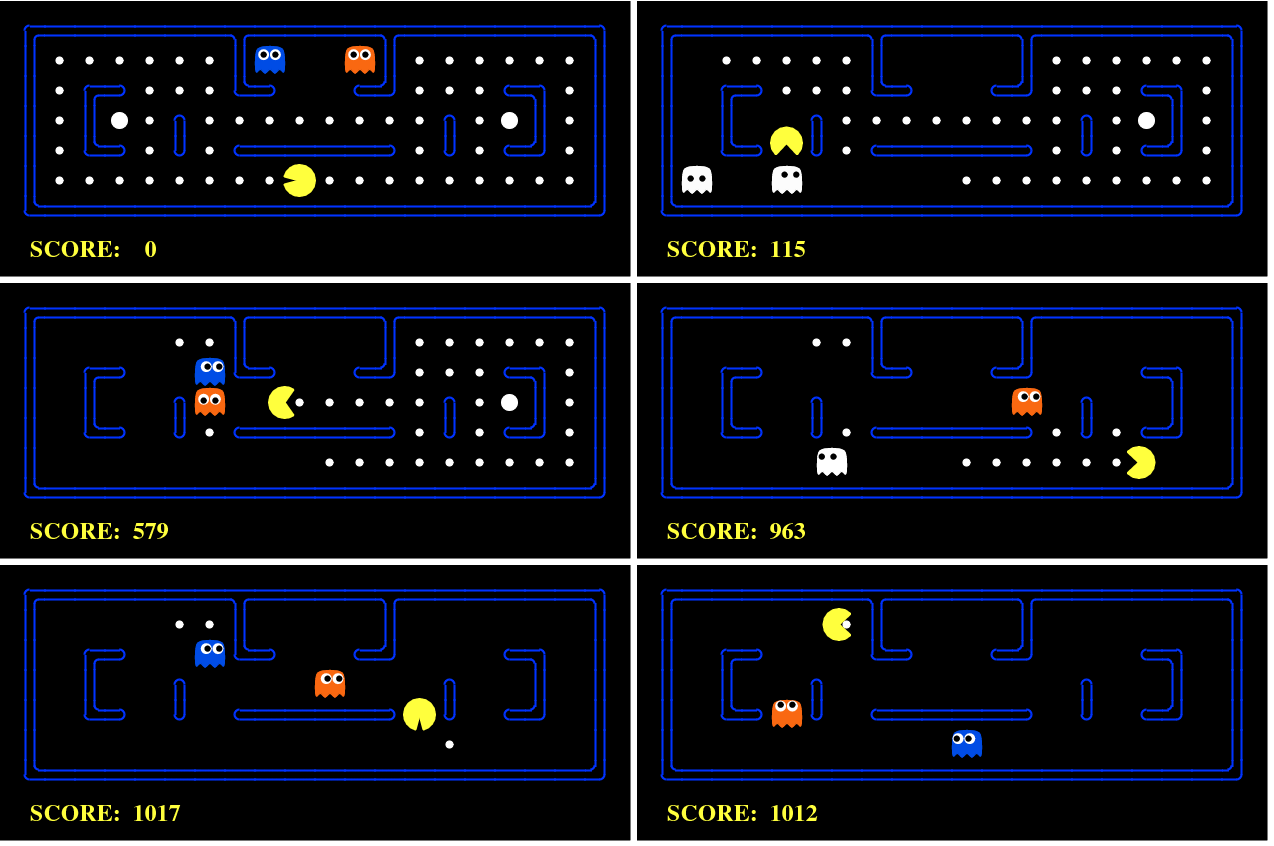
The Pac-Man projects are designed such that students can use an array of AI techniques to playing Pac-Man. However, these projects don't focus on building AI for video games. Instead, they teach foundational AI concepts, such as informed state-space search, probabilistic inference, and reinforcement learning. These concepts underly real-world application areas such as natural language processing, computer vision, and robotics.
Implement depth-first, breadth-first, uniform cost, and A* search algorithms. These algorithms are used to solve navigation and traveling salesman problems in the Pacman world.
Classic Pacman is modelled as both an adversarial and a stochastic search problem. Implement multiagent minimax and expectimax algorithms, as well as designing evaluation functions.
Probabilistic inference in a hidden Markov model tracks the movement of hidden ghosts in the Pacman world. Implement exact inference using the forward algorithm and approximate inference via particle filters.
Implemented depth-first, breadth-first, uniform cost, and A* search algorithms. These algorithms were used to solve navigation and traveling salesman problems in the Pacman world.
The command below tells the SearchAgent to use tinyMazeSearch as its search algorithm, which is implemented in search.py. Pacman should navigate the maze successfully.
$ python pacman.py -l tinyMaze -p SearchAgent -a fn=tinyMazeSearchThe commands below utilises the DFS algorithm to allow Pacman to nagivate the different sized mazes successfully.
$ python pacman.py -l tinyMaze -p SearchAgent$ python pacman.py -l mediumMaze -p SearchAgent$ python pacman.py -l bigMaze -z .5 -p SearchAgentThe commands below utilises the DFS algorithm to allow Pacman to nagivate the different sized mazes successfully.
$ python pacman.py -l mediumMaze -p SearchAgent -a fn=bfs$ python pacman.py -l bigMaze -p SearchAgent -a fn=bfs -z .5Note: If Pacman moves slowly for you, try the option --frametime 0
The commands below utilises the UCS algorithm to allow Pacman to nagivate the different sized mazes successfully.
$ python pacman.py -l mediumMaze -p SearchAgent -a fn=ucs$ python pacman.py -l mediumDottedMaze -p StayEastSearchAgent$ python pacman.py -l mediumScaryMaze -p StayWestSearchAgentThe command below utilises the A* Search algorithm to allow Pacman to nagivate the different sized mazes successfully.
$ python pacman.py -l bigMaze -z .5 -p SearchAgent -a fn=astar,heuristic=manhattanHeuristicIn corner mazes, there are four dots, one in each corner. Our new search problem is to find the shortest path through the maze that touches all four corners (whether the maze actually has food there or not). Note that for some mazes like tinyCorners, the shortest path does not always go to the closest food first!
$ python pacman.py -l tinyCorners -p SearchAgent -a fn=bfs,prob=CornersProblem$ python pacman.py -l mediumCorners -p SearchAgent -a fn=bfs,prob=CornersProblemNow we'll solve a hard search problem: eating all the Pacman food in as few steps as possible.
$ python pacman.py -l trickySearch -p AStarFoodSearchAgentSometimes, even with A* and a good heuristic, finding the optimal path through all the dots is hard. In these cases, we'd still like to find a reasonably good path, quickly. In this section, you'll write an agent that always greedily eats the closest dot.
$ python pacman.py -l bigSearch -p ClosestDotSearchAgent -z .5 In this project, you will design agents for the classic version of Pacman, including ghosts. Along the way, you will implement both minimax and expectimax search and try your hand at evaluation function design.
A capable reflex agent will have to consider both food locations and ghost locations to perform well.
$ python pacman.py -p ReflexAgent -l testClassicThe correct implementation of minimax will lead to Pacman losing the game in some tests. This is not a problem: as it is correct behaviour, it will pass the tests.
$ python pacman.py -p MinimaxAgent -l minimaxClassic -a depth=4$ python pacman.py -p MinimaxAgent -l trappedClassic -a depth=3$ python pacman.py -p AlphaBetaAgent -a depth=3 -l smallClassic$ python pacman.py -p ExpectimaxAgent -l trappedClassic -a depth=3 -q -n 10