1272. Remove Interval #191
Conversation


|
|
||
| public class RemoveInterval { | ||
|
|
||
| public int[][] solution(int[][] intervals, int[] toBeRemoved) { |
There was a problem hiding this comment.
Can we refactor the code to be compatible with LeetCode?
It is my fault that I could not think of adding images and default code before.
I recoup the fault:
#29
class Solution {
    public List<List<Integer>> removeInterval(int[][] intervals, int[] toBeRemoved) {

    }
}
 altay9
left a comment
altay9
left a comment
altay9
left a comment
There was a problem hiding this comment.
Quite fine.
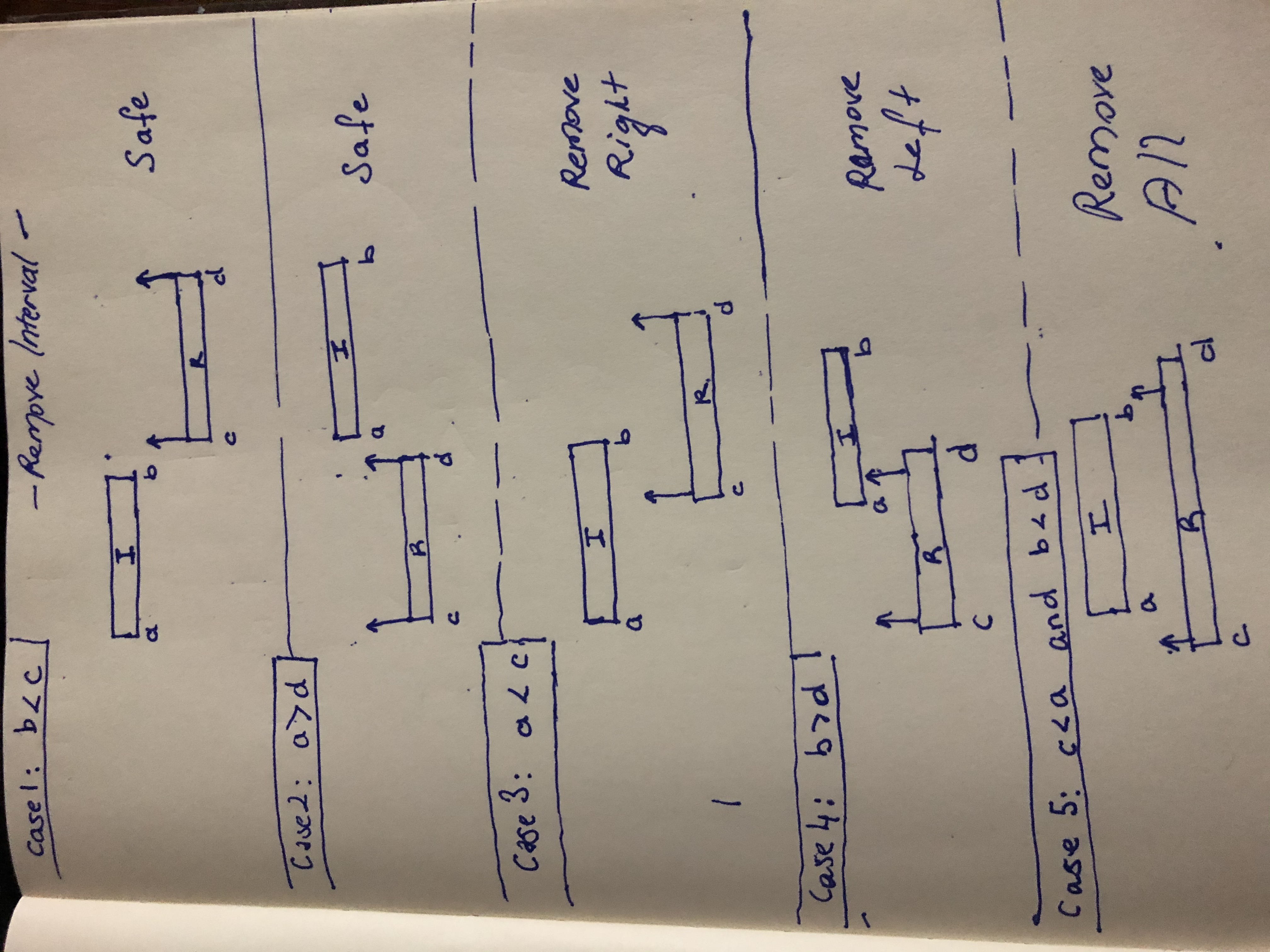
I tried to visualize the cases you mentioned:

|
Thank you for the drawing. |

Although I have not encountered a similar question yet, according to LeetCode:
https://leetcode.com/problems/rabbits-in-forest/ |



In this question, the given list is a sorted list, the output is also required to be sorted. So it's then the past practice to save these new intervals looping through the orıiginals.
There are 3 removal cases:
(Interval input) I = [a, b]; (Interval to remove) R = [c, d]
Case 1: b < c: This means that I ends before R starts. Then, I should be added to the list without any changes.
Case 2: a > d: This means that I starts after R end. Then, add I in the same way.
Case 3: a < c: This means that this interval begins at a but must end at c, because the rest is removed.
Case 4: b > d: This means that this interval ends at b but must begin at d, because the interval here is removed.
Case 5: I is an interval inside R, it does not get added.
Case 3 and Case 4 can work together. Consider: I = [ 2, 7 ]; R = [ 3, 5 ]
Then, we will add two arrays [ 2, 3 ] and [ 5, 7 ] to the list.