1057. Campus Bikes #195
1057. Campus Bikes #195
Conversation


|
|
||
| public int[] assignBikes(int[][] workers, int[][] bikes) { | ||
|
|
||
| w = workers.length; |

There was a problem hiding this comment.
As there may be more bikes than workers, we need to have a variable for bikes' size also.
            workerSize = workers.length;
            bikeSize = bikes.length;
| private void assignToBuckets(int[][] workers, int[][] bikes) { | ||
| for (int i = 0; i < w; i++) { | ||
| for (int j = 0; j < w; j++) { | ||
| int dis = Math.abs(bikes[j][0] - workers[i][0]) + Math.abs(bikes[j][1] - workers[i][1]); |
There was a problem hiding this comment.
In general, your solution is remarkably modular and very nicely organized.
Therefore we can also modularize the distance function as it has no direct dependence on the assignToBucketsFunction in which it will be injected.
  private int dist(int[] w, int[] b) {
        return Math.abs(w[0] - b[0]) + Math.abs(w[1] - b[1]);
    }
| int[] res = new int[w]; | ||
| boolean[] bikeAssigned = new boolean[w]; | ||
| boolean[] workerAssigned = new boolean[w]; | ||
| short assigned = 0; |
There was a problem hiding this comment.
I could not grasp why the assigned variable matters. We can simply remove it.
We could also check if all the workers are assigned with a bike like this:
workerAssigned.length<=workerSize
But, I am not sure it worths checking.
There was a problem hiding this comment.
workerAssigned is an array, not a list. That's why I needed a variable like that.
| for (int i = 0; i < buckets.length && assigned < w; i++) { | ||
| if (buckets[i] != null) { | ||
| for (int[] pair : buckets[i]) { | ||
| if (!workerAssigned[pair[0]] && !bikeAssigned[pair[1]]) { |
There was a problem hiding this comment.
Instead of reading from the array in each iteration more than once, we can assign the value to a variable once:
    int w = pair[0];
    int b = pair[1];
| package algorithms.curated170.medium; | ||
|
|
||
| import java.util.Arrays; | ||
| import java.util.Comparator; | ||
| import java.util.PriorityQueue; |
There was a problem hiding this comment.
We can apply the same refactoring with the Bucket Sort solution.
| boolean[] bikeAssigned = new boolean[w]; | ||
| boolean[] workerAssigned = new boolean[b]; |
There was a problem hiding this comment.
If we fix these:
            boolean[] bikeAssigned = new boolean[b];
            boolean[] workerAssigned = new boolean[w];
There was a problem hiding this comment.
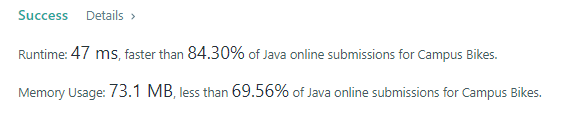
I have fixed it, actually at the same moment without seeing this comment.
There was a problem hiding this comment.
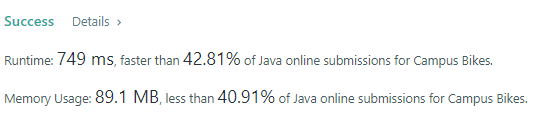
How does the Priority Queue solution perform?
There was a problem hiding this comment.
It is a little bit slow.
But, maybe it is normal for PQ.
This should work.

|
This question is a good example of modularity helping in managing code. If it hasn't been for the fact that we have separated the code into multiple methods, it would have been harder for us to debug it. |

|
Absolutely. |


Issue.
Approach-1: Bucket Sort
The maximum possible dimension of the grid are 1000 X 1000, which means that the maximum distance is 2000.
This means that we can store all possible worker-bike pairs with respect to their distances in an array of length 20.
After this procedure check each List of pairs (bucket) in this array (buckets). we traverse this array naturally from 0 to its end.
In each bucket, if we have not encountered this bike and the worker, that means that these bike and the worker are their pair. We store the bike's index in an array.
The setting by indexing is also taken care of, as we built the buckets iteratively from the workers and the bikes.
We return the stored bike indices at the end.
Approach-2: Priority Queue:
Here, we use a priority queue that stores a triplet* of the numbers ( distance between bike and worker, worker id, bike id). Similarly, we iterate through each bike and worker and add the relative triplet to the priority queue.
After creating the priority queue, the items we poll from it are compared first by their distances. If same, by the worker ids, if same, by the bike ids. We poll each item from the priority queue until we have assigned all the workers a bike. In order to avoid multiple worker-bike pairs interfering, we keep two checkers for this as we had done in the previous question.
*https://en.wikipedia.org/wiki/Tuple Learning about the naming here is helpful.