Gazetteer
There are two cities within a land, and people move fairly freely between them. In many ways, their fortunes and demeanors are opposite. But their fates are intertwined, and one cannot survive without the other.
The leaders of these two cities are aware of this relationship and have taken precautions to ensure that any military tensions between them are resolved on the lands between them, and not in the cities themselves. For if one city were to conquer the other, it would ensure its own destruction in the process.
That’s what the ancient tales say. The modern leaders may not necessarily believe them.
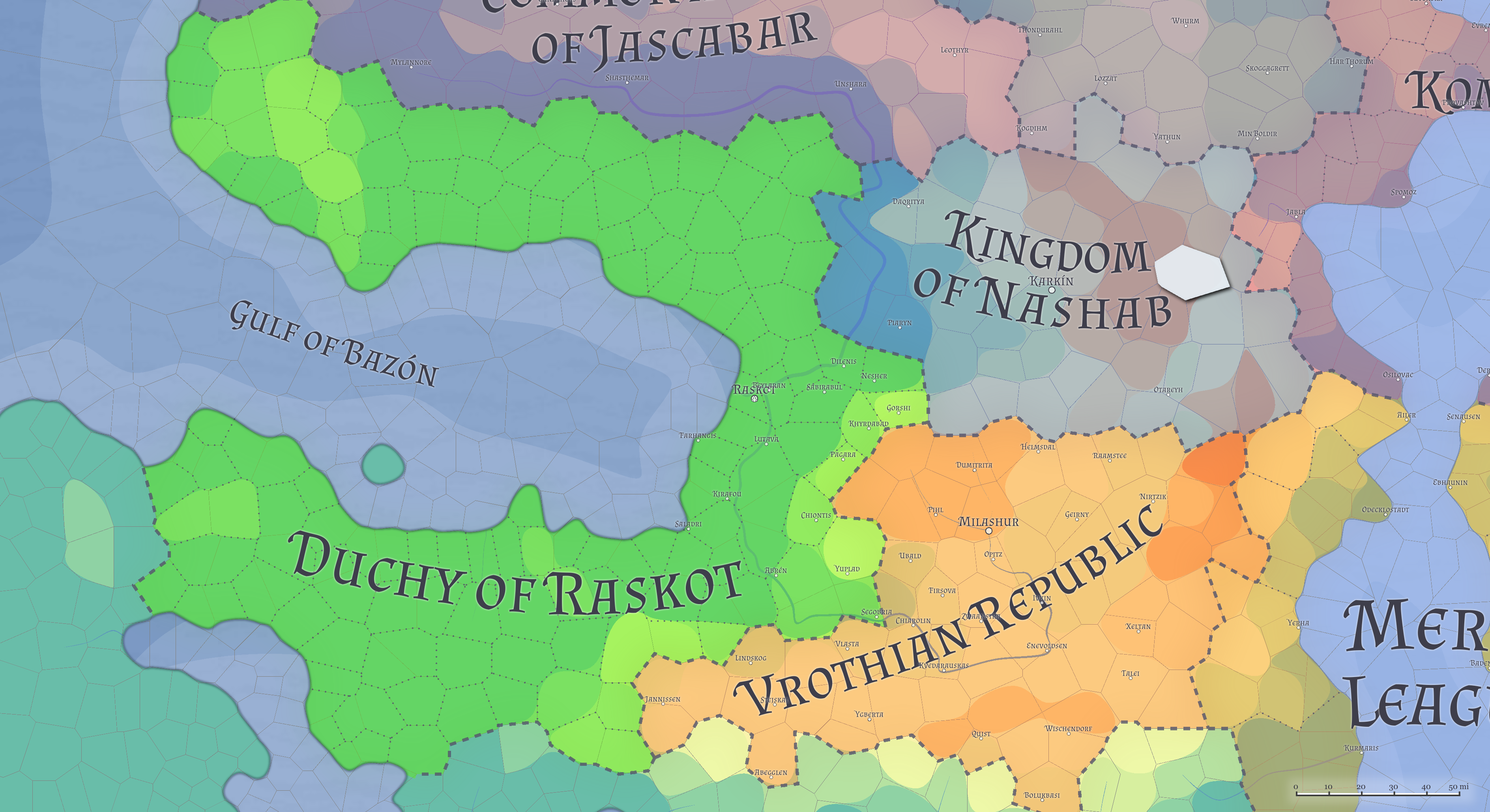
The Duchy of Raskot and the Vrothian Republic are more than just neighbors that share a border with each other. Despite their bonds of trade and diplomacy, they are engaged in a protracted and subtle struggle for regional dominance. Their respective capital cities, Raskot and Milashur, are not very far apart, and both nations allow people to move freely between them.
| Aspect | Raskot | Milashur |
|---|---|---|
| geography | fertile coastal plain | inland, foothills of significant mountains |
| economy and food system | local agriculture, fishing, and aquaculture; some trade | manufacturing, industry, hunting, herding, ranching, and extensive trade |
| population dynamics | most people born here live their lives here | many immigrants come here, and many emigrants go elsewhere |
| culture | homogeneous, passed down orally | heterogeneous polyglot, extensive written records |
| attitudes towards foreigners | shunned if they do not assimilate | many significant cultural and religious conclaves, sometimes in tension |
| government | hereditary monarchy, with varying degrees of benevolence | constitutional parliamentary republic, with varying degrees of stability and corruption |
| diet | fish, water-intensive crops | mammals, hardier crops that can be stored |
| military | conscripted by nobles | part volunteer, part criminals serving sentences, part mercenary |
| socioeconomic structure | noble families, feudalism | mostly unfettered capitalism, favoring the well-connected |
| social mobility | very little | based on money and connection |
| cultural dynamism | traditions are valued and preserved for their own sake | innovation born from naked ambition is commonplace |
| languages | one high-status language with dialects/accents of varying status | one official language of government and commerce, others used when practical |
| water | year-round abundant fresh water from local rivers | captured rainwater and snowmelt, with extensive storage and transport |
| climate | humid year round; mild winters and hot summers | warm, dry summers with occasional thunderstorms; cold, dry winters with regular snow |
| natural disasters | floods, hurricanes, severe rainstorms | blizzards, avalanches, mudslides, lightning strikes, wildfires |
| art | performing arts and experiences, song, dance, theater, cuisine | written and tangible works, painting, sculpture, textiles, architecture |
| spiritual life | worship dictated and promoted by monarch and advisers | secular; tolerates worship that does not directly harm others |
| intellectual life | directed by nobility; primarily religious scholarship | secular scholarship and research, with vigorous debate and oratory |
The smaller Kingdom of Nashab borders both the Duchy of Raskot and the Vrothian Republic, friend to both but ally of neither.
- Beiro
- crow-folk (Kenku)
- Benara
- rabbitfolk or hare-folk (Harengon)
- Fedetz
- turtlefolk or tortoise-folk (Tortle)
- Ha’at’l
- Lizardfolk
- Irash
- lionfolk (Leonin)
- Kadakh
- tuskenfolk (Loxodon)
- Niinat
- caimanfolk or gatorfolk (Troglodyte)
- Promised
- a longer-lived person touched by the divine
- Rakab
- oxenfolk (Minotaur)
- Reiman
- tigerfolk or leopardfolk (Tabaxi)
- Shakhan
- snake-folk or serpentfolk (Yuan-ti)
- Veiz
- wolf-folk
- Vodshi
- bear-folk
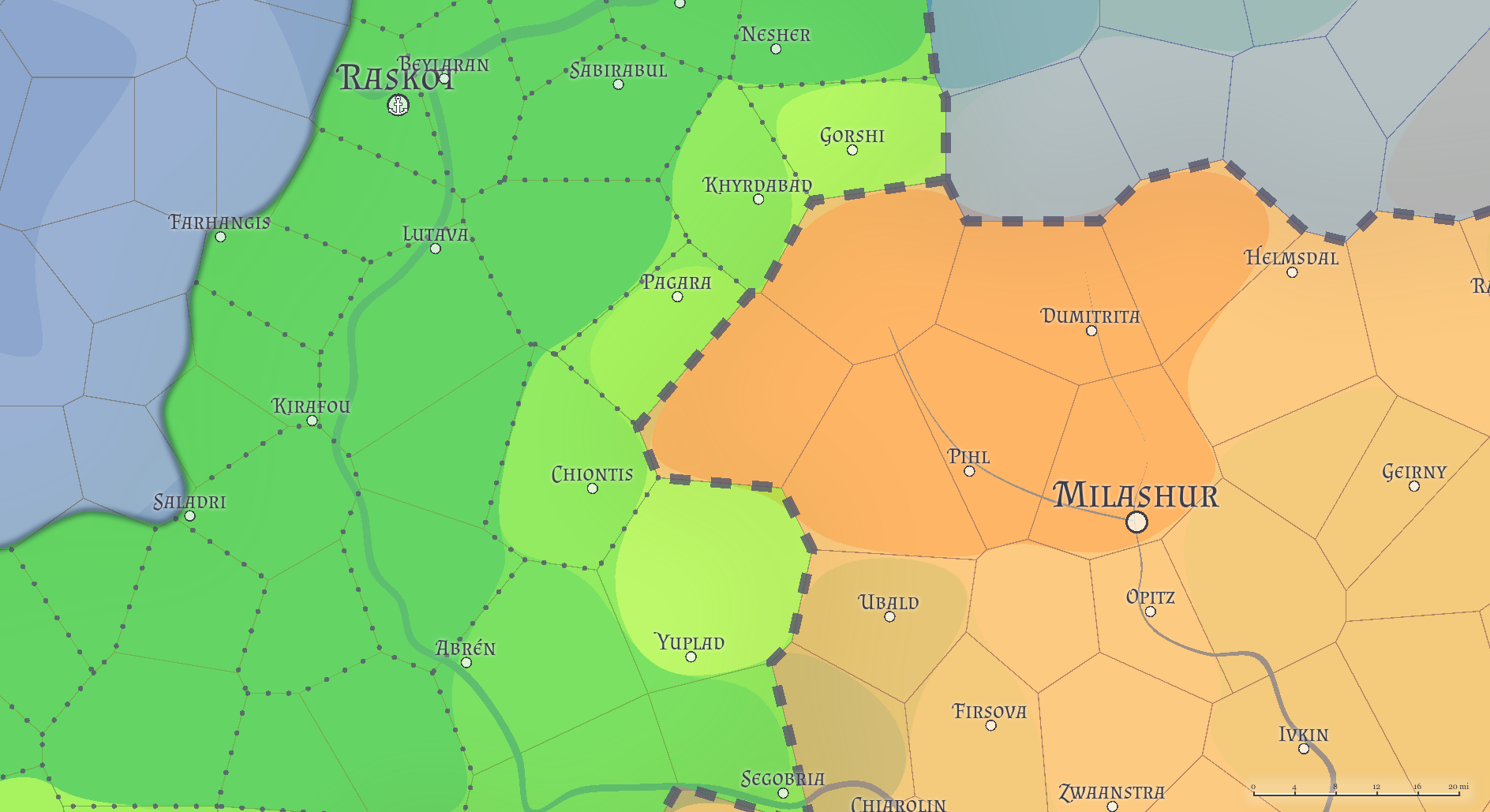
Map of settlements along the Tasza-rzeka/River Tazieu
The inspiration for this setting comes from The William Davidson Talmud (Koren - Steinsaltz), Tractate Megillah 6a:16.

This work is licensed under Creative Commons Attribution-NonCommercial-ShareAlike 4.0 International License.