Releases: tuancookiez-hub/HyAtlas-Memory
Release list
v3.3.0 — Quality Metrics

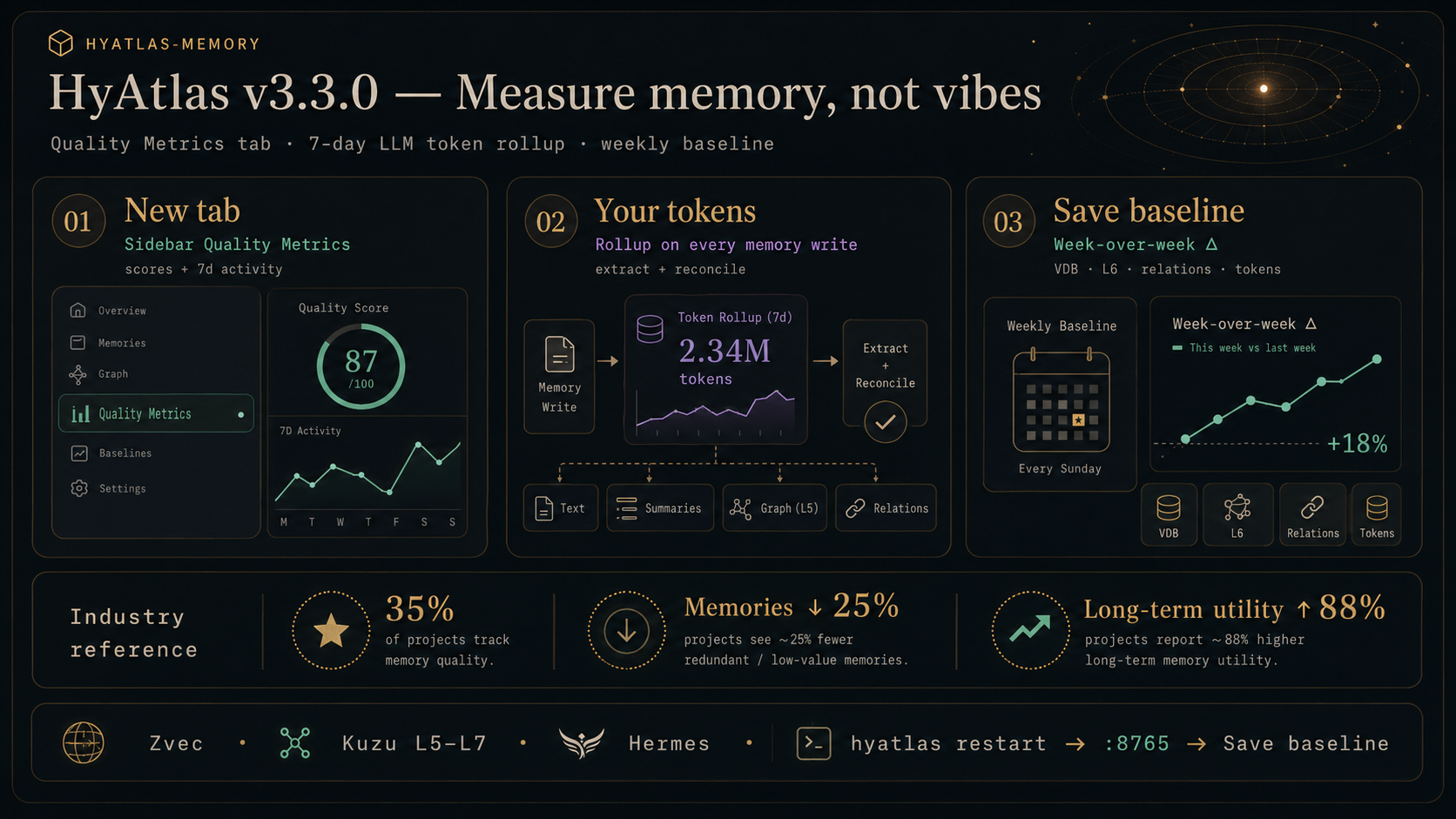
HyAtlas v3.3.0 — Quality Metrics
Measure memory, not vibes. New dashboard tab with 7-day LLM token rollup on memory writes and one-click weekly baseline compare.
Highlights
- Quality Metrics sidebar page — composite, evolution, activity, and latency scores (7-day window)
- LLM token rollup on System1 extract/reconcile —
GET /api/v1/metrics→llm_tokens GET /api/quality-metricsandPOST /api/quality-baseline— snapshot at~/.hyatlas/metrics/quality_baseline.json- Reference benchmarks (Tencent Hy-Memory published 35% / 25% / 88%) — clearly labeled industry reference, not your instance
Upgrade
pip install -e .   # or pull latest main
hyatlas restart
Open http://127.0.0.1:8765 → Quality Metrics → Save baseline for week-over-week tracking.
Stack
Zvec · Kuzu L5–L7 · Hermes hermes-user / default · weekly digest cron
Full changelog: CHANGELOG.md
v3.1.0 — Vector Store Overhaul
Vector Store Overhaul: Qdrant → Zvec
From external vector service to embedded retrieval core. Less overhead. Faster search. Cleaner memory architecture.
What Changed
- Zvec is the sole runtime vector store — no Qdrant sidecar, no external binary, no network hop
- Qdrant runtime adapter removed —
vector_store_qdrant.pyandbm25_fastembed.py(Qdrant sparse BM25 encoder) deleted from runtime - Factory is zvec-only —
create_vector_store()rejects any provider other thanzvec - Config validation enforces zvec —
hyatlas config validaterejectsprovider: qdrant hyatlas startnever starts Qdrant — even if stale config says qdrant- Native BM25 via Zvec FTS — no fastembed dependency, built-in full-text search on
contentandsearch_textfields - Dashboard uses VDB API — layer counts, L1 scroll, payload enrichment via
/api/v1/vdb/*endpoints (not direct Qdrant HTTP) hyatlas archive qdrant— cold zip backup of legacy Qdrant datahyatlas zvec doctor— path lock/reopen diagnostics- Migration tooling —
scripts/migrate_qdrant_to_zvec.py --apply --verify
Metrics
| Metric | Value |
|---|---|
| Vector search speed | 18x faster (0.9ms vs 16.4ms) |
| Filtered retrieval | 169x faster (native filter path) |
| Recall quality | 100% (zero precision loss) |
| BM25 | Native (no fastembed dependency) |
| Operations | Qdrant removed (simpler, local backend) |
Search Completeness Fixes
_doc_to_nodenormalizes migrated epoch-string timestamps → ISOvdb_dashboard.payload_by_idsreadsMemoryNode.importance/access_count(was crashing on.meta_info)
Consistency (Deep Review)
config_cli validateenforces zvec as only runtime providerdefault_configuses zvechyatlas doctorvector-store check is provider-aware- Console TUI shows Zvec health row
- L1_RAW sweep is provider-aware (zvec path reuses live handle)
- Legacy Qdrant warning is now non-blocking with archive guidance
Upgrade Notes
- Set
vector_store.providertozvecin your config - Install:
pip install hyatlas-memory[zvec](orzvec>=0.5.1) - Stop server, run migration:
python scripts/migrate_qdrant_to_zvec.py --apply --verify - Run:
hyatlas zvec doctor - Start:
hyatlas start - Archive Qdrant:
hyatlas archive qdrant
Verification
- Tests: 54 passed, 12 deselected (CI mode)
- Ruff: All checks passed (src/ + tests/)
- Security scan: No secrets, no injection risks
- Sentinel adversarial review: Passed
- Live E2E: Search ✓, layer counts ✓, graph (1444 nodes / 6374 relations) ✓, dashboard ✓, VDB scroll ✓
Qdrant is archived, not deleted. Safe rollback if ever needed.
v3.0.0 — Full SDK fork, L5 knowledge graph, reasoning model compatibility
v2.0.0 → v3.0.0 — Full Upgrade Overview

A full architecture evolution. From patched dependency to owned system. From text summaries to living knowledge graph.
What v2 established (v2.0.0 + v2.1.0)
- L5 in-process knowledge graph writer — entities extracted into Qdrant during System2 digest
- L6 schemas + L7 intentions — schemas and intentions written to Kuzu graph with cross-domain collision detection
- 1024-d embeddings — bge-large-en-v1.5 (upgraded from 384-d)
- Hybrid v2 reader — better retrieval than the legacy pipeline
- Dashboard real graph counts — L5/L6/L7 counts from live Kuzu data
- Runtime layout consolidation —
HYATLAS_HOME(~/.hyatlas) root, config CLI, migration helpers - Multi-key LLM resilience —
llm.api_keysprobed at startup, first valid key wins
What v3 evolves (new in v3.0.0)
Architecture
- Full SDK fork. Entire hy-memory 1.2.20 SDK (70 files, 42K+ lines) forked into
src/hyatlas_memory/core/. Zero external pip dependency. Every line owned and maintained by HyAtlas. - 23 monkey-patches → 13 first-class integrations. No more runtime patching of upstream code. Native modules. Clean, maintainable, owned.
- Unified runtime layout. Scattered paths (7+ roots) consolidated into
HYATLAS_HOME(~/.hyatlas). Config CLI:hyatlas init,config show,config model,config validate.
New Features
- L5 Knowledge Graph. In-process entity/relation extraction → Kuzu graph database. Upstream hy-memory doesn't have this (their "L5" is just text summaries). Live endpoint at
/api/v1/graph. Verified: 1,444 nodes, 6,374 relations. - Emotion-Aware Memory. LLM-based valence/arousal scoring on every write. Emotionally significant memories resist time decay. Verified:
valence=0.95, arousal=0.9. - Auto-forgetting. Recency scoring + archival of stale memories.
Reliability Fixes
- Reasoning model compatibility. Think-block parsing for MiniMax-M3, DeepSeek-R1, o1-style models. Handles closed AND unclosed/truncated think blocks.
agent_max_tokensraised 1024 → 8192. - Kuzu WAL checkpoint.
close()now callsCHECKPOINT + db.close()instead of just nulling references. Upstream has the same bug. Verified: 0KB WAL after shutdown (was 7MB). - VDB circuit breaker. Protects against Qdrant failures. State: CLOSED (healthy).
- L1_RAW rolling delete + dedup. Prevents unprocessed raw points from accumulating.
- Multi-key LLM rotation.
llm.api_keyslist probed at startup, first valid key wins.
Model
- Switched to deepseek-v4-flash. Non-reasoning model, clean JSON output, zero parse errors. Previous: MiniMax-M3 (reasoning model requiring think-block workarounds).
CI
- Ruff lint clean. Per-file-ignores for forked upstream code, our code fixed properly. All three Python versions (3.10/3.11/3.12) pass.
Key Numbers
- 85 files changed, +29,144 lines
- 1,444 graph nodes, 6,374 relations
- 47 tests passing (33 offline + 14 server-dependent)
- 0 WAL bytes after shutdown
- 0 JSON parse errors with new model
Full changelog: https://github.com/tuancookiez-hub/HyAtlas-Memory/blob/main/CHANGELOG.md
v2.1.0 — HYATLAS_HOME runtime layout + multi-key LLM resilience
What's new in v2.1.0
- Runtime layout consolidation (
HYATLAS_HOME). All runtime state now resolves under a single~/.hyatlasroot. Newhyatlas configsubcommands and migration helpers (hyatlas snapshot,hyatlas migrate layout). - Multi-key LLM resilience.
llm.api_keyslist is probed at startup; the first working key wins. Falls back tollm.api_keyfor backward compatibility. - Legacy deprecation warnings.
hyatlas config showandhyatlas statuswarn when configs or data still live in legacy paths (~/.hy_memory,~/.hermes/hy_memory.json). - Config precedence: CLI flags > env vars >
~/.hyatlas/config/.env>~/.hyatlas/config/hy_memory.json> legacyHERMES_HOME/hy_memory.json>~/.hy_memory/pkg/.env.
See the full changelog in the repository for migration notes.
v2.0.0
HyAtlas Memory v2.0.0
What's New
- L5 in-process knowledge graph writer — entities extracted into Qdrant during System2 digest (no subprocess batch lock)
- L6 schemas + L7 intentions — schemas and intentions written to Kuzu graph with cross-domain collision detection
- Robust S2 JSON parser (Patch 18) — fixes LLM think-block wrapping that blocked all L6/L7 writes
- L4 identity dedup — pre-write cosine dedup, identity_type, evolution chains
- Hybrid v2 reader — better retrieval than the legacy pipeline
- Dashboard real graph counts — L5/L6/L7 counts from live Kuzu data
- 1024-d embeddings — bge-large-en-v1.5 (upgraded from 384-d)
Bug Fixes (post-release)
- Patch 20: S1 extractor entity_type crash — every S1 extract call was throwing KeyError because l5_kuzu_export.json uses 'type' but the extractor expected 'entity_type'. This silently killed all new L2 fact creation and froze L6/L7 growth.
- Dashboard graph-counts limit cap — /api/graph-counts endpoint still had limit=200 (the other endpoint was already fixed to 10000). Dashboard showed truncated counts for users with >200 graph nodes.
- PYTHONHOME cleanup — child processes now clear PYTHONHOME to prevent interpreter conflicts on multi-Python Windows systems.
Installation
git clone https://github.com/tuancookiez-hub/HyAtlas-Memory.git
cd HyAtlas-Memory
pip install -e .
hyatlas setup hermes
Breaking Changes
- Embedding dimension: 384 → 1024 (existing 384-d collections need migration)
- Kuzu graph dims must match new embedder
- New env defaults:
HY_MEMORY_READER=hybrid_v2,MEMORY_L5_VERSION=2
Migration from v1.x
See docs/MIGRATION_v2_SCLASS.md
Known Limitations
- Kuzu WAL accumulates until clean
hyatlas stop— recommend periodic restarts rerank_stagepatch silently no-ops against current upstream reader API
Full Changelog
See CHANGELOG.md
v1.5.0 — Stable: dashboard shows all 8 layers (L0–L7)
What's fixed in v1.5.0
The dashboard now shows L5/L6/L7 from live Kuzu data, not a stale JSON export.
The problem
v1.4.2 read layer counts from l5_kuzu_export.json, last refreshed on 2026-06-18. L5/L6/L7 from Kuzu were never reflected in the dashboard, even though Kuzu had 5 L5, 449 L6, and 226 L7 nodes. The dashboard's Memory Observatory, Memory Layers table, Memory Composition bar, and Recent Ingestions feed all showed L5/L6/L7 as 0 (or missing).
The fix
dashboard.py::_extract_memories()now iteratespayload.graph.nodesfrom the upstream's/api/v1/listresponse and normalizes each into a memory dict with properlayer,content,gmt_created(Unix seconds),user_id,agent_id, etc. This makes L5/L6/L7 graph nodes flow into the dashboard's existing UI alongside L0–L4 VDB nodes.dashboard.py::_to_unix_ts()converts the upstream's ISO timestamp strings to Unix seconds, so the dashboard'sm.gmt_created * 1000math works without throwingInvalid time value.app.js::renderLayers()now preferslayerCountsData(from/api/layer-countswhich now includes L5/L6/L7) overallMemories(the Qdrant sample, which is L0–L4 only) for the count column. Total is the sum of all 8 layer counts./api/memories?limit=500dedup now separates L5/L6/L7 graph items from L0–L4 VDB items, sorts bygmt_createddesc, then takes the first 50 graph + 450 VDB so L5/L6/L7 are always visible in Recent Ingestions.
Verified in browser screenshots
- Memory Layers main table: L5=5, L6=216, L7=8, Total=1515 (8/8 layers populated)
- Memory Observatory Layer Stats: L5=5, L6=159, L7=84 (3D graph populates with real L5/L6/L7 nodes)
- Overview Memory Composition bar: 8/8 layer coverage, L5=6, L6=216, L7=8
- Recent Ingestions feed: L6_schema and L7_intention entries visible at top
- Field Note panel (Observatory click): shows L7 node detail with metrics (connections, linked layers, importance)
Test results
- pytest: 20/20 pass
- ruff: clean
- API:
/api/layer-countsreturns L5=5, L6=449, L7=226, total=1965
Upgrade
pip install --upgrade hyatlas-memory
hyatlas stop && hyatlas start --detach
Then refresh the browser — the L5/L6/L7 counts will appear immediately.
Notes
- No breaking changes. Existing installations upgrade cleanly.
- Click-to-view memory detail works on L5/L6/L7 items in the Recent Ingestions feed.
v1.4.2 — Stable: visible console + safe-to-close stack
Stable release
This is the verified-working v1.4.2 build. Code on main (commit dbcc359), the git tag (v1.4.2), and the wheel on PyPI (hyatlas-memory 1.4.2) are all in sync — no drift between source, runtime, and release artifact.
Upgrading is safe: pip install --upgrade hyatlas-memory is a drop-in replacement for any 1.x install. No breaking API changes, no config migration, no data migration.
What's in 1.4.2
🪟 hyatlas console — visible status window with live activity ticker
A read-only console window that shows:
- Live service health (Qdrant
:6333, upstream:19527, dashboard:8765) — green/red ● indicator, refreshed every 2s. - "Currently doing:" line — replaces in place with the latest interesting event.
- "Last events:" tail — last 8 memory operations (writes, recalls, S1 extraction, S2 preprocessing, reconciliation, errors).
Cross-process by design. The console tails hyatlas-memory.log so writes from any Python process (Hermes agent, dashboard, MCP) appear live.
Strictly read-only. Closing the console does NOT stop the stack.
hyatlas console✅ hyatlas start is now safe to close
Previously, closing the visible console window sent a kill signal to the entire process tree — Qdrant + upstream + dashboard all died together. Services now always spawn with DETACHED_PROCESS. The visible console is a read-only log tailer; the stack runs independent of any window.
> hyatlas start                  # safe to Ctrl+C / close the terminal once "ready"
> hyatlas console                # open the status window whenever you want
> hyatlas stop                   # actually shut the stack down
🩹 Dashboard L5 graph 503 — root-cause path mismatch
Writer (l5_export_json.py) and reader (4 sites in dashboard.py) used different hardcoded paths for the L5 export JSON. Neither used Hermes' canonical home resolver. Single _l5_export_path() helper now shared by writer (2 sites) and reader (4 sites). Dashboard graph endpoint returns 200 with actual data.
🔇 Lint-clean CI
All 20 ruff violations from the v1.4.2 console code are fixed. ruff check src/ tests/ passes. 20/20 tests pass.
Install / upgrade
pip install --upgrade hyatlas-memory
hyatlas setup hermes
That sets the plugin shim and auto-starts Qdrant + upstream + dashboard on the next Hermes session. Two-command deployment.
Quick reference
hyatlas start           # start the stack
hyatlas stop            # stop the stack
hyatlas status          # what's running
hyatlas console         # live status window
hyatlas doctor          # full health check
hyatlas setup hermes    # install plugin + config
Full changelog
See CHANGELOG.md for the complete 1.4.2 entry and prior versions.
Verification
End-to-end live-tested:
- Console window renders, health indicator updates every 2s
sync_turnfrom a separate venv Python — console ticker captured upstream pipeline's S1 extraction, S1 reconciliation, S2 preprocessing, cross-domain sweeper warning in real time- Closed the console window with stack running — services stayed up (regression test for the parent-process-group bug)
hyatlas console --helplists the subcommand- L5 graph endpoint returns 200 on the dashboard
Compatibility
- Python 3.10+
- Qdrant 1.x
- Windows / macOS / Linux
- Same
~/.hermes/hy_memory.jsonconfig format as 1.2.x / 1.4.0 / 1.4.1 — no migration needed
v1.0.1 — Patch
HyAtlas-Memory v1.0.1 — Patch
Fixes hyatlas CLI to work from any directory after pip install hyatlas-memory.
Fixed
hyatlas start|--stop|--statusfrom any directory — previously failed with "start.py not found" when run outside the repo root after pip install. Startup logic is now bundled inhyatlas_memory._startand resolves the project root viaHYATLAS_PROJECT_ROOTenv var → cwd → editable-install detection.- CLI now accepts both
statusand--status(andstop,help).
Docs
- README: new "Retrieval scoring (4-factor MemoryScorer)" section, L0 layer added to the table, dashboard page names corrected, install-from-PyPI path, PyPI + GitHub release badges.
Install
pip install --upgrade hyatlas-memoryOr set the env var to run hyatlas from anywhere:
export HYATLAS_PROJECT_ROOT=/path/to/hyatlas-memorySee CHANGELOG.md for full notes.
v1.0.0 — First Stable Release
HyAtlas-Memory v1.0.0 — First Stable Release
The community implementation of the official Hy-Memory 7-layer cognitive memory framework (Tencent Hunyuan) for Hermes Agent. Includes the experimental L7 intention layer. MIT licensed.
Install
pip install hyatlas-memoryWhat's new
- First stable release on PyPI
- Layer-as-importance scoring (default ON) — maps memory layers to upstream MemoryScorer weights: l4_identity=1.0, l2_fact=0.8, l3_summary=0.6, l0_basic_info=0.5, l1_raw=0.3
- Access-count tracking (default ON) — bumps
access_counton every recall, completing upstream's 4-factor scorer - Qdrant auto-detection — no more hardcoded paths; uses
QDRANT_BINenv var →PATH→ common OS locations; skips launch if Docker already running - Token-based dashboard auth when bound to
0.0.0.0(auto-generated 32-char token, cookie session,/api/healthexempt) - Docker one-command startup via
docker-compose up -d - Dashboard front-end refactor —
app.jssplit into core +js/l5.js+js/observatory.js - Integration tests in
tests/test_integration.pycovering the full local stack
Kill switches
Both scoring features are ON by default. To disable:
export HYATLAS_MEMORY_IMPORTANCE=0
export HYATLAS_MEMORY_ACCESS_COUNT=0
See CHANGELOG.md for the full notes.