This project is a high-performance Pokédex application built with SwiftUI, designed to serve as a strong reference for modern iOS development using Clean Architecture and MVVM.
The app fetches and displays the first 151 Pokémon from [PokeAPI], focusing on scalability, testability, and performance.
-
Clean Architecture: The codebase is strictly separated into Core, Data, Domain, and Presentation layers. This enforces the Dependency Rule, ensuring a decoupled, scalable, and highly testable system.
-
MVVM Design Pattern: The Presentation layer uses MVVM to separate UI (SwiftUI Views) from presentation logic (ViewModels), resulting in cleaner, more maintainable view code.
-
Performance Optimized:
- *- Infinite Scrolling: Pokémon are loaded in batches using a LazyVGrid, minimizing initial payload and memory usage.
-
Multi-Layer Caching: Implements an in-memory cache (NSCache) for both API responses and downloaded images, ensuring near-instantaneous loads on subsequent visits and reducing network usage.
-
Race Condition Prevention: The image loading system is designed to be thread-safe. It prevents redundant network requests by tracking in-flight downloads. If multiple requests for the same image URL are made concurrently, only the first one will trigger a network call; the subsequent requests will await the result of the initial download, saving bandwidth and system resources.
-
Concurrent Data Fetching: Utilizes Swift's async/await with withThrowingTaskGroup to fetch Pokémon details in parallel, drastically reducing wait times.
-
Protocol-Oriented Networking: The network layer is fully abstract, defined by an Endpoint protocol. This makes the NetworkService generic, reusable, and easy to mock for testing.
-
Scalable Navigation: A centralized Router class manages navigation using SwiftUI's NavigationStack, providing a single source of truth for the application's flow.
-
DTO & Mapper Pattern: The Data layer uses Data Transfer Objects (DTOs) to mirror the API's structure and Mappers to transform DTOs into clean Domain entities. This isolates the app from API-specific implementation details. If something changes in the response someday i dont need to change it on all screens.
The project adheres to the Clean Architecture dependency rule, ensuring dependencies only flow inwards.
Presentation (MVVM) -> Domain (Use Cases) -> Data (Repositories) -> Core (Network)
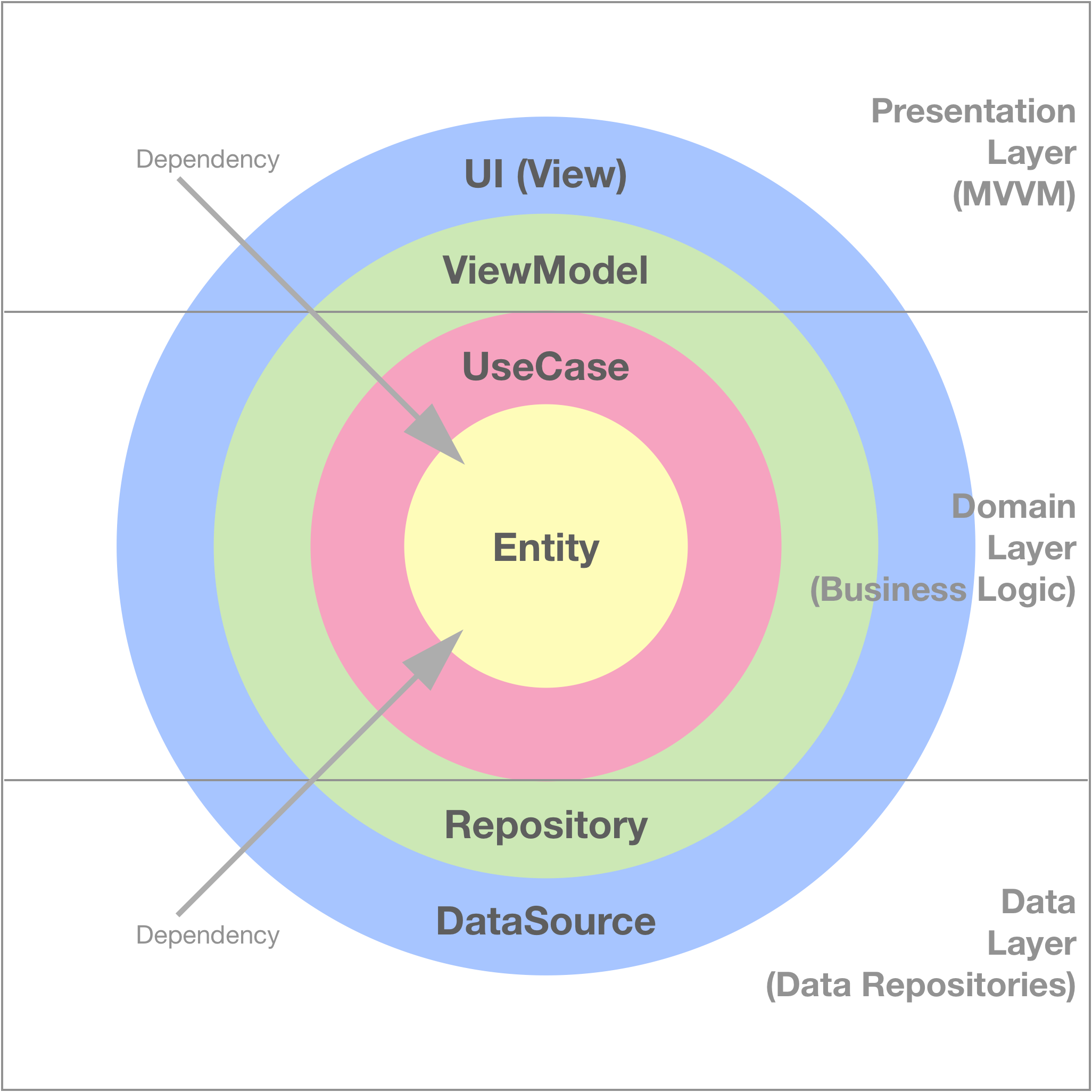
-
Core Layer: Contains a generic, protocol-based NetworkService and a reusable CacheManager. It has no knowledge of Pokémon or any other business logic.
-
Data Layer: Implements the PokemonRepository protocol. It's responsible for fetching data from the PokeAPI, handling DTO-to-Domain model mapping, and interacting with the network layer.
-
Domain Layer: The core of the application. It defines the Pokemon entity, the PokemonRepository contract (protocol), and business logic via UseCases. It is completely independent of UI and data sources.
-
Presentation Layer: The UI, built with SwiftUI. Views are lightweight and state-driven, observing a ViewModel that orchestrates data flow by calling UseCases.
-
Xcode 14.0+
-
Swift 5.7+
-
iOS 16.0+
-
Clone the repository:
git clone https://github.com/your-username/pokedex-swiftui-app.gitcontent_copydownload
Use code with caution.Bash
-
Open the project in Xcode.
-
Build and run (Cmd + R).
Modularity: Move each architectural layer (Core, Data, Domain, Presentation) into its own local Swift Package, it will improves build times, and promotes code reuse across potential future applications
DI container: Implement dedicated Dependency Injection (DI) container like Swinject or implementing a custom one, moving dependency resolution from the PokedexApp entry point to a centralized layer, decoupling object creation and making the dependency graph easier to manage and mock for testing.
Coordinator Evolving the current Router into a Coordinator Pattern and allowing each major app flow to have its own Coordinator. Further decouples navigation logic from Views, allowing coordinators presentations followed by pushes, much easier to manage and test.
Persistent Cache and Offline mode save data to the local storage, using Realm, CoreData, SwiftData, etc. Allowing the user to use the app even its not connected to the internet, additionally improving the perfomance by saving the content even the app was closed
Others:
- Search Feature
- Filter and sorting
- Detail Screen
- Monitoring
- RemoteFlag
- Increase testing coverage
- Add UI testing