Skip to content

williamesamuelson/quantumdots-exceptionalpoint

Folders and files

NameName
Last commit message
Last commit date

Latest commit


History

59 Commits


Repository files navigation

My B.Sc. Thesis

This repository contains the Python code and TeX files from my BSc thesis.

Dynamics at an exceptional point in an interacting quantum dot system

A fundamental postulate of quantum mechanics is that the Hamiltonian of a closed system is Hermitian, guaranteeing real-valued energies and conserved probabilities throughout the evolution of the system. However, for quantum systems where there is dissipation and crosstalk with the environment, such as a system of quantum dots connected to an environment of metallic leads, the dynamics of the system is instead generated by a non-Hermitian Liouvillian superoperator $\mathcal{L}$. In the low-coupling limit, the dynamics can be described by a Lindblad master equation
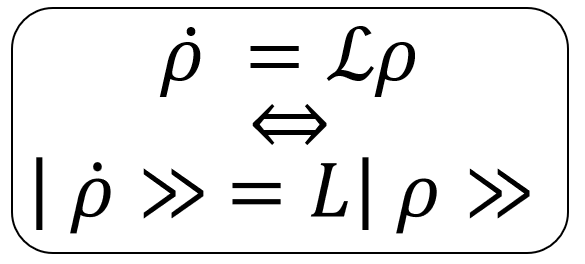
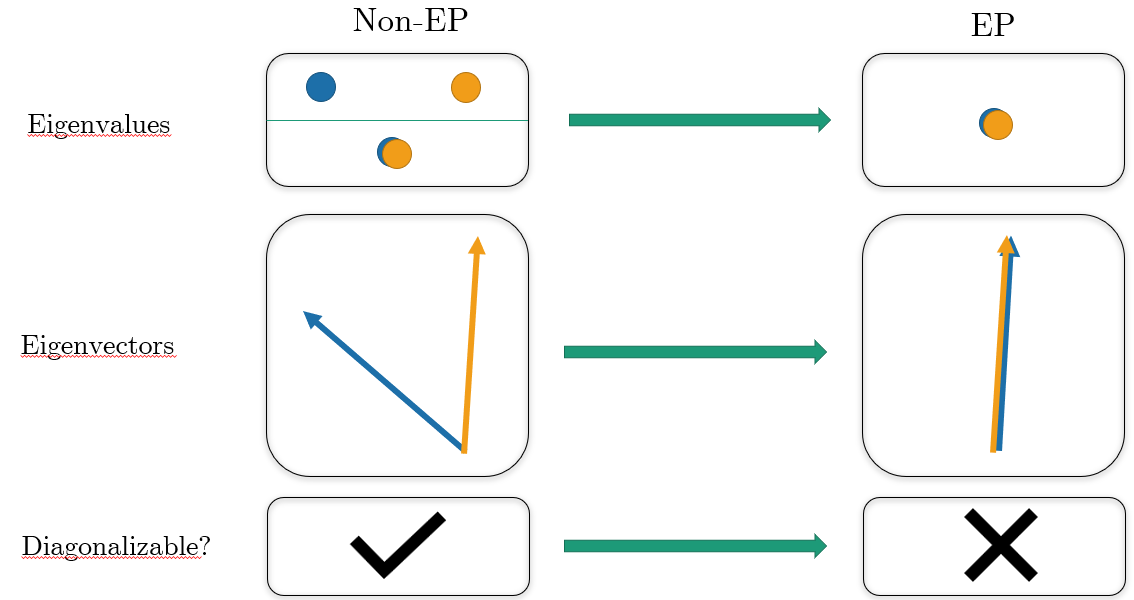
which tells us how the reduced density matrix $\rho$ evolves over time. One feature in the Liouvillian of particular interest recently is the possibility of exceptional points. These are points in parameter space which cause two or more eigenvalues and their corresponding eigenvectors of the operator to simultaneously coalesce. Exceptional points have been theorized to have important applications in quantum sensing and quantum control.

In this thesis, we study a system of two quantum dots coupled in parallel to metallic leads (see figure below) and demonstrate the existence of a second order exceptional point in the Liouvillian superoperator.
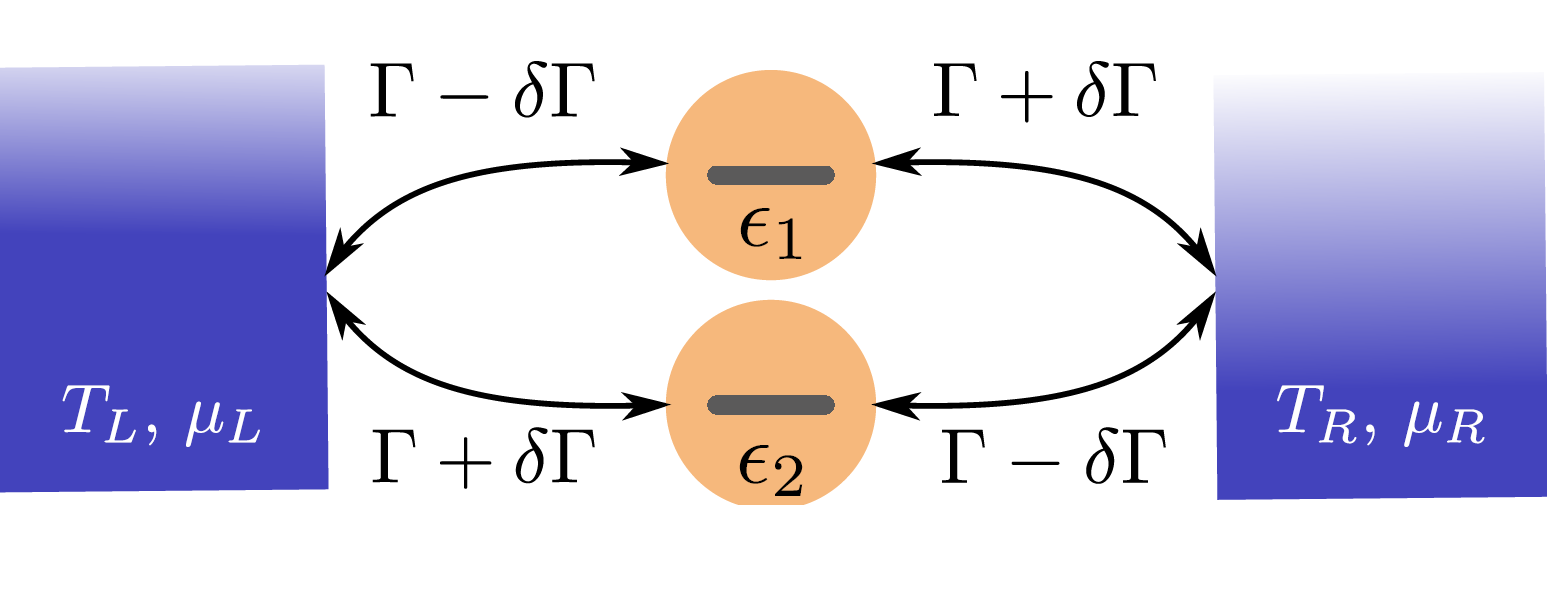
Furthermore, the dynamics at this exceptional point is analyzed in detail using a combination of analytical and numerical methods, including simulations of the density operator and the current through the system. By considering the Jordan form of $\mathcal{L}$, we show that the dynamics can be understood in terms of generalized modes and that the system exhibits unique algebraic decay at the exceptional point. Furthermore, critical damping at the exceptional point is indicated in the current, in accordance with a previous work on exceptional points in quantum thermal machines.

About

No description, website, or topics provided.

Resources

Stars

Watchers

Forks

Releases

No releases published

Packages


Contributors