
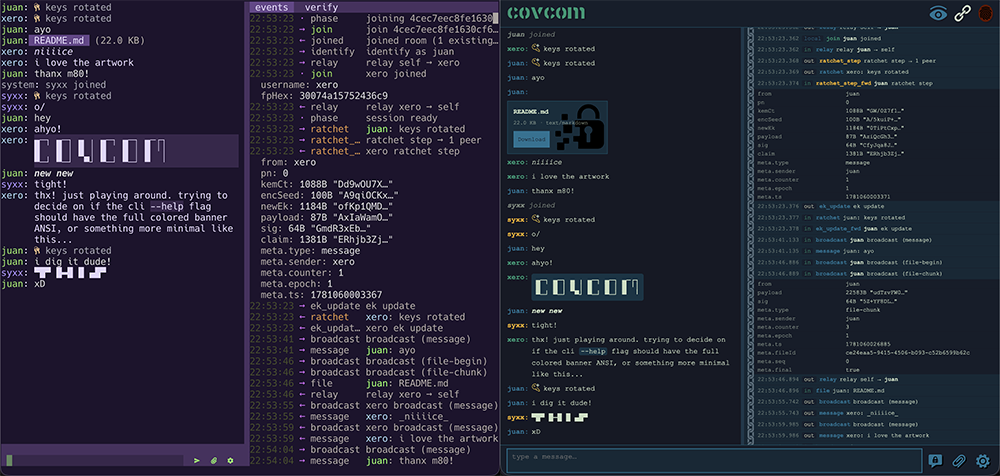
This release adds rich-text formatting to messages on both clients and hardens
every path that renders peer-controlled text. Untrusted display data is now
treated as data, never as code. It also reworks file transfer to stream in
bounded chunks with receiver-paced flow control, so large attachments move
reliably without crashing the renderer. Clients and the server now negotiate a
protocol version when you create or join a room, so a version skew is rejected
cleanly at the door instead of failing as cryptic dropped messages.
Warning
Breaking wire-protocol change. File transfer drops the single file
envelope for a file-begin frame followed by file-chunk frames, and every
peer-to-peer relay payload now carries a one-byte tag prefix. All
participants in a room must run this release or newer. A v3.0.0 client
cannot receive files from a newer peer, and the tagged relay payload breaks
its key handshake outright, so mixed-version rooms fail to connect rather
than just failing to share files. Version negotiation now catches this case
at join time and returns the client to the start screen with a clear message
instead of a cryptic handshake failure.
Security
No HTML-string path in the web client. A SafeHtml branded type and a
single setHtml() sink replace every ad-hoc innerHTML write. The only values
minted as trusted HTML are the bundled SVG icons; all other DOM is built through
createElement and textContent. A peer-controlled value can no longer become
markup, which closes the XSS and mXSS surface.
ReDoS-immune markup parser. The shared markup model is a hand-written linear
scanner, not a backtracking regex. It is DOM-free and crypto-free and emits a
token tree, so no renderer ever assembles an HTML string from untrusted input.
Bidi and zero-width spoofing defense. Untrusted display text is stripped of
bidirectional controls and zero-width format characters on both clients before
rendering, and the web client isolates message and name spans with CSS
unicode-bidi: isolate. This defeats Trojan-Source text reordering and
zero-width or homoglyph display-name spoofing. ZWNJ, ZWJ, and variation
selectors stay allowed because they are legitimate in emoji and in Persian,
Arabic, and Indic text.
Terminal escape-injection defense in the CLI. Peer usernames, message
bodies, filenames, event-log keys and values, and fingerprint names now pass
through a terminal sanitizer that strips ANSI, CSI, and OSC sequences (including
OSC 52 clipboard writes), stray control bytes, and HTML-ish tags before the CLI
emits its own SGR. A hostile peer can no longer move the cursor, clear the
screen, or write the clipboard through chat content.
Server username hardening. On identify the relay rejects (closes) any
username containing C0/C1 control characters, DEL, or the bidi and zero-width
format characters used for display-name spoofing. The server rejects rather
than sanitizes, because the username is bound by the signed identity claim and
silently altering it would break peer verification.
Clickjacking protection on the container. Caddy now sends
X-Frame-Options: DENY. The equivalent frame-ancestors directive moved out of
the web client's <meta> CSP, where browsers silently ignore it, into a real
response header.
Constant-time room-secret comparison. The relay's join handler checks the
submitted roomSecret with constantTimeEqual over encoded bytes instead of a
string !==. The 128-bit secret space already made timing-assisted brute force
impractical over a network; the comparison now leaks nothing, so the oracle is
closed outright rather than argued away.
Added
Rich text in messages. Both clients render a markdown subset in message
bodies: bold (*), italic (_), bold and italic (_* or *_), inline code
(`), and fenced ``` code blocks. Formatting is display-only; the wire
still carries your exact plaintext.
CLI code styling. New codeFg and codeBg theme slots color inline code
and fenced blocks, fenced blocks render with a filled background, and italic
text now emits the italic SGR.
Distinct per-sender colors in the CLI. Each peer's name renders in its own
color in the chat scroll and the verify panel, cycling through seven shared
slots (peer1 through peer7) by join order to match the web client. Your own
name always uses peer0, a slot reserved for self. Peers never draw from it,
and they never draw the system-message color, so no peer can paint their name to
look like you or like a server notice.
Modal keys-display on both clients. Pressing Esc while the message input
is focused swaps the input bar for a row of action units: R ratchet, E
events, V verify, and Esc return to chat. Pressing the key fires the action
(shift-insensitive) and closes the display: ratchet returns to the input, events
and verify defer to the panel toggle's own focus move, and Esc just returns to
typing. This unifies the keyboard model across clients: it replaces the CLI's
old Ctrl+R/E/V chords (now removed) and gives the web a discoverable hotkey
path it never had, since the browser owns those chords. The slash commands
(/ratchet, /events, /verify) still do the same. The CLI units take
optional leading glyphs from three new icon settings, icons.events,
icons.verify, and icons.escape; an unset icon renders nothing.
More themeable CLI slots. The send, attach, and ratchet bar buttons take
their own colors (barBtnBg, barBtnFg, barBtnFocusBg, barBtnFocusFg),
defaulting to the generic button colors. The attach-mode icon that prefaces the
input box takes barAttach. The in-chat "keys rotated" ratchet notice splits
into keyFg for the key glyph and ratchetTxtFg for the label. System notices
and /help output get their own system slot, split out from disabled so the
two roles recolor independently.
CLI config validation. The config is checked on launch so a bad file can
never crash the client. Every top-level field is type-checked (server,
username, and copyCmd must be strings, showSystem a boolean, sidebar and
icons objects), and each theme color must be a valid ansi16 (0 to 15),
256-color (0 to 255), or #RRGGBB hex. An invalid value is dropped back to its
default instead of crashing a consumer or rendering as a broken escape, and the
unparseable config file as a whole falls back to defaults rather than being
silently ignored. When anything is wrong, a modal on startup names the ignored
settings so a typo like ##00ff00 is easy to spot. Unknown keys, including your
own _comment keys, are left untouched.
CLI config file location. A new --config <path> flag points covcom at a
specific config file. Without it, the path follows the XDG base directory
spec: $XDG_CONFIG_HOME/covcom/config.json when that variable is set, otherwise
~/.config/covcom/config.json.
CLI --help flag. covcom --help (or -h) prints the banner and a
GNU-style usage summary of every option, then exits without starting the TUI.
CLI --version flag. covcom --version prints the version and protocol byte
and exits without starting the TUI. Both values are baked in at build time, the
version from the project root package.json and the protocol byte from the
shared protocol manifest.
Short flags for every CLI option. Each invocation flag now has a short form:
-v (--version), -c (--config), -j (--join), -x (--clean), and
-a (--anon). --clean takes -x because -c belongs to --config. The
parser is getopt-style: long flags accept a value after a space or an =
(--config <path> or --config=<path>), short flags accept the same plus a
glued value (-c<path>), short booleans bundle (-xa), and a value flag can end
a bundle (-xac <path>). A value that looks like another flag is treated as
missing, so a flag is never swallowed as a path.
Receiver flow control for file transfer. The receiver acknowledges consumed
chunks over the peer-to-peer relay channel and the sender holds a bounded window
of chunks ahead of the slowest recipient, so a large transfer survives a slow or
backpressured relay. The scheme is N-party and paces to the slowest peer.
Protocol manifest. A single lib/src/protocol.ts now holds covcom's
protocol-identifying values: the cipher and KEM display names, the cipher and
signature format bytes, the auto-ratchet interval, and the wire-contract
version. Web, cli, and server read from it instead of each carrying its own
copy. The cipher-suite tables, ratchet timing, and version checks now share one
source, so they stay consistent across both clients and the server. The format
bytes are derived from the cipher suites, so they track the cipher in use on
their own.
Protocol version negotiation. The client sends its protocol version when you
create or join a room, and the server stamps its own version on the reply. A
mismatch returns you to the start screen with a generic "different version"
message instead of hanging or dying with a cryptic decryption error deeper in
the handshake. The check runs in both directions, so it catches an old client
against a new server and a new client against an old server. The version rides
in plaintext as a compatibility gate, not a security boundary; the signed
identity claims still protect against a hostile server.
Server address autofill. The web client prefills the connection field with
the host that served the page, which is the relay in the single-container
deployment. Edit it to point at a decoupled relay.
VITE_DEFAULT_SERVER override. Set this build-time env var to prefill the web
client's create screen with a specific relay address instead of the host that
served the page. It is unset in production builds, which keep the autofill
behavior above.
CLI paranoia flags. --clean ignores the config file entirely, so the
session never reads or writes ~/.config/covcom/config.json. --anon skips
only the saved server and username, leaving them untouched on disk while every
other setting persists as normal.
Server command-line flags. Every server env var now has a matching flag
(--port, --host, --max-room-size, --admin-token, --room-ttl), plus
--help and --version. Precedence is flag > env var > .env > default,
and flags fail loudly: a bad value or an unknown flag prints usage and exits
- The interface is identical from source and from a compiled binary; see
USAGE.md.
Compiled server binaries. Releases attach standalone server executables
for five targets, including fully self-contained musl builds for alpine and
locked-down hosts. Assets ship xz-compressed with a SHA256SUMS file and a
GitHub build-provenance attestation. CI compiles the host binary on every
push and reruns the entire relay suite against it, so source mode and binary
mode cannot drift.
npm distribution. npm i -g covcom installs the CLI and
npm i -g covcom-server installs the relay. Each meta package pulls one
prebuilt @covcom/<app>-<platform> binary as an optional dependency and
launches it through a small Node shim; the binaries embed their own runtime,
so Bun is never required, and on linux the shim picks the glibc or musl
package automatically. Every publish carries sigstore provenance, and the
outgoing version is deprecated in lockstep with the Docker tombstone, with
the same reason string.
Parallel test fanout. bun run test runs all four unit suites
concurrently with per-suite prefixed output and keeps going past a failing
suite while still exiting nonzero. typecheck fans out per-workspace the
same way, and the new test:server:bin alias compiles the host binary and
runs the relay suite against it in one command.
Changed
Create and Join screens center vertically. The create-room and join-room
forms now center the banner and form together as one block, the same way the
landing screen does, instead of pinning the banner to the top with the form
floating below. On a terminal too narrow or too short for the banner, it drops
out and the form centers on its own so a tall form still fits. The QR waiting
screen is unchanged.
Modals scale with the terminal. Modal dialogs wrapped their body at a fixed
24 columns regardless of terminal size, so a long message stacked into a tall,
narrow column. The body now wraps at roughly 60% of the terminal width, bounded
by the screen, and the box still shrinks to its content. Short messages stay
compact at the same 24-column minimum as before; long ones spread out instead of
stacking.
Config location is XDG-based. The covcom-specific COVCOM_CONFIG_DIR
environment variable is removed. Point covcom at a different config with the new
--config <path> flag, or set $XDG_CONFIG_HOME to relocate the whole
covcom/config.json tree. With neither set, the path stays
~/.config/covcom/config.json.
Unified sender-color names across both clients. The web's --sender-0
through --sender-7 CSS variables are now --peer0 through --peer7, and the
silver system color is --system. The CLI drops the yourName theme slot in
favor of peer0 and renames peerName0-peerName7 to peer0-peer7. Both
clients now reserve slot 0 for self and cycle peers through slots 1 to 7, so a
peer can no longer wrap onto your color or the system color. A config that still
sets yourName or peerName* falls back to the defaults for those slots;
update ~/.config/covcom/config.json to keep a custom palette.
Confirm-quit on Ctrl+C in the CLI. A first Ctrl+C now pops a "quit covcom?"
prompt; a second exits and any other key cancels. The /exit family still quits
immediately.
Web message rendering. User messages render through the shared token model:
fenced blocks become a <pre>, and paragraphs preserve their original line
breaks.
Display-column-aware wrapping in the CLI. Word wrap now measures display
columns through a pragmatic wcwidth instead of counting code points, so wide
CJK glyphs and emoji wrap and pad at their true width. A word wider than the
pane is hard-split on code-point boundaries and never severs a surrogate pair.
Docker self-hosting ergonomics. docker/run loads docker/.env, fails fast
with a clear message when DOMAIN is unset instead of launching a container
that exits on startup, and always builds with --no-cache so a rebuild never
serves a stale web client. The image also points Caddy's storage at the mounted
/data and /config volumes, so the TLS certificate and ACME account survive a
restart.
Build system reorg. Root tooling lives in ./scripts/ (build, dev,
stage, tombstone, version). A thin orchestrator runs version codegen first,
then dispatches each app's exported build(); every app declares its compile
targets as data, and that one table drives the compile loop, the npm platform
manifests, and the launcher shim. Generated files (version.ts, the CLI
banner) are gitignored and regenerate on demand, so a fresh clone passes
check with no manual step and version drift is structurally impossible.
Full-matrix builds clean their own dist/ first; single-target builds
overwrite in place.
Release flow hardening. The release workflow is dispatch-only and demands
a non-empty deprecation reason up front. It builds and stages every artifact
before publishing anything, then pushes registries in reversibility order
(Docker, then npm with skip-if-published idempotency), and touches the git
remote dead last, so a failed run is a rerun rather than a revert and
force-push. The GitHub release is created from the verified tag with the
binaries and checksums attached.
Fixed
Large encrypted file transfer no longer crashes the renderer. Files stream
as bounded per-chunk frames instead of one monolithic sealed frame, so a big
attachment no longer balloons renderer memory or exceeds the relay's
message-size cap. Multi-hundred-megabyte files now transfer end to end.
Secure WebSocket scheme on HTTPS deployments. The web client derives the
socket scheme from the page it loaded, so an HTTPS page connects over wss://
instead of attempting a ws:// connection that the CSP and mixed-content rules
block.
Clean terminal restore on every CLI exit. All quit paths (Ctrl+C, the
/exit family, SIGTERM, a fatal error) now funnel through one doCleanup
routine that wipes crypto state and then restores the terminal. The CLI no
longer leaves a stuck alternate-buffer frame, a hidden cursor, or raw mode
behind, and an intentional socket close on the way out no longer prints a
spurious "Connection lost. Reconnecting" notice.
Web chat input focused on start. Reaching the chat now focuses the message
box automatically (on first entry and when returning from the lobby), so you can
type straight away without clicking into it first.
CLI config no longer clobbered on room create. Creating a room remembered
the server and username with a bare write that overwrote the whole config file,
wiping any saved theme, icons, sidebar width, and showSystem on disk. It now
read-merges, so only server and username are updated and the rest of the
config survives.
Full Changelog: v3.0.0...v3.1.0
