Lipid Spectrum Generator v1.1.0

Lipid Spectrum Generator v1.1.0
This is the second release of Lipid Spectrum Generator (LSG).
This program is intended to enable the user to generate on-demand (mass)spectral libraries for the identification of lipid species. Lipids are generated with respect to class and fatty acid composition, spectra are then generated with respect to their adducts with the help of a simple script.
Updates:
LSG can now generate [M+H]+ spectra for the following glycolipid classes:
- GM1a
- GM2
- GM3
- GD1a
- GD1b
- GD2
- GD3
Features
- Prediction of lipid fragmentation patterns based on templates
- Templates may be created / modified in software
- Lipid fragmentation patters may be exported as .MSP or .CSV files
Use
When opening the software, the user is provided the following page:
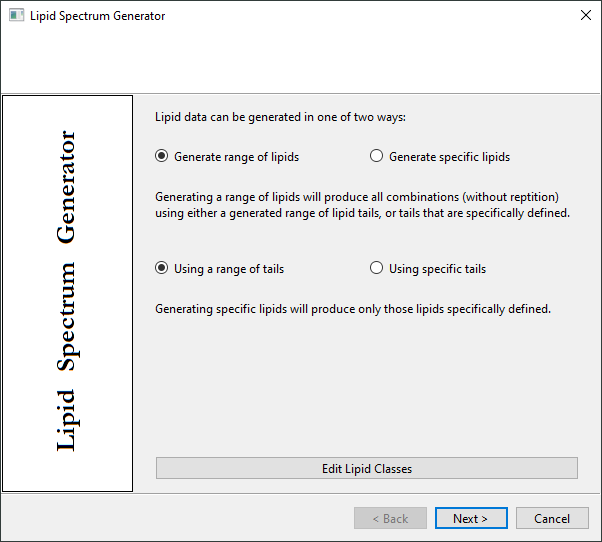
The process of generating software outputs first requires the generation of lipid species. This may begin in one of two ways:
1) By generating a range of lipids, 2) or by generating specific lipids.
Generating a range of lipids
Generating a range of lipids separates the process of lipid creation into two steps: i) First, tails must be defined, ii) next, lipid classes are selected.
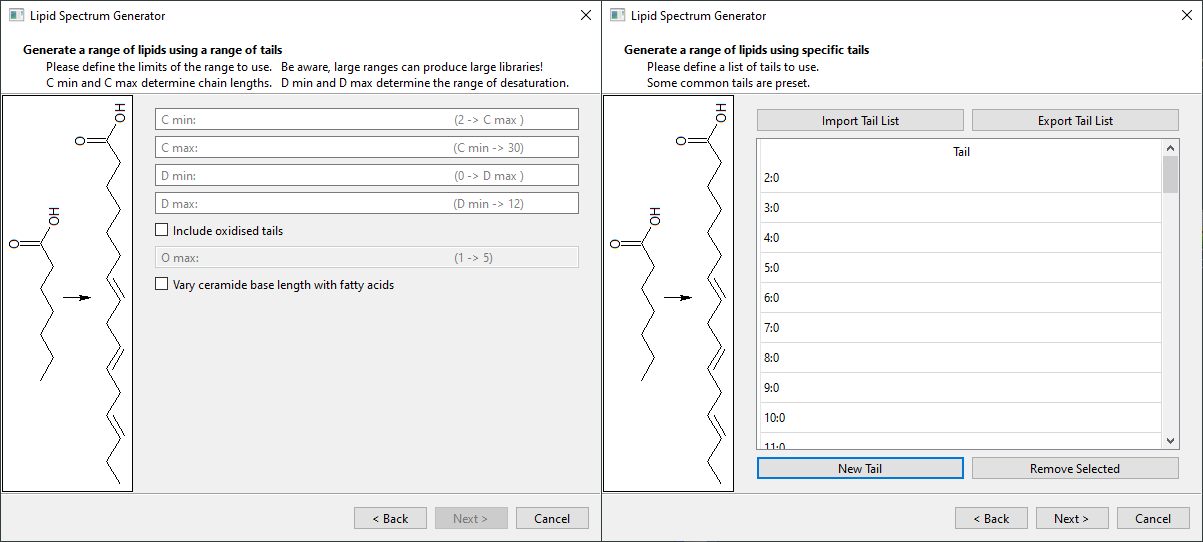
Two methods of tail generation are available if the "Generate a range of lipids" option is selected, enabling a range of lipids to be generated using either a range of tails (left), or specifically defined tails (right).
Caution should be taken when generating lipids using a large quantity of tails. Certain lipid classes have the capacity to generate a broad range of species due to their increased quantity of fatty acids. For example, 1540 triglyceride species can be generated with 20 tails, whereas 88560 species are possible with 80 tails. This may be compared against 210 and 3240 diglyceride species, or 20 and 80 monoglycerides.
Following the specification of tails, lipid classes are selected using the following page.
An option to "Respect headgroup-acyl isomerism" is provided to help manage library size, with an associated tool-tip explanation:
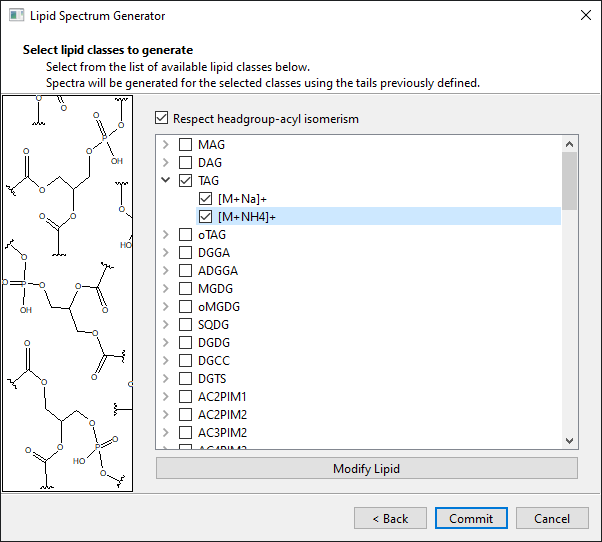

Selecting "Commit" will prevent access to prior pages and enable the generation of outputs.
At multiple stages throughout this process, fragmentation patterns may be adjusted on a class/adduct-basis:
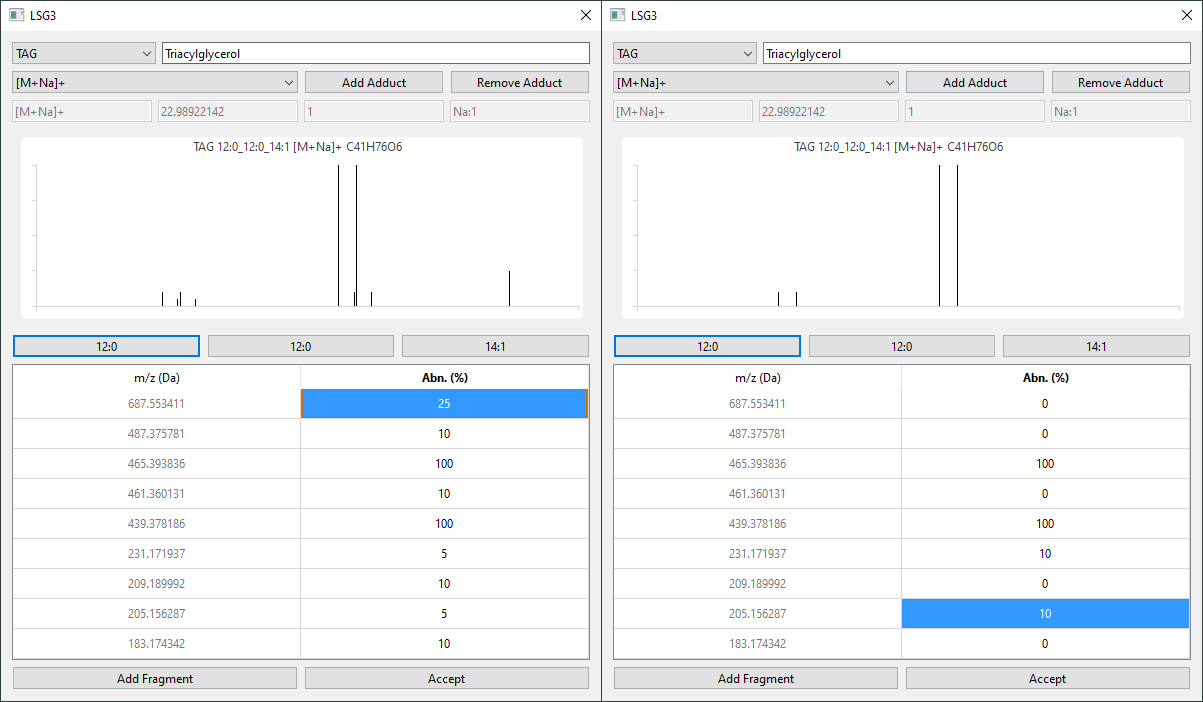
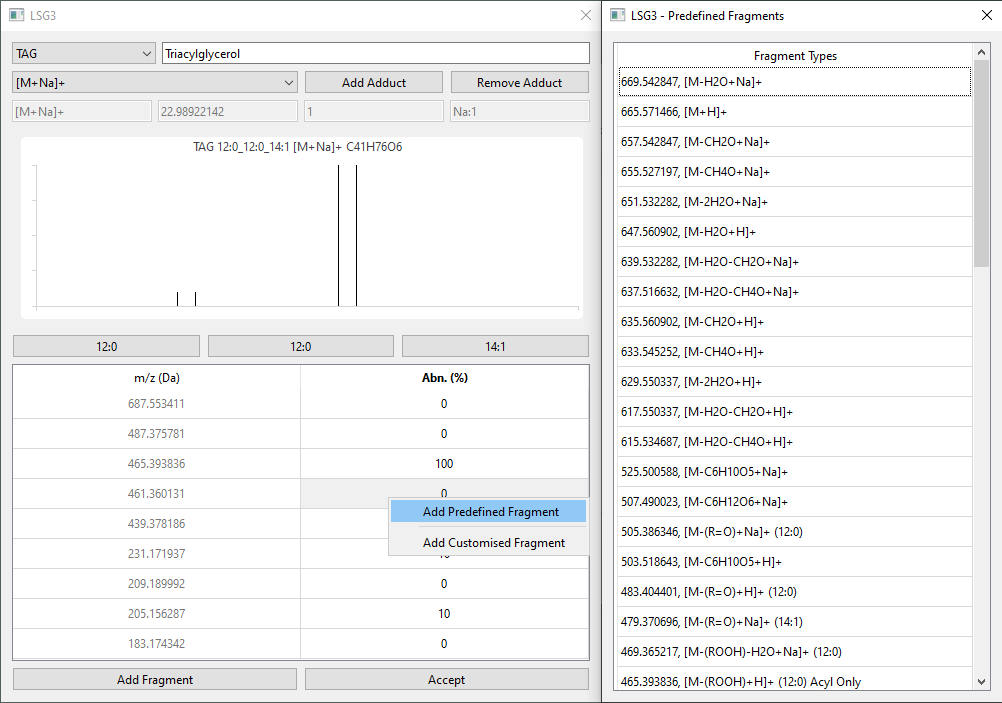
Generating specific lipids
Generating specific lipids combines the steps taken to specify lipid class and tails.
Selecting this option will next direct the user to the following page:
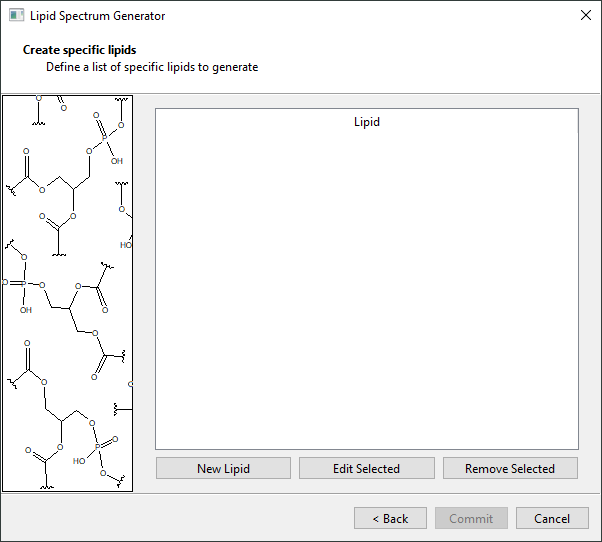
Selecting the "New Lipid" option will then provide the following popup in which the user may specify the details.
First, the desired class and adduct are selected:
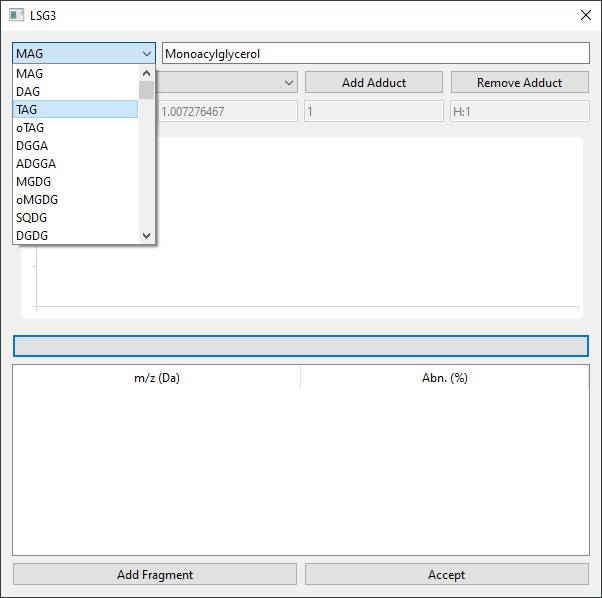
A number of new buttons will appear, equivalent to the quantity of required fatty acids. Selecting these will then provide the user with an additional popup:
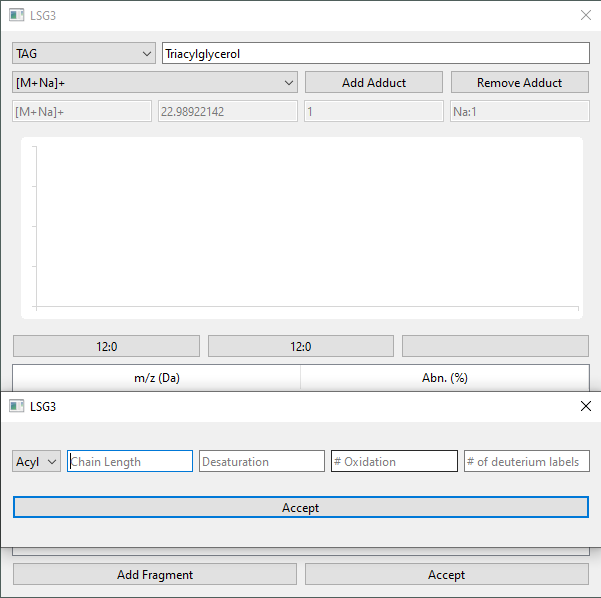
After the lipid and adduct have been specified, the fragmentation pattern may be altered as needed:
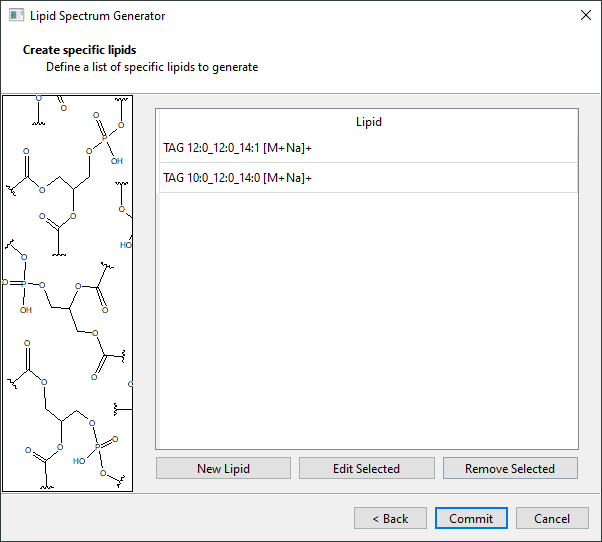
Once satisfied, the list may be committed.
Selecting "Commit" will prevent access to prior pages and enable the generation of outputs.
Output
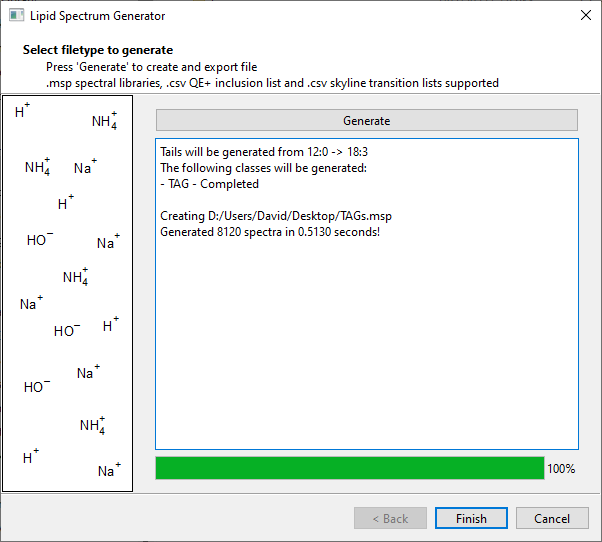
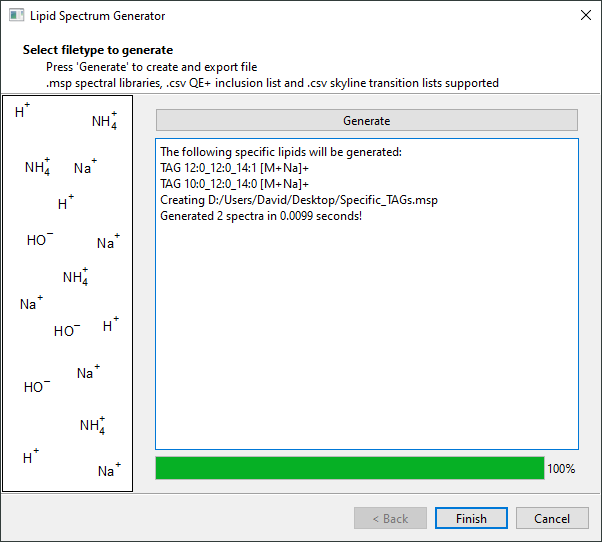
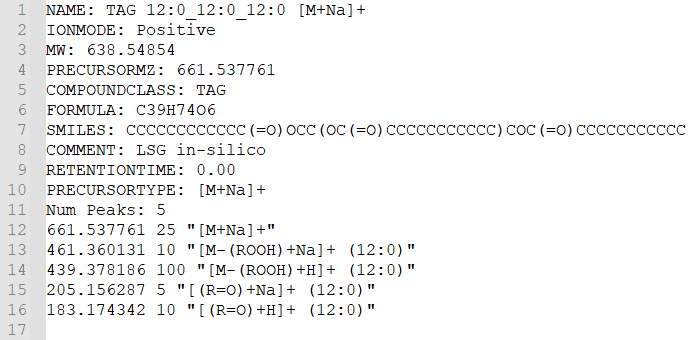
Results may be exported as a .MSP formatted spectral library:
A .CSV formatted inclusion list of unique precursor masses, made for Orbitrap DDA analysis:

A .CSV formatted transition list, made for Skyline analysis:

What's Changed
New Contributors
Full Changelog: v1.0.0...v1.1.0
