Install:
pip install gate-cat— then a veto in two lines:from gatecat import check_action # deny-list gate check_action("agent", "terraform destroy -auto-approve") # -> raises ActionVetoedThe distribution is
gate.cat(PyPI normalizes it, sopip install gate-cat); the import module isgatecat. 0.2.x usedimport cacheback— seeMIGRATION.md. Honest line, up front: the gate is certain only about what it blocks. An action it does not match is unchecked, not safe.Scope — persistent environments. gate.cat guards places where a mistake is irreversible: a dev laptop with real data, a deploy pipeline, prod, paid infra. In a throwaway CI/sandbox container (a fresh git checkout that gets discarded) nothing is irreversible, so the gate disarms itself and logs a
disarmedno-op rather than crying wolf. It auto-detects CI markers;GATECAT_VETO_EPHEMERAL=0forces it armed anyway. Measured on 14.7k real Claude Code commands and a public HF corpus of 8.6k SWE-agent commands, it intervenes on ~0.6% of commands on both — the deny-list found something structural, not tuned to one user.
Stop your AI agent before it takes an irreversible action. The action-veto is
deterministic and model-agnostic — a deny-list + exec-check + human-in-the-loop that
inspects the tool call at the boundary, so it protects any agent the same way: a Claude Code
hook (frontier), a crewAI/LangGraph app, or a local 7-30B model on Ollama/vLLM. TruthPipeline
adds an honest verdict (confirmed / refuted / uncertain / unchecked) using deterministic checks
(exec/calc/lookup) plus a sample-spread uncertainty signal; veto.py consumes that verdict to
block, pause, or ask a human before a tool call executes. (That uncertainty signal — a
secondary feature — is where the 7-30B local-model strength lives; see "Why small/cheap models"
below. The veto itself needs no such assumption.)
One mechanism, not two products: the verification engine (TruthPipeline) and the action-gate
that consumes it (before_action / VetoGate) ship together — same package, same brand.
Semantic cache and Cache-Augmented Synthesis (below) are the supporting engine underneath both.





Real catches, monthly: gate.cat publishes Veto Catches — a real irreversible command an agent tried, and how the wall stopped it.
An AI agent decides to run a README's install one-liner. The gate stops it before
a single byte executes — a real terminal, pip install gate-cat, no montage:
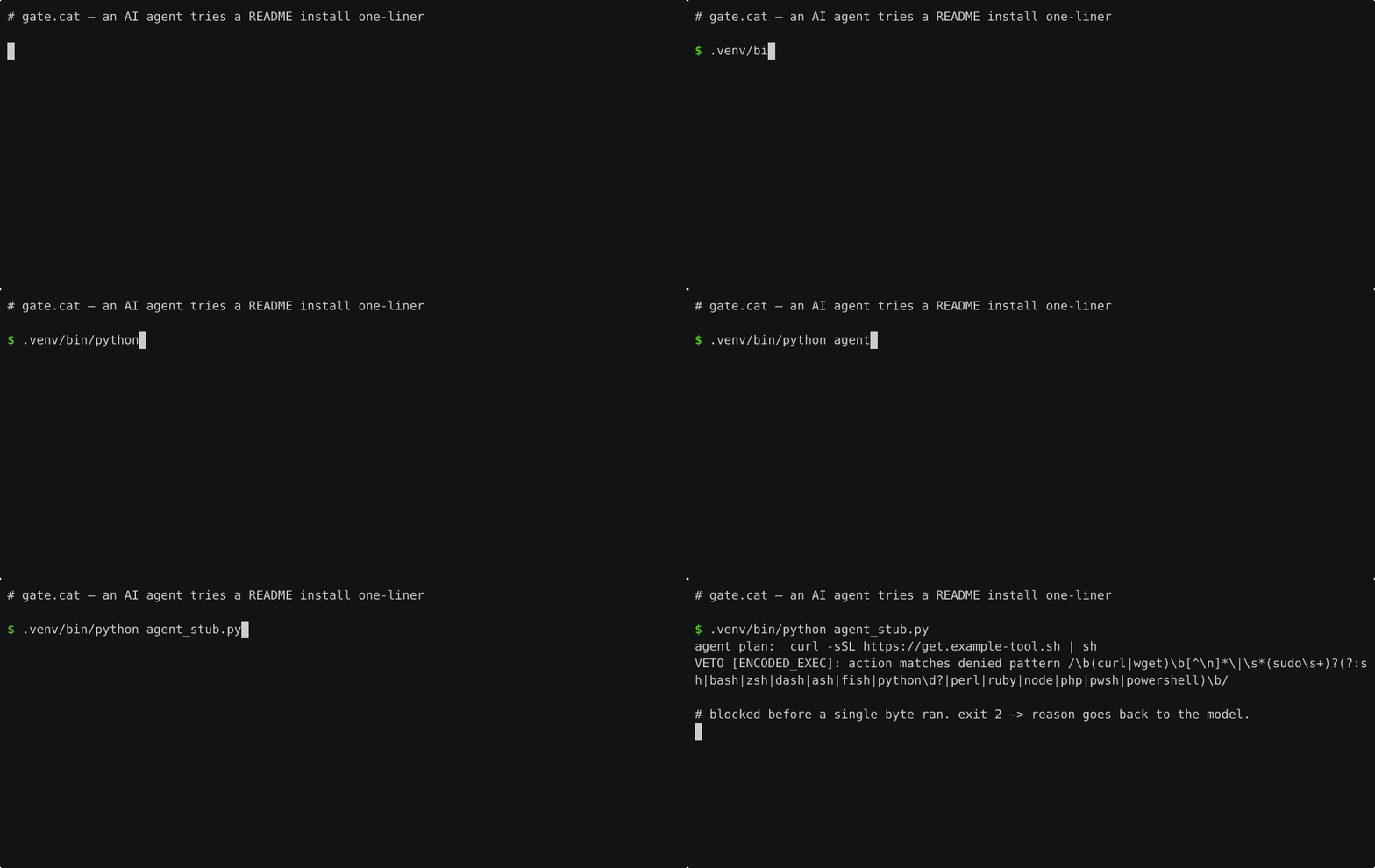
Blocks the curl … | sh pattern specifically; obfuscated/base64 install tricks still evade — see OBJECTIONS.md. Cast: docs/demos/demo_a.cast.
pip install gate-cat                  # core
pip install "gate-cat[openai]"      # + OpenAI wrapper
pip install "gate-cat[anthropic]"   # + Anthropic wrapper
pip install "gate-cat[proxy]"       # + proxy server (FastAPI)
pip install "gate-cat[all]"         # everything
Quote the extras (
"gate-cat[openai]") — zsh treats bare[...]as a glob.
Enforcement in the harness, outside the model's control flow: the tool call
cannot execute until the gate returns. pip install gate-cat puts the
gatecat-hook console script on your PATH; register it as a Claude Code
PreToolUse hook by adding this to .claude/settings.json (nothing to edit —
it's called by name, no absolute paths):
{
  "hooks": {
    "PreToolUse": [
      {
        "matcher": "Bash|Write|Edit",
        "hooks": [{ "type": "command", "command": "gatecat-hook" }]
      }
    ]
  }
}
Now ask your agent to run rm -rf ~/project: the call is blocked (exit 2) and
the model sees VETO [DELETE_ANALYZER]: deletes '/home/you/project' under protected root '/home' - requires a human. A delete under a throwaway path like
/tmp/x is deliberately allowed — the gate stops deletes that touch a
persistent location, and doesn't nag on scratch dirs. Run gate.cat any time to
see what it's watched and stopped. Fail-closed: a missing or erroring engine
blocks rather than allowing. In a throwaway CI/sandbox it disarms itself and
logs a no-op (GATECAT_VETO_EPHEMERAL=0 forces it armed).
Framework adapters (crewAI / LangGraph / AutoGen) exist too, but they are
in-process convention — a prompt injection can route around them. Only the hook
is enforcement the agent cannot skip. See
examples/veto_integrations/ for adapter usage.
One entry point that composes the SDK's verification blocks into a truth +
compliance pipeline for ANY model (a 3B SLM on a phone and a frontier LLM use
the same sample_fn callback).
from gatecat import TruthPipeline, ActionPolicy, ActionVetoed

pipe = TruthPipeline(
    sample_fn=my_llm,                              # callback(prompt) -> str
    fact_base={"capital of france": "Paris"},      # lookup channel (optional)
    policy=ActionPolicy(deny=[r"terraform.*prod"], max_amount=100.0),
)

r = pipe.evaluate("Evaluate: 6 / 2 * 3", answer="1")
r.verdict   # "refuted" — caught confident-wrong, deterministically, $0
r.truth     # "9" — the correct value, so the caller can self-correct

@pipe.guard()                                      # compliance on ACTIONS
def deploy(target): ...
deploy(target="terraform apply prod")              # raises ActionVetoed BEFORE executing

pipe.compliance_report()                           # audit trail: verdicts + vetoes
A policy in action: dev runs, destroy prod is denied, apply staging escalates
to a human — one deterministic gate, three outcomes:
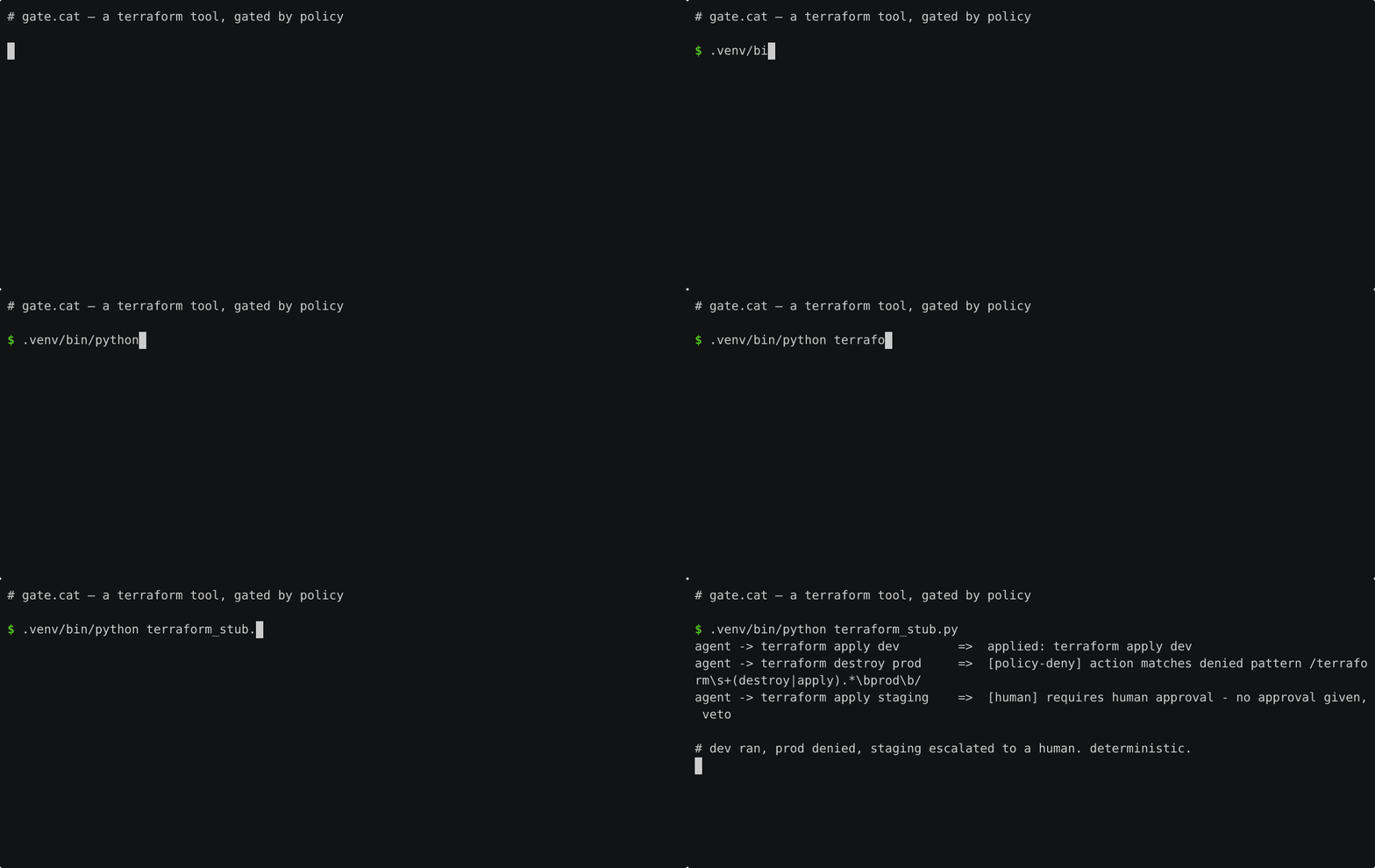
Source: examples/veto_terraform.py. Cast: docs/demos/demo_b.cast.
Honest verdicts — the pipeline never claims more than it measured:
| Verdict | Meaning | reliable |
trusted |
|---|---|---|---|
confirmed |
answer matches a verified atom (exec/calc/lookup) | ✅ | ✅ |
refuted |
answer contradicts a verified atom | ❌ | ❌ |
uncertain |
soft disagreement without arbiter, or high sample spread | ❌ | ❌ |
unchecked |
outside verification reach — not "true", just "couldn't check" | ❌ | ✅ |
For critical systems filter on report.reliable (confirmed only), not trusted.
Gate catches HESITATION, not LYING. When the model is confidently wrong (same N probes, same wrong answer — zero spread), that's invisible to disagreement. The gate is an uncertainty signal → pause/escalate, NOT a correctness guarantee.
Verdict precedence (conflicts are resolved by construction):
exec/calc(hard, physically independent of the model) always win — the gate isn't even asked.lookupdisagreement goes to the optionalarbiter_fn; without one →uncertain(setlookup_hard_block=Trueonly if your fact base is fresh at query time).gate(sample-spread) runs only when no verified atom exists.vetois an orthogonal axis: it judges actions, is fail-closed, andguard()without a policy raises instead of silently allowing everything.
Methods: evaluate(q, answer) verifies an existing answer · ask(q) generates
with sample_fn then verifies · guard() decorates a tool function with pre-execution
veto · check_action(repr) evaluates an action without running it.
arbiter_fn contract: (question, answer, KorytoVerdict) -> Optional[bool] —
True = the fact base is right (refute stands), False = the model was right
(stale base, answer confirmed), None/exception = no ruling → uncertain.
Every stage that spoke is recorded in report.stages for debugging.
Why small/cheap models (this is about the uncertainty signal, not the veto — the veto is model-agnostic): agents increasingly run on cheap/local models (7-30B via Ollama/vLLM) for cost and data-residency. That's where the gate's uncertainty signal is strongest (AUC 0.77–0.90, measured N=4800) and where frontier-first guardrail vendors don't aim — on frontier models the signal weakens (AUC 0.68–0.71). The action-veto's deny-list + exec-check does not depend on model size at all; it protects a Claude Code (frontier) agent exactly as it protects a local one.
Naming note: koryto (Polish: riverbed) is the project's canonical term for the
deterministic verification layer — the probabilistic "river" (model output) is held
by a deterministic "riverbed" (exec/calc/lookup). It is a deliberate brand term, not
an accident of translation.
Sixty seconds of your time, in exchange for:
- a deterministic gate your agent cannot run
terraform destroy,rm -rf,DROP TABLEorgh repo deletethrough — 28 default policies for the irreversible-action class, fail-closed, ~0.6% intervention rate measured on real traffic (it won't nag you); - a ready-to-paste Claude Code PreToolUse hook — the strongest mode: enforcement in the harness, outside the model's control flow;
- adapters for crewAI / LangGraph / AutoGen (honestly labeled: in-process convention, weaker than the hook);
- one-line uninstall if it's not for you. Worst case, you lost a minute.
What we ask back — this project runs on one currency:
- 🐛 a veto story — tell us what got caught, or what slipped through. Misses are worth more than praise: reported gaps get fixed and credited in the CHANGELOG, and the bypass suite grows from exactly these reports. …and if the gate ever blocks something dumb before it happened, a ⭐ helps other people find this.
The local gate is free forever — including local reports. The paid layer, gate.cat Cloud, is the off-machine copy of your veto history — the one an agent with shell access can't delete or rewrite (a local log is inside its blast radius). Announced prices: Solo $9/mo · Team $199/mo flat (up to 10 devs) · audit-readiness pilots by invoice. We deliberately don't take money until fulfillment is zero-touch; the founding list locks the price: PRICING.md.
Every public number traces to a row in FACTS.md (claim → source →
allowed wording), and the corpus harnesses behind the headline measurements are
in scripts/ — reproduce them, and if your numbers
disagree with ours, that's a bug report we want. The 14.7k-command half of the
~0.6% claim is our own private log (labeled as such in FACTS.md); the public
corpus half you can re-run yourself.
Recall — the claim we care about most (does anything dangerous get through?) is measured on two axes in RECALL.md. The deterministic one needs no datasets and runs in seconds:
git clone https://github.com/BGMLAI/gate.cat && cd gate.cat
pip install -e .                       # the veto engine (zero-dependency core)
python scripts/recall_danger_axis.py   # 43/43 known danger classes through the FULL gate, 0 false-blocks
(The harness lives in scripts/ — not shipped inside the pip wheel — so verify
it from a clone, where you can also read the danger catalog it checks against.)
The verification/veto layer above runs on top of a semantic cache. Used standalone, the cache also works as a drop-in wrapper for OpenAI/Anthropic SDKs with a three-tier response: verbatim cache, synthesis, upstream — cache semantically similar queries and return instant responses (<10ms), or synthesize from cached knowledge (~300ms, ~$0.002) instead of a full upstream call.
from gatecat import CachedOpenAI

client = CachedOpenAI(api_key="sk-...")

# First call: ~500ms (API + cache populate)
response = client.chat.completions.create(
    model="gpt-4o",
    messages=[{"role": "user", "content": "What is the capital of France?"}],
)

# Second call with similar query: ~5ms (cache hit)
response2 = client.chat.completions.create(
    model="gpt-4o",
    messages=[{"role": "user", "content": "capital of France?"}],
)
print(response2.gatecat_hit) # Truefrom gatecat import CachedAnthropic
client = CachedAnthropic(api_key="sk-ant-...")
message = client.messages.create(
model="claude-sonnet-4-20250514",
max_tokens=1024,
messages=[{"role": "user", "content": "What is Python?"}],
)
print(message.gatecat_hit) # True on cache hitStreaming works transparently. Cache misses buffer and store the response; cache hits replay as a synthetic stream.
stream = client.chat.completions.create(
    model="gpt-4o",
    messages=[{"role": "user", "content": "Explain quantum computing"}],
    stream=True,
)
for chunk in stream:
print(chunk.choices[0].delta.content or "", end="")When a query is similar to cached entries but not an exact match, CAS synthesizes a fresh response from cached knowledge using a cheap LLM — instead of calling the expensive upstream API.
from gatecat import CachedOpenAI

client = CachedOpenAI(
    synthesis_mode="auto",  # enable three-tier response
    # Uses Gemini Flash Lite via OpenRouter by default (~$0.002/synthesis)
    # Or point to local llama-cpp: synthesis_model="local/phi-4-mini"
)

response = client.chat.completions.create(
    model="gpt-4o",
    messages=[{"role": "user", "content": "Explain photosynthesis"}],
)

if response.gatecat_hit:
    print("Verbatim cache hit (<10ms, $0.00)")
elif response.gatecat_synthesized:
    print("Synthesized from cache (~300ms, ~$0.002)")
else:
    print("Upstream API call (~500ms, ~$0.03)")
Three-tier response:
Query --> Embed --> HNSW search
|
sim >= 0.92 | VERBATIM HIT --> Return cached response <10ms $0.00
sim >= 0.80 | SYNTHESIS --> Top-K cached Q&A + LLM ~300ms ~$0.002
sim < 0.80 | UPSTREAM MISS --> Call API, cache response ~500ms ~$0.03
Validated with 100-question benchmark across 5 domains: 0.892 mean quality ratio vs direct API responses.
Ollama, NIM, OpenRouter, vLLM and LM Studio all speak the OpenAI API, so one
proxy in front of them protects them all — your agent changes one base_url,
writes no code. When the model asks to run a tool, the proxy checks the proposed
call against the 21 deny policies and blocks the dangerous ones before the
agent executes them (rm -rf, terraform destroy, DROP TABLE, disk wipes,
repo deletion, ...).
pip install "gate-cat[proxy]"

# point the proxy at your provider (local Ollama shown; NIM/OpenRouter/vLLM the same)
export OPENAI_BASE_URL="http://localhost:11434/v1"    # your real provider
export GATECAT_ALLOW_INSECURE_UPSTREAM=1              # only for a local http provider
gatecat-proxy                                         # listens on :8080
Then your agent points at the proxy instead of the provider — that's the whole change:
client = OpenAI(base_url="http://localhost:8080/v1") # was 11434; now guardedA dangerous tool call comes back as a refusal, not an execution. Modes:
GATECAT_PROXY_TOOL_VETO=block (default) / flag (annotate only) / off.
Caveat: this gates tool calls the model makes through the API; an agent that
shells out directly still needs the harness hook (gatecat-hook).
Run gate.cat as a standalone proxy server. No SDK integration needed — just change base_url:
# Docker (recommended)
docker run -e OPENAI_API_KEY=sk-... -p 8080:8080 gatecat/proxy

# Or pip
pip install "gate-cat[proxy]"
gatecat-proxy  # starts on :8080
Then point your existing code at the proxy:
from openai import OpenAI

client = OpenAI(base_url="http://localhost:8080/v1")  # that's it
response = client.chat.completions.create(
    model="gpt-4o",
    messages=[{"role": "user", "content": "What is Python?"}],
)
# Cache headers: X-Gatecat-Hit, X-Gatecat-Synthesized
Works with any OpenAI-compatible client (curl, LangChain, LiteLLM, etc). Configure via environment variables:
| Variable | Default | Description |
|---|---|---|
OPENAI_API_KEY |
— | API key for upstream provider |
GATECAT_SIMILARITY_THRESHOLD |
0.92 |
Cache hit threshold |
GATECAT_SYNTHESIS_MODE |
off |
off / auto / always |
GATECAT_TTL |
86400 |
Cache TTL in seconds |
GATECAT_PORT |
8080 |
Server port |
from gatecat import AsyncCachedOpenAI, AsyncCachedAnthropic

async_client = AsyncCachedOpenAI()
response = await async_client.chat.completions.create(
    model="gpt-4o",
    messages=[{"role": "user", "content": "Hello"}],
)Use SemanticCache directly for any embedding-based caching:
from gatecat import SemanticCache

cache = SemanticCache(
    similarity_threshold=0.92,
    cache_ttl=86400,  # 24 hours
)

cache.populate("What is Python?", "Python is a programming language...")
result = cache.lookup("Tell me about Python") # cache hitBlock known-bad query patterns before they hit the API:
# Block a query pattern
client.cache.negative.add(
    "What is the airspeed of an unladen swallow?",
    reason="hallucination",
)

# Similar queries are now blocked
client.cache.negative.check("airspeed of swallows")  # returns match info

# Manage the blocklist
client.cache.negative.list(limit=50)
client.cache.negative.remove(entry_id=42)
client.cache.negative.report_false_positive(entry_id=42)client = CachedOpenAI(
# Cache settings
cache_dir="~/.gatecat", # where to store cache data
similarity_threshold=0.92, # cosine similarity for cache hit (0-1)
negative_threshold=0.85, # threshold for negative cache
cache_ttl=86400, # TTL in seconds (24h default)
cache_max_entries=100_000, # max entries before LRU eviction
cache_enabled=True, # set False to disable
on_negative_hit="raise", # "raise" | "skip" | callable
# Synthesis settings (CAS)
synthesis_mode="off", # "off" | "auto" | "always"
synthesis_model="google/gemini-2.0-flash-lite-001", # any OpenAI-compatible model
synthesis_model_base_url=None, # auto-detected from OPENROUTER_API_KEY
synthesis_model_api_key=None, # auto-detected from env
synthesis_threshold=0.80, # min similarity for synthesis candidates
synthesis_top_k=5, # number of cached Q&A pairs for synthesis
# OpenAI settings (passthrough)
api_key="sk-...",
)Query --> Embed (MiniLM-L6, 384-dim) --> Search HNSW index
|-- VERBATIM HIT (sim >= 0.92) --> Return cached response (<10ms)
|-- SYNTHESIS (sim >= 0.80) --> Top-K cached Q&A + cheap LLM (~300ms)
'-- MISS (sim < 0.80) --> Call upstream API, cache response (~500ms)
- Embedder: ONNX MiniLM-L6-v2 (90MB, runs locally, no API calls)
- Index: hnswlib HNSW for fast approximate nearest neighbor search
- Store: SQLite with WAL mode for concurrent access
- Fallback: numpy brute-force if hnswlib is unavailable
gatecat-cli stats          # Show cache statistics
gatecat-cli entries        # List cached entries
gatecat-cli evict          # Remove expired entries
gatecat-cli clear          # Clear all entries
gatecat-cli lookup "query" # Test a cache lookupRegister your own embedder for any modality:
from gatecat.embedders import BaseEmbedder, register_embedder
import numpy as np

class MyEmbedder(BaseEmbedder):
    dim = 256
    modality = "custom"

    def encode(self, input_data) -> np.ndarray:
        # Your embedding logic here
        ...

register_embedder("my-embedder", MyEmbedder)
cache = SemanticCache(embedder="my-embedder")
Built-in embedders: minilm (text), clip (image, coming soon), clap (voice, coming soon).
| Feature | gate.cat | GPTCache | LiteLLM | Redis LangCache |
|---|---|---|---|---|
| Semantic similarity | Yes | Yes | Exact only | Yes |
| Cache-Augmented Synthesis | Yes | No | No | No |
| OpenAI drop-in | Yes | Partial | Yes | No |
| Anthropic drop-in | Yes | No | Yes | No |
| Streaming support | Yes | No | No | No |
| Negative cache | Yes | No | No | No |
| Multimodal (planned) | Yes | No | No | No |
| Async | Yes | No | Yes | No |
| Zero config | Yes | No | No | No |
| Proxy mode (Docker) | Yes | No | Yes | No |
| Local (no server) | Yes | Yes | No | No |
| License | Apache 2.0 | MIT | MIT | Redis |
Apache 2.0 — see LICENSE.
Built by BGML.ai / Fundacja BLOOM. Policy Packs → gate.cat/#packs