Repository navigation
Home
This documentation is licensed under a Creative Commons Attribution-ShareAlike 4.0 International License.

DynaLoRa-USB is a low cost and open source, CircuitPython and Arduino compatible, LoRa tinkering dongle designed by and for makers.
Our aim is to facilitate access to the hottest radio technology (LoRa) through the use of maker-friendly languages such as Python and the Arduino framework. With that intent, DynaLoRa-USB is a simple device that you just plug and play with! It includes a powerful SAMD21 microcontroller and a HopeRF LoRa radio module (RFM96W for 868/915 MHz or RFM95W for 433 MHz), an user button, an RGB LED and an external 2.54 mm pin header interface to plug your favorite peripherals.
Here is an overview of the technical characteristics of the board:
- ATSAMD21E18 48 MHz Cortex-M0+ processor with 256 KB flash + 32 KB RAM, compatible with CircuitPython and Arduino
- 32 Mbit SPI flash for storing CircuitPython code and libraries
- High performance HopeRF radio module. We offer the device with the RFM96W, which is capable of LoRa modulation at 868/915 MHz, or the 433 MHz version, the RFM95W. You can easily replace it by the generic Sub-GHz radio version (RFM69HCW) since they are pin compatible.
- User-controllable WS2812B addressable RGB LED (NeoPixel)
- Regular user LED
- 3V3 @ 1A power through a DC/DC buck regulator from USB
- MicroSD Card slot
- GPIO header exposing SWD interface, a full SERCOM (enabling external SPI/I2C/UART peripherals) and a DAC for prototyping and tinkering
- This version comes with an USB-A plug. It should be easy enough to modify the design to offer other options (such as USB-C).
- Comes preprogrammed with the UF2 Bootloader and latest release of CircuitPython 6.X.X.
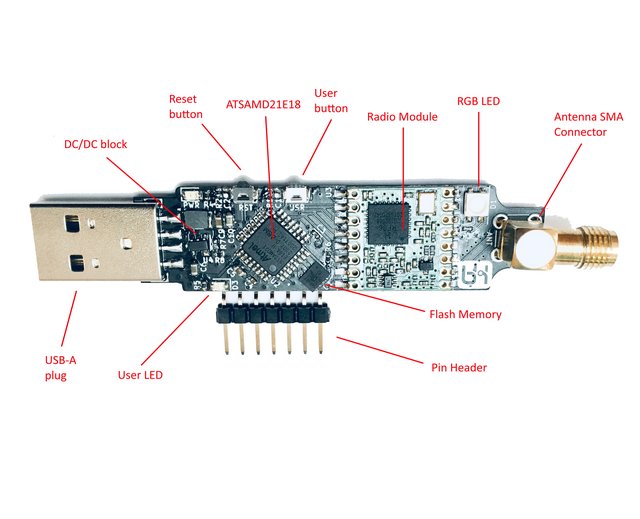
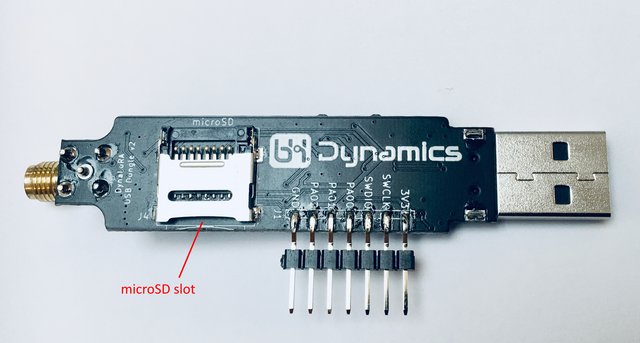
Microcontroller. The heart of the board is an ATSAMD21E18, a well known MCU running at 48 MHz with 256 KB flash + 32 KB of RAM. Together with its big brother the SAMD21G18, it’s one of the most used chips in the maker scene (with permission of the venerable ATmega328, of course). It comes pre programmed with the UF2 bootloader + CircuitPython 6.0.0. To store CircuitPython’s libraries and code, an additional 4 MB SPI flash is fully available to you, appearing as a USB drive when connecting the board to a computer.
Radio module. The main radio of the board is a LoRa capable HopeRF module, available in two flavors (RFM96W for 868/915 MHz and RFM95W for 433 MHz). It is easily controlled by SPI, and can be replaced by other frequencies pin-to-pin compatible modules (for example, RFM69HCW for non-LoRa Sub-GHz band). A standard SMA coaxial connector for an antenna is provided.
RGB. DynaLoRa has an addressable RGB LED, a WS1228B-MINI fully compatible with Adafruit’s NeoPixel library. It also has a regular LED for other uses!
Power block. The board has an DC/DC buck regulator capable of delivering up to 1A continuous to convert USB voltage (5V) to 3.3V.
Micro SD card. The board has a micro SD card slot available through an SPI interface. You can use it as you like: datalogging, storing configuration, etc.
Reset button. Simply press this button to reset the board! Also, if you press it twice, the board will boot to the UF2 bootloader.
External interface. In case you want to connect other devices to DynaLoRa-USB, it offers a 7-pin header with VCC, GND, a full SERCOM (capable of SPI, I2C and UART) and a true analog pin. It also enables you to reflash the MCU since it exposes the SWD interface.