This repository was forked from ORB-SLAM3 https://github.com/raulmur/ORB_SLAM3. SuperPoint-SLAM is a modified version of ORB-SLAM3 which use SuperPoint as its feature detector and descriptor. The pre-trained model of SuperPoint come from https://github.com/MagicLeapResearch/SuperPointPretrainedNetwork. This version is supposed to work with ORB-SLAM3 instead of ORB-SLAM2. This version is not optimised and might not outperfom ORB-SLAM3.
Authors: Carlos Campos, Richard Elvira, Juan J. Gómez Rodríguez, José M. M. Montiel, Juan D. Tardos.
The Changelog describes the features of each version.
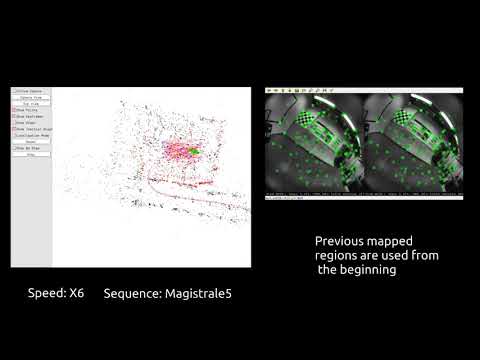
ORB-SLAM3 is the first real-time SLAM library able to perform Visual, Visual-Inertial and Multi-Map SLAM with monocular, stereo and RGB-D cameras, using pin-hole and fisheye lens models. In all sensor configurations, ORB-SLAM3 is as robust as the best systems available in the literature, and significantly more accurate.
We provide examples to run ORB-SLAM3 in the EuRoC dataset using stereo or monocular, with or without IMU, and in the TUM-VI dataset using fisheye stereo or monocular, with or without IMU. Videos of some example executions can be found at ORB-SLAM3 channel.
This software is based on ORB-SLAM2 developed by Raul Mur-Artal, Juan D. Tardos, J. M. M. Montiel and Dorian Galvez-Lopez (DBoW2).
[ORB-SLAM3] Carlos Campos, Richard Elvira, Juan J. Gómez Rodríguez, José M. M. Montiel and Juan D. Tardós, ORB-SLAM3: An Accurate Open-Source Library for Visual, Visual-Inertial and Multi-Map SLAM, Under review. PDF.
[IMU-Initialization] Carlos Campos, J. M. M. Montiel and Juan D. Tardós, Inertial-Only Optimization for Visual-Inertial Initialization, ICRA 2020. PDF
[ORBSLAM-Atlas] Richard Elvira, J. M. M. Montiel and Juan D. Tardós, ORBSLAM-Atlas: a robust and accurate multi-map system, IROS 2019. PDF.
[ORBSLAM-VI] Raúl Mur-Artal, and Juan D. Tardós, Visual-inertial monocular SLAM with map reuse, IEEE Robotics and Automation Letters, vol. 2 no. 2, pp. 796-803, 2017. PDF.
[Stereo and RGB-D] Raúl Mur-Artal and Juan D. Tardós. ORB-SLAM2: an Open-Source SLAM System for Monocular, Stereo and RGB-D Cameras. IEEE Transactions on Robotics, vol. 33, no. 5, pp. 1255-1262, 2017. PDF.
[Monocular] Raúl Mur-Artal, José M. M. Montiel and Juan D. Tardós. ORB-SLAM: A Versatile and Accurate Monocular SLAM System. IEEE Transactions on Robotics, vol. 31, no. 5, pp. 1147-1163, 2015. (2015 IEEE Transactions on Robotics Best Paper Award). PDF.
[DBoW2 Place Recognition] Dorian Gálvez-López and Juan D. Tardós. Bags of Binary Words for Fast Place Recognition in Image Sequences. IEEE Transactions on Robotics, vol. 28, no. 5, pp. 1188-1197, 2012. PDF
ORB-SLAM3 is released under GPLv3 license. For a list of all code/library dependencies (and associated licenses), please see Dependencies.md.
For a closed-source version of ORB-SLAM3 for commercial purposes, please contact the authors: orbslam (at) unizar (dot) es.
If you use ORB-SLAM3 in an academic work, please cite:
@article{ORBSLAM3_2020,
  title={{ORB-SLAM3}: An Accurate Open-Source Library for Visual, Visual-Inertial
           and Multi-Map {SLAM}},
  author={Campos, Carlos AND Elvira, Richard AND G\´omez, Juan J. AND Montiel,
          Jos\'e M. M. AND Tard\'os, Juan D.},
  journal={arXiv preprint arXiv:2007.11898},
  year={2020}
 }
We have tested the library in Ubuntu 16.04 and 18.04, but it should be easy to compile in other platforms. A powerful computer (e.g. i7) will ensure real-time performance and provide more stable and accurate results.
We use the new thread and chrono functionalities of C++11.
We use Pangolin for visualization and user interface. Dowload and install instructions can be found at: https://github.com/stevenlovegrove/Pangolin.
We use OpenCV to manipulate images and features. Dowload and install instructions can be found at: http://opencv.org. Required at leat 3.0. Tested with OpenCV 3.2.0.
Required by g2o (see below). Download and install instructions can be found at: http://eigen.tuxfamily.org. Required at least 3.1.0.
We use modified versions of the (https://github.com/rmsalinas/DBow3) library to perform place recognition and g2o library to perform non-linear optimizations. Both modified libraries (which are BSD) are included in the Thirdparty folder.
Required to calculate the alignment of the trajectory with the ground truth. Required Numpy module.
- (win) http://www.python.org/downloads/windows
- (deb)
sudo apt install libpython2.7-dev - (mac) preinstalled with osx
We use Pytorch C++ API to implement SuperPoint model. It can be built as follows:
git clone --recursive -b v1.0.1 https://github.com/pytorch/pytorch
cd pytorch && mkdir build && cd build
python ../tools/build_libtorch.py
It may take quite a long time to download and build. Please wait with patience.
NOTE: Do not use the pre-built package in the official website, it would cause some errors.
We provide a script build.sh to build the Thirdparty libraries and ORB-SLAM3. Please make sure you have installed all required dependencies (see section 2). Execute:
cd Ms-Deep_SLAM
chmod +x build.sh
./build.sh
This will create libORB_SLAM3.so at lib folder and the executables in Examples folder.
You can download the vocabulary from google drive https://drive.google.com/file/d/1p1QEXTDYsbpid5ELp3IApQ8PGgm_vguC/view. And then put it into Vocabulary directory. The vocabulary was trained on Bovisa_2008-09-01 using DBoW3 library. Branching factor k and depth levels L are set to 5 and 10 respectively.
#5. Monocular Examples KITTI Dataset
Download the dataset (grayscale images) from http://www.cvlibs.net/datasets/kitti/eval_odometry.php
Execute the following command. Change KITTIX.yamlby KITTI00-02.yaml, KITTI03.yaml or KITTI04-12.yaml for sequence 0 to 2, 3, and 4 to 12 respectively. Change PATH_TO_DATASET_FOLDER to the uncompressed dataset folder. Change SEQUENCE_NUMBER to 00, 01, 02,.., 11.
./Examples/Monocular/mono_kitti Vocabulary/ORBvoc.txt Examples/Monocular/KITTIX.yaml PATH_TO_DATASET_FOLDER/dataset/sequences/SEQUENCE_NUMBER
@inproceedings{deng2019comparative,
  title={Comparative Study of Deep Learning Based Features in SLAM},
  author={Deng, Chengqi and Qiu, Kaitao and Xiong, Rong and Zhou, Chunlin},
  booktitle={2019 4th Asia-Pacific Conference on Intelligent Robot Systems (ACIRS)},
  pages={250--254},
  year={2019},
  organization={IEEE}
}