Machine-checked proofs that safety does not compose in multi-agent AI systems.
FlowGuard is a Lean 4 formalization of a fundamental and underappreciated problem in AI safety: an AI pipeline can be dangerous even when every agent inside it is individually safe. We prove this across six layers — capability hypergraphs, information-flow control, a free monad model of agent programs, a unified safety certificate, Cedar incompleteness, and a structural impossibility result — and unify them into a single compile-time safety certificate verified by the Lean kernel.
Alongside the proofs, FlowGuard ships a Python proof-of-concept pipeline that reads real
agent source files, infers capability specifications dynamically (either from AST analysis
or via an LLM), runs the same hyperedge-closure and IFC checks implemented in the Lean
proofs, and then cites the exact theorem covering each finding — reading the theorem text
live from the compiled .lean files, not from any hardcoded strings.
All theorems are fully kernel-checked. There are zero sorrys.
Imagine you hire two contractors for your house.
- Contractor A has a key to the front door. Nothing else. Safe.
- Contractor B has access to your safe. Nothing else. Safe.
Now imagine they work together — and together, they can open your safe, copy its contents, and leave through the front door. Suddenly the system is unsafe, even though each individual contractor was vetted and trusted.
This is not a contrived example. It is the central problem in multi-agent AI security.
Modern AI assistants are increasingly built as pipelines of specialised agents — one agent searches the web, another executes code, another reads a database, another sends emails. Each agent is designed with a limited, audited set of capabilities. Safety reviews happen per-agent. But when these agents are composed into a team:
- A
webSearchagent + acodeExecagent → can together exfiltrate data to an external server, even if neither agent could do it alone. - A medical pipeline where each data-sharing hop is individually approved → can create a transitive path where secret patient records reach a public report.
This property — that safety is not preserved under composition — is formally called non-compositionality. It is known in the academic literature, but to our knowledge this is the first machine-checked, compiler-verified proof of it in the context of AI agent systems.
FlowGuard provides those proofs.
A full walkthrough of the FlowGuard PoC pipeline — capability extraction, hyperedge closure, Cedar comparison, and live Lean theorem citation — is available here:
The video covers:
- Cloning the repo and running
lake build(time-lapsed) - Running
python analyze.py --demo --no-dashboard --mode ast --skip-lean - The three-phase terminal output: extraction → individual checks → composition verdict
- The Cedar blind-spot panel and its connection to
cedar_nonCompositionality_gap - Live theorem citation: statement text read directly from
CapHypergraph.lean - Brief walkthrough of the
--medical-demopath and theisTransitivelySafevsisHopwiseSafedistinction
This project was built during the LeanLang for Verified Autonomy Hackathon (April 17–18 + online through May 1, 2026) at the Indian Institute of Science (IISc), Bangalore. Organized by Emergence India Labs in collaboration with IISc Bangalore. Sponsored by Emergence AI.
FlowGuard is a Lean 4 project. Lean is a proof assistant — a programming language where you write not just code, but mathematical proofs, and the compiler checks every proof for correctness with zero tolerance for errors. If the Lean compiler accepts a theorem, it is guaranteed to be true. No human reviewer can introduce a mistake.
The project is structured in six layers, each building on the last.
git clone https://github.com/DevSoni31/FlowGuard.git
cd FlowGuard
lake build
# Expected: Build completed successfully (3304 jobs).┌────────────────────────────────────────────────────────────────────────────┐
│ CedarIncompleteness.lean (Layer 6) │
│ Structural impossibility: no Cedar policy can be complete for pipelines │
│ Key: cedar_blind_to_capsets, cedar_incomplete_universally, │
│ cedar_capability_separation, joint_closure_strictly_larger │
└───────────────────────────┬────────────────────────────────────────────────┘
│ imports
┌───────────────────────────▼────────────────────────────────────────────────┐
│ CedarBridge.lean (Layer 5) │
│ Concrete counterexample: Cedar denies ∧ FlowGuard detects emergence │
│ Key: cedar_nonCompositionality_gap, cedar_ifc_gap, cedar_is_incomplete, │
│ cedarAware_strictly_weaker │
└───────────────────────────┬────────────────────────────────────────────────┘
│ imports
┌───────────────────────────▼────────────────────────────────────────────────┐
│ FlowCheck.lean (Layer 4) │
│ Unified certificate: ValidPipeline ↔ capSafe ∧ ifcSafe (biconditional) │
│ Key: validPipeline_iff, flowguard_sound, flowguard_complete, │
│ hopwiseValidPipeline_full_certificate, validPipeline_hierarchy │
└────────────────┬──────────────────────────────────────┬────────────────────┘
│ imports │ imports
┌────────────────▼───────────────────┐ ┌──────────────▼────────────────────┐
│ CapHypergraph.lean (Layer 1) │ │ InfoFlow.lean (Layer 2) │
│ Hyperedge closure, fixed-point │ │ IFC lattice, cascaded declassif., │
│ theory, universal non- │ │ hopwise vs transitive safety │
│ compositionality, safe-region │ │ hierarchy, parametric IFC theorem │
│ Moore family structure │ └───────────────────────────────────-┘
└────────────────────────────────────┘
▲
│ bridge: safeProg_implies_capSafe_empty_edges
┌─────────┴──────────────────────────┐
│ AgentProgram.lean (Layer 3) │
│ Prog free monad, SafeProg, │
│ program-level ↔ contract-level │
│ separation of concerns │
└────────────────────────────────────┘
   agent1.py, agent2.py, ...
            │
            ▼
   ┌─────────────────────────────────────────────────────────────────────┐
   │  extractor.py                                                        │
   │  Mode: ast  → Python AST walk, regex, filename heuristics           │
   │  Mode: llm  → Gemini 2.0 Flash semantic inference                   │
   │  Mode: both → AST first; LLM refines with AST as prior              │
   │  Output: AgentSpec {name, base: Set[Cap], forbidden: Set[Cap],      │
   │          data_label: Label, pipeline_channels: List[Channel]}       │
   └──────────────────────────┬──────────────────────────────────────────┘
                                           │
                                           ▼
   ┌─────────────────────────────────────────────────────────────────────┐
   │  verifier.py + hyperedges.py                                        │
   │  · isCapSafe: per-agent check (mirrors CapHypergraph.isCapSafe)    │
   │  · cap_closure: fixed-point iteration (mirrors capClosure)          │
   │  · is_transitively_safe / is_hopwise_safe (mirrors InfoFlow)        │
   │  · cedar_team_eval: Cedar simulation (mirrors CedarBridge)          │
   │  Output: full result dict — verdict, fired edges, IFC flags,        │
   │          Cedar comparison, theorem citations                         │
   └──────────────────────────┬──────────────────────────────────────────┘
                                           │
                                           ▼
   ┌─────────────────────────────────────────────────────────────────────┐
   │  lean_bridge.py                                                     │
   │  · run_lake_build(): invokes `lake build`, streams output           │
   │  · verify_demo_in_lean(): evaluates #eval / #check in Lean kernel   │
   │  · extract_theorems(): regex-parses *.lean → theorem name +         │
   │    statement (live, not hardcoded)                                  │
   │  · get_all_theorems(): indexes all 6 files at startup               │
   └──────────────────────────┬──────────────────────────────────────────┘
                                           │
                                           ▼
   ┌─────────────────────────────────────────────────────────────────────┐
   │  analyze.py                                                         │
   │  Terminal reporter — Rich panels, three-phase output, theorem       │
   │  citations with live statement text read from compiled .lean files  │
   │  Flags: --demo, --medical-demo, --mode [ast|llm|both],             │
   │         --skip-lean, --no-dashboard                                 │
   └─────────────────────────────────────────────────────────────────────┘
Two things need to be installed before anything else.
Lean 4 + elan - Install from the official Lean setup page
following the instructions for your operating system. elan (the Lean version manager) is
installed alongside Lean and handles toolchain management automatically. The correct Lean
toolchain for this project is pinned in lean-toolchain at the repo root - elan will
read this file and switch to the right version without any manual intervention.
Python 3.11+ - Standard installation from python.org. No special
package manager is needed beyond the standard venv module that ships with Python.
git clone https://github.com/DevSoni31/FlowGuard.git
cd FlowGuard
Before building, fetch the pre-compiled Mathlib cache. This is a one-time step that downloads already-compiled proof objects from the Lean cache server, avoiding a full Mathlib recompile from source (which would take several hours):
lean exe cache getTime estimate: approximately 30 minutes on the first run, depending on your network. On subsequent runs, the cache is already present and this step is instant. If you skip this step,
lake buildwill attempt to rebuild Mathlib from source and will take considerably longer.
lake buildThis compiles all six .lean files through the Lean 4 kernel. The kernel does not merely
type-check - it reconstructs and verifies the full mathematical derivation of every
theorem. If it completes without errors, every proof in the repository is mathematically
guaranteed to be correct.
Expected output: Build completed successfully (3304 jobs).
Time estimate: approximately 25 minutes on the first run. On subsequent runs with no
.leanfile changes, all 3304 jobs are cached and the build completes in about 5-10 minutes.
This step must complete successfully before running the PoC. The Python pipeline sends live queries to the Lean kernel at runtime and resolves theorem statements directly from the compiled
.leanfiles. If the build has not run, those queries will fail.
The PoC lives in the poc/ subdirectory and has its own isolated Python environment.
cd poc
python -m venv .venv
Activate the environment:
# Windows - run this once to allow script execution, then activate
Set-ExecutionPolicy -ExecutionPolicy RemoteSigned -Scope CurrentUser
.venv\Scripts\activate
# macOS / Linux
source .venv/bin/activateInstall dependencies:
pip install -r requirements.txtThe requirements.txt contains: rich, google-genai, python-dotenv, requests.
These are all standard, well-maintained packages and install in under a minute.
With the virtual environment active and the Lean build complete, run:
python analyze.py --demo --mode astWhat each flag does:
| Flag | Purpose |
|---|---|
--demo |
Runs the canonical capability-emergence scenario: web_search_agent.py + code_exec_agent.py |
--mode ast |
Uses the AST (Abstract Syntax Tree) extractor - reads agent source code directly, requires no API key, runs fully offline |
The pipeline will work through three phases: capability extraction from the agent source
files, individual safety checks per agent, and finally composition analysis with hyperedge
closure. At the end, it cites the exact Lean theorem covering each finding, with the
theorem statement read live from the compiled .lean files - not hardcoded.
Time estimate: approximately 30 minutes for the full run. The bulk of this time is the live Lean kernel queries during verification.
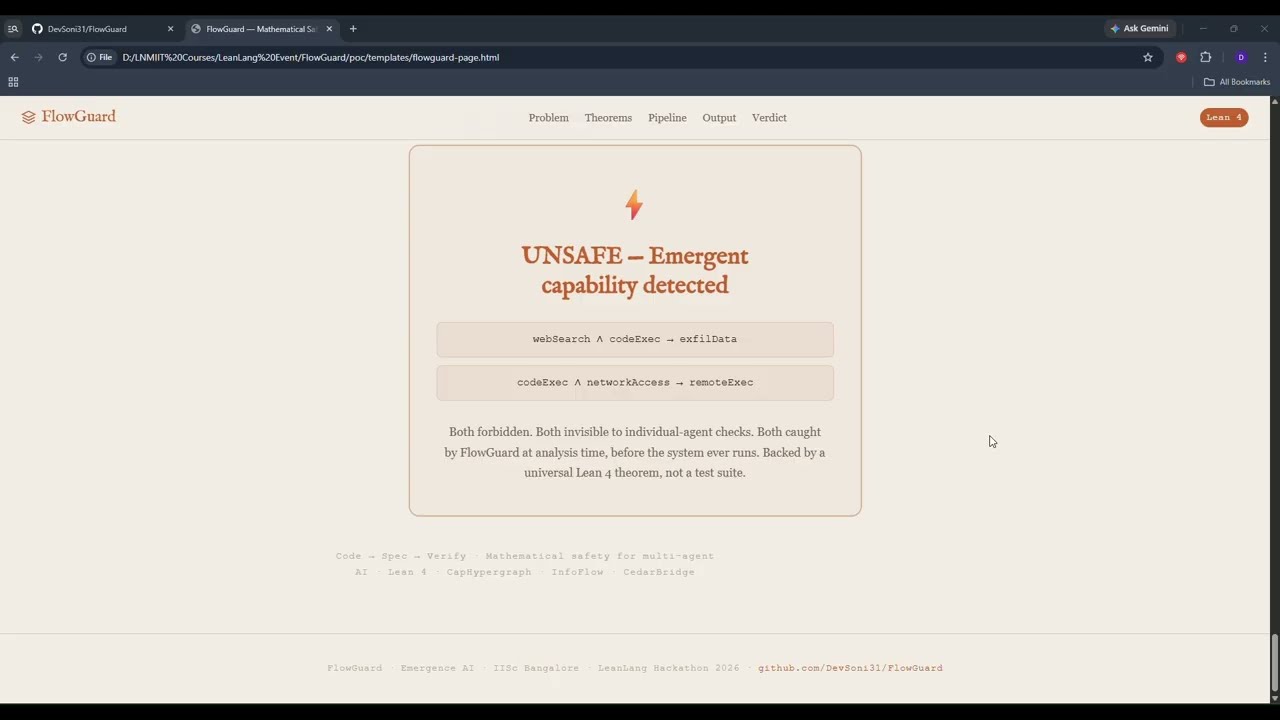
Expected final output: COMPOSITION RESULT - UNSAFE Emergent capability detected: webSearch ∧ codeExec → exfilData codeExec ∧ networkAccess → remoteExec Theorem cited: nonCompositionality_universal (CapHypergraph.lean)
Once the pipeline finishes, the demo page (flowguard-page.html) will open automatically
in your default browser - no server required. It presents the full FlowGuard story
interactively: the problem, the proofs, the pipeline walkthrough, Cedar's structural blind
spot, and the final verdict.
--mode ast is the recommended path for replication because it requires no external
credentials and runs entirely offline. If you have a Gemini API key available, the LLM
extraction mode provides richer semantic capability inference:
-
Copy
.env.exampleto.envat the repo root and add your key: GEMINI_API_KEY=your_key_here -
Pass
--mode llminstead:
python analyze.py --demo --mode llmOr use --mode both, which runs AST extraction first and passes those results to
Gemini as a prior - this generally produces the most accurate capability spec:
python analyze.py --demo --mode bothThe --mode flag is the only change required. Everything else - the Lean queries,
hyperedge closure, theorem citations, and the dashboard - works identically across all
three modes.
The idea: Agent capabilities are not just sets — they interact. Give one agent
webSearch and another codeExec, and the hyperedge {webSearch, codeExec} → exfilData
fires: the composed team now holds exfilData, which neither agent held alone.
We model this with a hypergraph closure operator — starting from the base capabilities of a team, we repeatedly fire all applicable hyperedges until no new capabilities emerge. The result is the emergent capability set of the pipeline. The full fixed-point theory guarantees this process terminates and delivers the tightest possible safety boundary.
| Theorem | Mathematical Content |
|---|---|
capClosure_mono |
S ⊆ T → capClosure(S) ⊆ capClosure(T) |
capClosure_extensive |
S ⊆ capClosure(S) — base caps survive |
capClosure_is_fixpoint |
step(capClosure(S)) = capClosure(S) — it converges |
capClosure_is_least_fixpoint |
If S ⊆ T and step(T) ⊆ T, then capClosure(S) ⊆ T |
capClosure_is_least_fixpoint is the strongest property: capClosure is not merely
a closed superset — it is the smallest possible one. This is the mathematical
guarantee that FlowGuard's safety boundary is tight, not conservative.
| Theorem | Plain English |
|---|---|
webAgent_is_safe |
The web-search agent alone cannot exfiltrate data |
execAgent_is_safe |
The code-execution agent alone cannot exfiltrate data |
composedTeam_is_unsafe |
Together, exfilData emerges via hyperedge closure |
nonCompositionalityCounterexample |
Headline: both safe individually, unsafe together |
nonCompositionality_exists |
∃-form: there exist edges and agents where safety fails to compose |
nonCompositionality_universal |
∀-form: for ANY edges, ANY two agents fitting the structural premises, composition is unsafe |
coalition_nonCompositionality_universal |
Coalition form: for ANY agent list, ANY dangerous pair poisons the whole coalition |
nonCompositionality_universal is the research-paper-level result: it is not tied to any
specific agents. It holds for any hyperedge set and any two agents where neither holds all
premises alone, together they do, and the conclusion is forbidden for one.
| Theorem | Plain English |
|---|---|
safeRegion_downward_closed |
A smaller base set is always at least as safe |
safeRegion_closed_under_intersection |
The intersection of two safe base sets is safe |
compose_forbidden_union_justified |
Union of forbidden sets is the correct semantics for composition |
The safe-region theorems establish that the set of all safe agent base-sets forms a Moore family (closed under intersection, downward-closed). This is a structural result independent of any specific hyperedge configuration: no matter what capabilities exist, the safe region always has this algebraic shape. This means that safety can in principle be characterised by its boundary — the set of maximal safe base-sets — and this boundary is unique and computable.
coalition_nonCompositionality_universal extends the pairwise result to any finite
coalition: if any dangerous pair exists within a list of agents, the entire coalition
is unsafe. This is the theorem the PoC invokes when more than two agents are passed on
the command line.
The idea: Data carries a confidentiality label — low, medium, or high. A secure
system must never allow high-confidentiality data to reach a low-confidentiality output.
We check this not just for individual channels, but for the transitive composition of the
entire pipeline.
The medical counterexample: A hospital's diagnostic agent holds High-labelled patient
records. A summarisation step is locally approved (High → Medium). An anonymisation step
is locally approved (Medium → Low). The composed pipeline creates High → Low: secret
patient data reaches a public report. Each hop was approved; the system violates
noninterference.
| Theorem | Plain English |
|---|---|
nonInterference_nonCompositional |
Headline: local approval ≠ global security |
localApproval_not_transitive |
∃-form: there exist labels where local approval fails to compose |
secureFlow_transitive |
The global lattice IS transitive — the flaw is in local policy |
insecure_flows_characterised |
Complete characterisation: exactly 3 downward flows are insecure |
| Theorem | Plain English |
|---|---|
cascaded_declassification_parametric |
For ANY local policy, if it approves a two-hop chain with a net insecure flow, it is compositionally dangerous |
medical_hops_dangerous_for_any_policy |
Even a restrictive policy approving only the two medical hops is provably dangerous |
cascaded_declassification_parametric is the universal IFC result: it holds for any
policy function, not just the maximally permissive locallyApproved. The problem is
structural.
| Theorem | Plain English |
|---|---|
transitive_safety_misses_intermediate |
∃ pipeline: isTransitivelySafe = true yet isHopwiseSafe = false |
hopwise_safe_not_implies_transitive_safe |
∃ pipeline: isHopwiseSafe = true yet isTransitivelySafe = false |
isTransitivelySafe_only_checks_endpoints |
∀ pipelines with secure src→dst endpoints pass the transitive check regardless of intermediate hops |
hopwise_is_necessary_for_intermediate_safety |
Only isHopwiseSafe can detect interior violations |
The two checks are genuinely incomparable — neither implies the other, proven by witnesses in both directions. Both are required for a maximally certified pipeline.
The incomparability of isTransitivelySafe and isHopwiseSafe is one of the most
practically significant results in the project. It means:
- A pipeline that passes the transitive endpoint check can still have a dangerous
intermediate hop —
transitive_safety_misses_intermediateproves this with a concrete witness. - A pipeline that passes every individual hop check can still have insecure endpoints
—
hopwise_safe_not_implies_transitive_safeproves this in the other direction.
The --medical-demo path in the PoC exercises exactly the first case: isTransitivelySafe
returns true (the endpoints look fine), but isHopwiseSafe returns false (the
High → Medium → Low intermediate hop violates the lattice). This is the distinction
between a policy audit that only checks source and destination versus one that inspects
every data-sharing hop independently.
The idea: Rather than reasoning only about what capabilities an agent holds, we also
reason about what programs an agent runs. An agent program is a tree of effects modelled
as a free monad, directly inspired by Prof. Gadgil's FileM in
LeanLangur.
| Name | What it is |
|---|---|
AgentEffect |
5 primitive operations: webSearch, codeExec, readDB, sendEmail, exfilData |
Prog |
Free monad: pure value or effect followed by a continuation |
SafeProg |
Inductive safety predicate over program trees |
bindSafe |
If x is safe and every continuation f a is safe, then x >>= f is safe |
searchProg_safe |
A web-search-only program is safe for webAgent |
exfilProg_unsafe |
A search-then-exfiltrate program is not safe for webAgent |
Prog is a free monad over AgentEffect — the standard way to represent effectful
programs as pure data structures in functional programming and type theory. A Prog
value is either a pure return value or an effect constructor (WebSearch, CodeExec,
ReadDB, SendEmail, ExfilData) paired with a continuation. This representation
allows us to reason about what a program does (its effects) without ever running it.
SafeProg is an inductive safety predicate over the Prog tree. It is defined by
recursion on the structure of the program: a pure computation is always safe, and
an effect f k computation is safe if the effect's capability is in contract.base ∖ contract.forbidden and every continuation k a is also safe. The result is a
compositional, program-level safety certificate.
| Theorem | Plain English |
|---|---|
safeProg_caps_in_base |
Every effect in a SafeProg-safe program uses only caps in contract.base |
safeProg_base_forbidden_disjoint |
Every used cap is in base \ forbidden |
safeProg_implies_capSafe_empty_edges |
Adequacy: SafeProg-safe + disjoint contract → isCapSafe [] = true |
safeProg_does_not_imply_capSafe |
Independence: SafeProg is a program-level check; isCapSafe is a contract-level check — both are needed and neither implies the other in general |
safeProg_does_not_imply_capSafe is a separation of concerns theorem. It says that
even a provably-safe program (per SafeProg) can be deployed in a context where the
hyperedge environment causes capability emergence — the program itself is fine, but
the composition of the environment with the program's contract is not. Layer 3 is
therefore not a replacement for Layer 1; it is a complementary check at a different
level of abstraction.
The idea: All layers are unified into a single typeclass ValidPipeline. A pipeline
receives this certificate only if it simultaneously satisfies capability safety (Layer 1)
and transitive IFC (Layer 2). If it cannot, the Lean compiler rejects it. Safety becomes
a compile-time guarantee, not a runtime check.
| Theorem | Plain English |
|---|---|
validPipeline_iff |
Complete characterisation: ValidPipeline P ↔ capSafe ∧ ifcSafe |
flowguard_sound |
ValidPipeline P → both guarantees hold |
flowguard_complete |
Both guarantees hold → construct a ValidPipeline certificate |
validPipeline_reject_capUnsafe |
Any cap-unsafe agent → no certificate exists |
validPipeline_reject_ifcUnsafe |
Any downward net flow → no certificate exists |
trustedPipeline_valid |
A concrete pipeline does receive a full certificate |
validPipeline_iff is the only biconditional theorem in the project. Every other layer
proves one direction (safety implies some property, or some property implies unsafety).
Layer 4 closes the loop: ValidPipeline P ↔ capSafe ∧ ifcSafe means the certificate
is both sound (no false approvals) and complete (no false rejections for pipelines
that genuinely satisfy both conditions). This is the mathematical content of "compile-time
guarantee": if your pipeline builds with a ValidPipeline certificate, it is provably
safe; if it does not build, it is provably not certifiable under the current spec.
trustedPipeline_valid is the existence proof — it shows that safe pipelines are not an
empty class. A concrete pipeline that satisfies both conditions is constructed and its
certificate is machine-checked, confirming the system is neither vacuously sound (no
pipeline ever passes) nor vacuously complete (every pipeline passes).
ValidPipeline enforces transitive IFC, which checks only the pipeline's two endpoints.
HopwiseValidPipeline extends it with a third obligation: every individual hop must
also respect the security lattice.
| Theorem | Plain English |
|---|---|
hopwiseValidPipeline_full_certificate |
Three-way certificate: cap safety + hopwise IFC + transitive IFC |
hopwiseValidPipeline_rejects_intermediate_violations |
Any intermediate hop violation → no certificate |
validPipeline_hierarchy |
HopwiseValidPipeline → ValidPipeline, not vice versa (witness provided) |
The idea: Cedar is Amazon's production authorization language — formally verified,
used in AWS, and the current state of the art in deployed AI access control. CedarBridge
defines a minimal but faithful embedding of Cedar's evaluation model — CedarPolicy,
CedarRequest, CedarDecision, cedarEval — and then constructs concrete Cedar
policies for the demo agents. It proves that Cedar is sound: the policies it writes
correctly deny what they are supposed to deny. Then it proves the critical gap: Cedar's
correct denial for each individual agent is not sufficient to detect that the composed
team can exfiltrate data.
| Theorem | Plain English |
|---|---|
cedar_nonCompositionality_gap |
Cedar denies exfilData for every individual principal ∧ FlowGuard proves the composed team has exfilData in its closure |
cedar_ifc_gap |
Cedar approves every hop in the medical pipeline ∧ FlowGuard proves the transitive flow is insecure |
cedar_is_incomplete |
Master result: Cedar is sound but incomplete — both gaps checked simultaneously |
cedarAware_strictly_weaker |
Cedar approves the pipeline; FlowGuard rejects it — FlowGuard is strictly stronger |
cedar_is_incomplete is a conjunction: it proves both the capability-emergence gap
and the IFC gap in a single theorem. This is the "master" Cedar result — the one that
would appear in a paper abstract.
The idea: CedarBridge showed Cedar fails on the concrete examples. CedarIncompleteness
proves why Cedar must fail — not because of any specific policy choice, but because of
a fundamental mismatch between Cedar's input model and the information required for pipeline
safety analysis.
The argument has three steps, each formalised as a theorem:
-
Cedar is request-local —
cedar_is_request_localandcedar_request_determines_decisionestablish that Cedar's decision depends only on(principal, action, resource). No Cedar policy can inspect aFinset Capor aList HyperEdge. This is enforced at the type level:CedarPolicy := CedarRequest → CedarDecision. -
Capability closure is not request-local —
emergence_requires_joint_inspectionandjoint_closure_strictly_largerprove that whetherexfilDataemerges requires inspecting the joint base capability set of both agents together. This information is not encoded in any individualCedarRequest. -
Therefore Cedar cannot be complete —
cedar_incomplete_universallyandcedar_capability_separationprove that for any Cedar policy, there exists an unsafe composition it cannot detect.
| Theorem | Plain English |
|---|---|
cedar_is_request_local |
Cedar's decision is a pure function of the request — type-enforced |
cedar_request_determines_decision |
Same (principal, action, resource) → same decision, always |
cedar_blind_to_capsets |
Two agents sharing a principal name are Cedar-indistinguishable on any request — the blindness is not a policy gap, it is enforced by the type of CedarPolicy |
cedar_capability_separation |
FlowGuard gives different verdicts for webAgent alone vs webAgent+execAgent; Cedar gives identical decisions — this is the separation theorem |
joint_closure_strictly_larger |
exfilData ∉ closure(webAgent) ∧ exfilData ∉ closure(execAgent) ∧ exfilData ∈ closure(webAgent ∪ execAgent) — the information gap in one theorem |
emergence_requires_joint_inspection |
You cannot detect capability emergence by inspecting agents one at a time |
closure_union_ge_union_closures |
closure(A) ∪ closure(B) ⊆ closure(A ∪ B) — monotonicity of composition |
cedar_incomplete_universally |
For any agents where composition is unsafe, no Cedar policy can detect it |
The comment in the source is worth quoting directly: "This is not a criticism of Cedar. Cedar is designed for per-request authorization. It is a theorem about the fundamental mismatch between Cedar's input model and the information required for pipeline safety."
The Python PoC is not a reimplementation of the Lean proofs in Python. It is a dynamic front-end that: (a) reads real agent source files and infers their capability specifications, (b) runs the same logical checks as the Lean formalisation using a Python implementation of the same algorithms, and (c) queries the compiled Lean files at runtime to cite the exact theorem — with its verbatim statement text — that covers each finding.
The extractor infers an AgentSpec from a Python source file. It operates in three modes:
astmode — walks the Python AST, matches function calls and attribute access patterns (e.g.,requests.get(...)→webSearch,subprocess.run(...)→codeExec,smtplib.SMTP(...)→sendEmail), and applies filename heuristics as a secondary signal. Fully offline; no credentials required.llmmode — sends the source file to Gemini 2.0 Flash with a structured prompt requesting a JSONAgentSpec. Produces richer semantic inference (catches higher-level patterns that AST walks miss), but requires aGEMINI_API_KEYin.env.bothmode — runs AST extraction first, passes the result as a structured prior into the LLM prompt, and merges the outputs. This is the most accurate mode because the LLM receives concrete AST evidence to confirm or expand.
The extractor also infers pipeline_channels for the IFC layer: a list of
(src_label, dst_label) tuples representing data-sharing steps in the agent file.
hyperedges.py implements the core algorithms as a direct mirror of the Lean formalisation:
| Python function | Lean theorem it mirrors |
|---|---|
cap_closure(edges, base) |
capClosure fixed-point iteration (CapHypergraph) |
is_cap_safe(edges, agent) |
isCapSafe (CapHypergraph) |
compose_list(agents) |
compose + coalition_nonCompositionality_universal (CapHypergraph) |
get_fired_edges(edges, agent) |
hyperedge premise check (CapHypergraph) |
is_transitively_safe(channels) |
isTransitivelySafe (InfoFlow) |
is_hopwise_safe(channels) |
isHopwiseSafe (InfoFlow) |
cedar_team_eval(cap, policies) |
cedarEval (CedarBridge) |
verifier.py orchestrates the three-phase check: individual safety per agent, composition
with hyperedge closure, and Cedar comparison. It produces a structured result dict that is
consumed by both the terminal reporter (analyze.py) and the HTML dashboard.
The hyperedge library (HYPEREDGE_LIBRARY in hyperedges.py) is not hardcoded to the
demo agents. It is a general-purpose library of capability interaction rules. Running the
PoC on any Python agent file will apply the same closure rules to whatever capabilities the
extractor infers — the demo is just a concrete entry point into a general system.
This is what makes the PoC dynamic rather than a static display:
extract_theorems(lean_file)— reads a compiled.leanfile with a regex over theorem/lemma declarations, extracting name, statement text (up to 400 characters), and the preceding docstring. This runs against the actual source files in the repo, not a cached snapshot.get_all_theorems()— indexes all 6.leanfiles at startup, building a dict{filename: [theorem_dicts]}.verify_demo_in_lean()— writes a temporary.leanfile containing#evaland#checkcalls, invokeslake env leanas a subprocess, and matches the Lean kernel's output against expected values. This is a live round-trip: the kernel re-evaluatesisCapSafe demoEdges webAgent,isCapSafe demoEdges (compose webAgent execAgent), andcedarEval teamPolicy {...}from scratch on every run.
When the terminal output says ↑ text read directly from CapHypergraph.lean, it means
exactly that: the theorem statement was parsed from the file on disk in that run, not
retrieved from any database or hardcoded string in the Python source.
The --demo flag is a shorthand for two specific files in poc/sample_agents/. The PoC
accepts any Python files directly:
The current PoC is a solid foundation for more complex versions. Natural next steps include:
- New hyperedge rules — adding entries to
HYPEREDGE_LIBRARYinhyperedges.pyimmediately extends the capability interaction model without any change to the verifier or bridge. New rules should ideally be mirrored by a corresponding theorem inCapHypergraph.lean. - New agent types — adding a new Python file to
poc/sample_agents/and running it through the extractor. The system handles coalitions of arbitrary size viacompose_list. - Richer IFC labelling — the current IFC layer uses a three-level lattice
(
low < medium < high). ExtendingInfoFlow.leanto a four-level or lattice-ordered poset would require updatingis_transitively_safeandis_hopwise_safeinhyperedges.pyto match. - LLM-based hyperedge inference — rather than a fixed library, a future version could prompt an LLM to propose candidate hyperedges from the agent descriptions, then verify the proposed edges against the Lean closure theorems.
- Automated Lean proof generation —
lean_bridge.pyalready writes and evaluates temporary.leanfiles. A natural extension would generate a fresh#evalcheck for each new composition at runtime, making the Lean verification truly dynamic rather than limited to the five pre-definedDEMO_CHECKS. - Integration with real orchestration frameworks —
extractor.pycurrently reads standalone Python files. Adding parsers for LangChain agent definitions, AutoGenConversableAgentconfigs, or CrewAI task YAML files would make FlowGuard applicable to production multi-agent deployments without any change to the core verification logic.
Current AI safety tools — guardrails, red-teaming, constitutional AI — almost universally evaluate agents in isolation. FlowGuard demonstrates, with machine-checked mathematical proof, that this is insufficient.
- AI governance frameworks that certify individual models are incomplete without compositional guarantees.
- Multi-agent orchestration platforms (LangChain, AutoGen, CrewAI) need pipeline-level safety analysis, not just per-agent evaluation.
- Production authorization languages (Cedar, OPA, RBAC) have structural blind spots for emergent capabilities — FlowGuard proves this, not merely argues it.
- Formal verification of AI systems is tractable today — the proofs in this repository compile, are machine-checked, and can be extended.
- The PoC demonstrates production tractability — FlowGuard's verification pipeline runs on real Python agent source files today, infers capability specifications without manual annotation, and cites machine-checked theorems against its findings. This is not a research prototype requiring a PhD to operate.
- Dynamic theorem citation bridges formal and operational — the PoC reads theorem
statement text live from the compiled
.leanfiles on each run. Every verdict is traceable to a specific line of machine-checked mathematics, not to a hardcoded string in the analysis tool.
| Theorem | File | What it proves |
|---|---|---|
capClosure_mono |
CapHypergraph | S ⊆ T → capClosure(S) ⊆ capClosure(T) |
capClosure_extensive |
CapHypergraph | S ⊆ capClosure(S) — base caps always survive |
capClosure_is_fixpoint |
CapHypergraph | step(capClosure(S)) = capClosure(S) — convergence |
capClosure_is_least_fixpoint |
CapHypergraph | capClosure is the smallest closed superset |
webAgent_is_safe |
CapHypergraph | Web-search agent alone cannot exfiltrate |
execAgent_is_safe |
CapHypergraph | Code-execution agent alone cannot exfiltrate |
composedTeam_is_unsafe |
CapHypergraph | Composed team: exfilData enters closure |
nonCompositionalityCounterexample |
CapHypergraph | Both safe individually ∧ unsafe together (concrete) |
nonCompositionality_exists |
CapHypergraph | ∃-form: there exist edges and agents where safety fails to compose |
nonCompositionality_universal |
CapHypergraph | ∀-form: for any edges and agents fitting structural premises, composition is unsafe |
coalition_nonCompositionality_universal |
CapHypergraph | ∀ agent lists: any dangerous pair poisons the whole coalition |
safeRegion_downward_closed |
CapHypergraph | Smaller base set → at least as safe |
safeRegion_closed_under_intersection |
CapHypergraph | Intersection of two safe base sets is safe (Moore family) |
compose_forbidden_union_justified |
CapHypergraph | Union of forbidden sets is correct composition semantics |
nonInterference_nonCompositional |
InfoFlow | All local hops approved ∧ transitive flow globally unsafe |
localApproval_not_transitive |
InfoFlow | ∃-form: local approval fails to compose |
secureFlow_transitive |
InfoFlow | The global security lattice IS transitive — the flaw is in local policy |
insecure_flows_characterised |
InfoFlow | Complete characterisation: exactly 3 downward flows are insecure |
cascaded_declassification_parametric |
InfoFlow | ∀ policies approving a downward two-hop chain → compositionally dangerous |
medical_hops_dangerous_for_any_policy |
InfoFlow | Even a maximally restrictive two-hop policy is provably dangerous |
transitive_safety_misses_intermediate |
InfoFlow | ∃ pipeline: isTransitivelySafe = true yet isHopwiseSafe = false |
hopwise_safe_not_implies_transitive_safe |
InfoFlow | ∃ pipeline: isHopwiseSafe = true yet isTransitivelySafe = false |
isTransitivelySafe_only_checks_endpoints |
InfoFlow | ∀ good-endpoint pipelines pass transitive check regardless of middle |
hopwise_is_necessary_for_intermediate_safety |
InfoFlow | Only isHopwiseSafe catches interior violations |
bindSafe |
AgentProgram | SafeProg is closed under monadic bind |
safeProg_implies_capSafe_empty_edges |
AgentProgram | SafeProg-safe + disjoint contract → isCapSafe [] = true |
safeProg_does_not_imply_capSafe |
AgentProgram | SafeProg and isCapSafe are independent checks (separation of concerns) |
validPipeline_iff |
FlowCheck | ValidPipeline P ↔ capSafe ∧ ifcSafe — biconditional certificate |
flowguard_sound |
FlowCheck | ValidPipeline P → both guarantees hold |
flowguard_complete |
FlowCheck | Both guarantees hold → construct a ValidPipeline certificate |
trustedPipeline_valid |
FlowCheck | A concrete pipeline does receive a full certificate |
hopwiseValidPipeline_full_certificate |
FlowCheck | Three-way certificate: cap + hopwise IFC + transitive IFC |
validPipeline_hierarchy |
FlowCheck | HopwiseValidPipeline → ValidPipeline, not vice versa |
cedar_is_request_local |
CedarIncompleteness | Cedar's decision is a pure function of the request — type-enforced |
cedar_blind_to_capsets |
CedarIncompleteness | Same-name agents are Cedar-indistinguishable on any request |
cedar_capability_separation |
CedarIncompleteness | FlowGuard gives different verdicts for webAgent vs composed team; Cedar gives identical decisions |
joint_closure_strictly_larger |
CedarIncompleteness | exfilData absent from individual closures but present in joint closure |
emergence_requires_joint_inspection |
CedarIncompleteness | Cannot detect capability emergence by inspecting agents one at a time |
closure_union_ge_union_closures |
CedarIncompleteness | closure(A) ∪ closure(B) ⊆ closure(A ∪ B) — monotonicity |
cedar_incomplete_universally |
CedarIncompleteness | ∀ agents where composition is unsafe, no Cedar policy can detect it |
cedar_nonCompositionality_gap |
CedarBridge | Cedar denies ∧ FlowGuard detects emergence — concrete gap |
cedar_ifc_gap |
CedarBridge | Cedar approves every medical hop ∧ FlowGuard proves transitive flow insecure |
cedar_is_incomplete |
CedarBridge | Cedar is sound but incomplete — both gaps machine-checked simultaneously |
cedarAware_strictly_weaker |
CedarBridge | Cedar approves pipeline; FlowGuard rejects it — FlowGuard strictly stronger |
-
Spera, M. (2026). Safety is Non-Compositional: A Formal Framework for Capability-Based AI Systems. arXiv:2603.15973
-
Costa, et al. (2025). Securing AI Agents with Information-Flow Control. arXiv:2505.23643
-
Clarkson, M. R., & Schneider, F. B. (2010). Hyperproperties. Journal of Computer Security, 18(6), 1157–1210
-
Gadgil, S. (2026). LeanLangur — Language and formal verification experiments. github.com/siddhartha-gadgil/LeanLangur
-
de Moura, L., & Ullrich, S. (2021). The Lean 4 theorem prover and programming language. CADE 2021
-
Cutler, J. & others. (2024). Cedar: A new language for expressive, fast, safe, and analyzable authorization. Amazon Science
This project was made possible by:
Emergence AI — Hackathon sponsor
Emergence India Labs — Event organizer and research direction
Indian Institute of Science (IISc), Bangalore — Academic partner, hackathon co-design, tutorials, and mentorship
Hackathon Page · Emergence India Labs · Emergence AI
The question is not whether individual AI agents are safe. The question is whether their composition is.