| title | ASL Translator |
|---|---|
| emoji | 🤟 |
| colorFrom | gray |
| colorTo | blue |
| sdk | gradio |
| sdk_version | 6.19.0 |
| app_file | app.py |
| pinned | false |
| license | mit |
| short_description | Real-time American Sign Language fingerspelling translator |
Real-time American Sign Language fingerspelling translator. Show a hand sign to your webcam and it predicts the letter live; or type text and see it fingerspelled back. Built around a YOLOv8 hand-sign detection model and served with Gradio.
▶ Live demo: https://huggingface.co/spaces/FaizD1/asl-translator 💻 Source: https://github.com/FaizD18/ASL-Translator
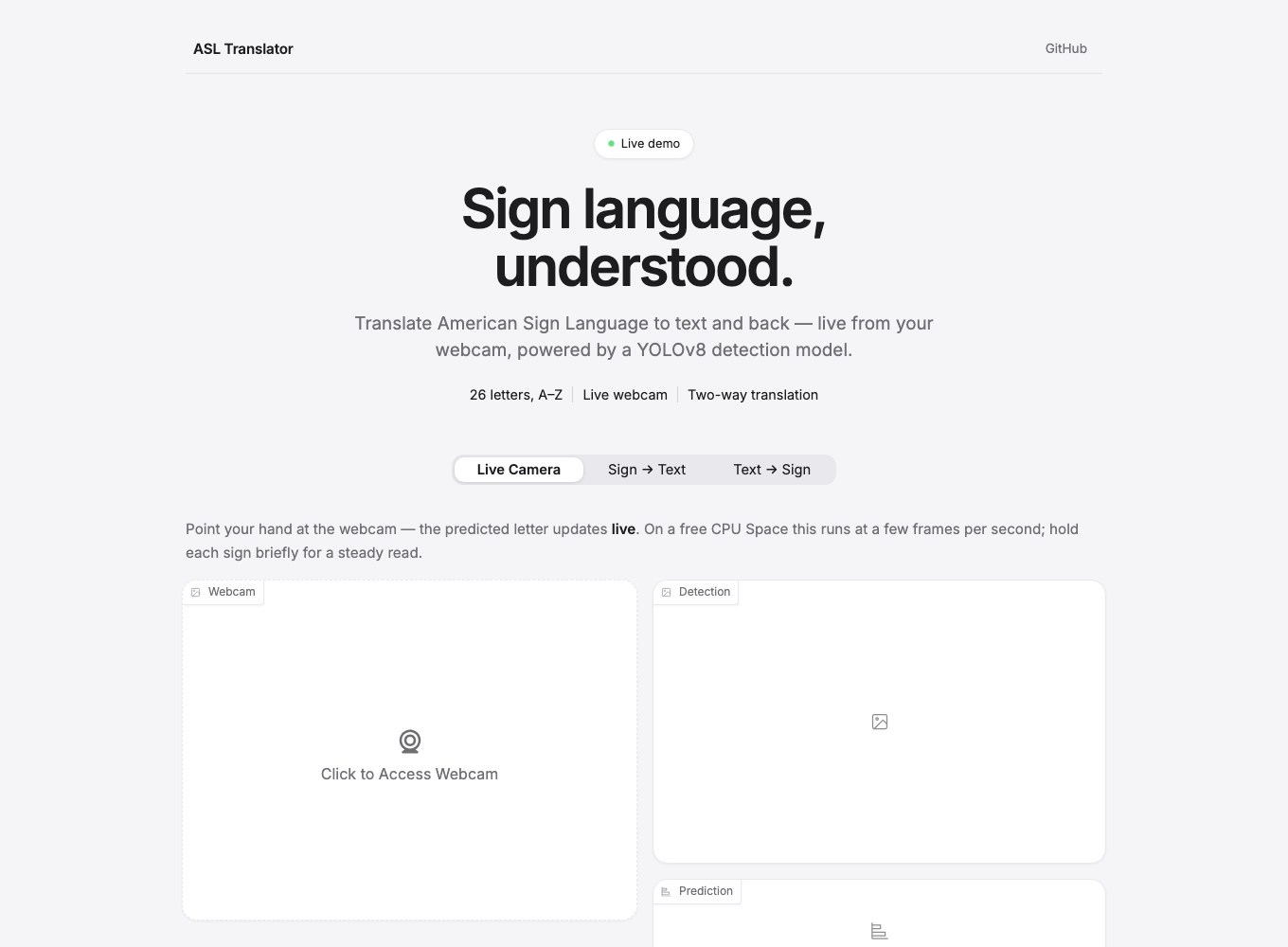
- 🔴 Live Camera — continuous webcam streaming; the predicted letter and its confidence update in real time as you sign.
- 📷 Sign → Text — capture a frame (or upload a photo), see the detection with a top-3 candidate picker for look-alike letters, and build a word or sentence.
- ⌨️ Text → Sign — type a word or a whole sentence and see it fingerspelled in ASL, one letter at a time, with spaces preserved between words.
| Metric | Score |
|---|---|
| Top-1 letter accuracy (held-out test set) | 87.5% |
| mAP50 / mAP50-95 | 0.951 / 0.800 |
These are measured on test images drawn from the same dataset as training, so they're an upper bound — live-webcam accuracy is lower (different lighting, background, and hand). See Improving accuracy to close that gap with your own samples. Weakest letters are the closed-hand look-alikes (I, M, N), which the top-3 candidate picker helps with.
webcam frame (raw RGB)
        │
        ▼
  YOLOv8n detector  ──  Ultralytics resizes to 416px + normalises internally
   (26 classes A–Z)
        │
        ▼
  bounding boxes → highest-confidence box → letter + confidence
The model is a plain object detector — there is no MediaPipe / hand-landmark step. A raw frame goes straight in; Ultralytics does the letterboxing and normalisation. The one rule that matters: inference runs at 416px (the size the model was trained at). At the library's default 640px, accuracy drops to ~68%.
- Model: Ultralytics YOLOv8n (PyTorch), trained on the Roboflow ASL Letters dataset
- App / UI: Gradio (native webcam streaming + Hugging Face Spaces support)
- Serving: Hugging Face Spaces (Gradio SDK)
| File | Role |
|---|---|
inference.py |
Model layer — SignDetector loads the model and predicts from a frame. No UI. |
app.py |
UI layer — the Gradio interface (Live / Sign→Text / Text→Sign). Imports SignDetector. |
model.pt |
Trained YOLOv8 weights the app serves. |
train.py / collect.py |
Train a better model / capture your own webcam samples. |
assets/letters/ |
ASL fingerspelling images (a–z) for Text → Sign. |
requirements.txt / packages.txt |
Python and system dependencies. |
deploy_hf_space.sh |
One-command lean deploy to a Hugging Face Space. |
model-data/, ASL-DB/ |
Old training runs and the dataset (not needed at runtime). |
python3 -m venv .venv
source .venv/bin/activate
pip install -r requirements.txt
python app.py
Then open the URL Gradio prints (default http://localhost:7860). The app loads
model.pt; override with the MODEL_PATH environment variable.
pip install -U "huggingface_hub[cli]"
hf auth login                       # token from https://huggingface.co/settings/tokens
# create the Space at https://huggingface.co/new-space  (SDK: Gradio)
./deploy_hf_space.sh <your-username>/<space-name>
deploy_hf_space.sh pushes only what the Space needs (app.py, inference.py,
model.pt, assets/, requirements) — not the dataset or old training runs — so
builds stay fast. The Space's README front-matter configures it automatically.
The most effective way to improve live-webcam accuracy is to add examples from your own camera and lighting:
# 1) Record ~30 samples per letter from your webcam (needs a camera + display).
python collect.py

# 2) Train on the bundled data plus your captures, and promote the result.
python train.py --base model.pt --extra my-data --epochs 60 --promote
train.py reports test-set metrics for the new vs current model so you can compare
before promoting.
Want more public data? Drop additional Roboflow ASL letter datasets (YOLOv8 export) into folders and merge them with repeated
--extra <dir>flags.
Faiz Daroga — github.com/FaizD18/ASL-Translator