RandONets - MATLAB Code (J. Comp. Phys). RandONets (Random projection-based Operator Networks) is a MATLAB implementation designed for learning efficiently linear and nonlinear operators using randomized neural networks.
If you use or modify for research purposes this software, please cite our paper as below:
📘Fabiani, G., Kevrekidis, I. G., Siettos, C., Yannacopoulos, A. N., RandONets: Shallow Networks with Random Projections for learning linear and nonlinear operators. J Comp Phys 520, 113433, (2025) open access paper at: https://doi.org/10.1016/j.jcp.2024.113433
Last revised by G. Fabiani, October 8, 2024
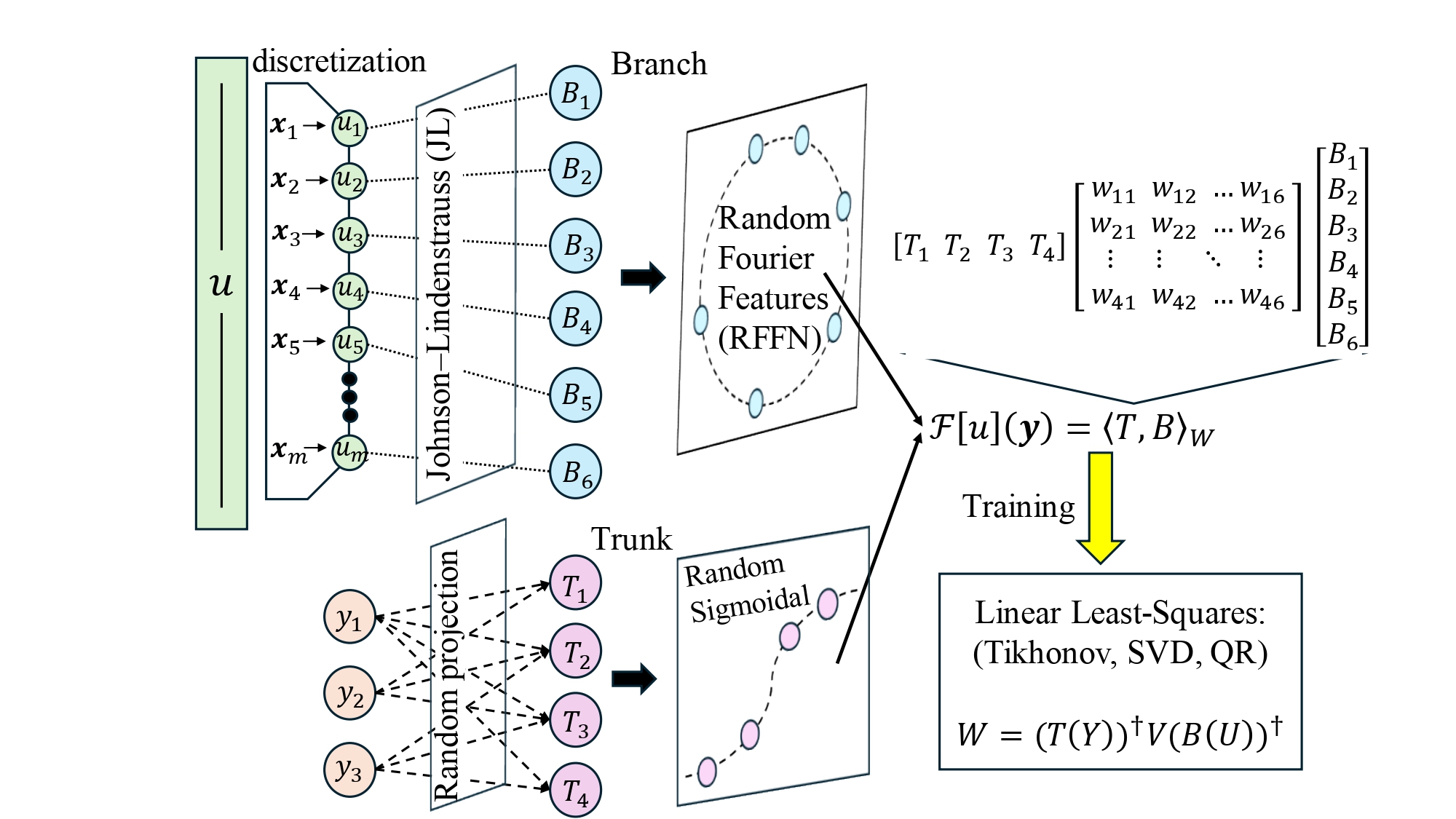
We present a machine learning method based on random projections with Johnson-Lindenstrauss (JL) and/or Rahimi and Recht (2007) Random Fourier Features (RFFN) for efficiently learning linear and nonlinear operators.
⭐🔍 IMPORTANTLY: We rigorously and theoretically prove the universal approximation of nonlinear operators with RandONets, extending the proof of Chen and Chen (1995) ✏️🔥
The efficiency of the scheme is compared against DeepXDE/DeepOnet python library that implements, among others, deep-learning operator networks.
Keywords: RandONets - Machine Learning - Random Projections - Shallow Neural Networks - Approximation of Linear and Nonlinear Operators - Differential Equations - Evolution Operators - DeepONet - Numerical Analysis
DISCLAIMER: This software is provided "as is" without any express or implied warranties. This includes, but is not limited to, warranties of merchantability, fitness for a particular purpose, and non-infringement. The authors and copyright holders are not liable for any claims, damages, or other liabilities arising from the use of this software
Copyright (c) 2024 Gianluca Fabiani
Shield:

Licensed under the Creative Commons Attribution-NonCommercial-ShareAlike 4.0 International License.
You may not use this material for commercial purposes.
If you remix, transform, or build upon this material, you must distribute your contributions under the same license as the original.

Deep neural networks have been extensively used for the solution of both the forward and the inverse problem for dynamical systems. However, their implementation necessitates optimizing a high-dimensional space of parameters and hyperparameters. This fact, along with the requirement of substantial computational resources, pose a barrier to achieving high numerical accuracy, but also interpretability. Here, to address the above challenges, we present Random Projection-based Operator Networks (RandONets): shallow networks with random projections and tailor-made numerical analysis methods that learn accurately and fast linear and nonlinear operators. Building on previous works, we prove that RandOnets are universal approximators of linear and nonlinear operators. Due to their simplicity, RandONets provide a one-step transformation of the input space, facilitating interpretability. For the evaluation of their performance, we focus on operators of PDEs. We show, that RandONets outperform by several orders of magnitude, both in terms of numerical approximation accuracy and computational cost, the “vanilla” DeepONets. Hence, we believe that our method will trigger further developments in the field of scientific machine learning, for the development of new "light" schemes that will provide high accuracy while reducing dramatically the computational cost.
The main function (i.e. the training) is train_RandONet.m
Here, we provide 5 examples/demos in the file main_RandDeepOnet_examples.m:
- The antiderivative problem (load('data_antiderivative.mat')) [as proposed in deepxde python library]
- The pendulum with external force (load('data_Pendulum.mat')) [as proposed in deepxde python library]
- Linear PDE Diffusion-Reaction (load('data_DiffReac.mat'))
- Nonlinear PDE Viscous Burgers' equation (load('data_burgers.mat'))
- Nonlinear PDE Allen-Cahn equation (load('data_AllenCahn.mat'))
In this study, we focus on the challenging task of learning linear and nonlinear functional operators
These operators play a pivotal role in various scientific and engineering applications, particularly in the context of (partial) differential equations. By effectively learning (discovering from data) such nonlinear operators, we seek to enhance our understanding and predictive capabilities in diverse fields, ranging from fluid dynamics and materials science to financial and biological systems and beyond.
Although our objective is to learn functional operators from data, which take functions (
Regarding the availability of data for the output function, we encounter two scenarios. In the first scenario, the functions in the output are known at the same fixed grid
We provide an user-friendly and MATLAB-friendly software for learning Linear and Nonlinear Operators using RandONets. The Random projection-based algorithm is a fast and efficient machine learning algorithm for function approximation.
train_RandONet.m trains a Random Projection-based Operator Network (RandONet) model.
Syntax: net = train_RandONet(ff, yy, Nt, Nb, kmodel)
Inputs:
- ff: Input matrix (functions) for the branch network.
- yy: Input vector (spatial locations) for the trunk network.
- G: Input matrix (transformed functions G(ff) ).
- Nt: Number of neurons in the trunk network (default: 200).
- Nb: Number of neurons in the branch network (default: 1000).
- kmodel: Model type (1 for JL, 2 for RFFN; default: 2).
Output:
- net: Trained RandONet model, which contains fields for the trunk and branch networks, including weights and biases.
Structure of the net:
- tr_fT: Trunk network activation function (nonlinear transformation).
- tr_fB: Branch network activation function (nonlinear transformation).
- alphat, betat: Parameters for input transformation in the trunk network.
- alphab, betab: Parameters for input transformation in the branch network.
- C: Weight matrix for the inner product.
Description:
The function initializes network parameters and trains using COD-based pseudo-inverse of the trunk and branch layers, with the results stored in the output net.
eval_RandONet evaluates a Random projection-based Operator Network (RandONet) model by computing the weighted inner product between the trunk and branch networks.
Syntax: G = eval_RandONet(net, ff, yy)
Inputs:
- net : Structure containing the parameters of the RandONet model.
Fields include: - tr_fT : Trunk network activation function (nonlinear transformation). - tr_fB : Branch network activation function (nonlinear transformation). - alphat, betat : Parameters for input transformation in the trunk network. - alphab, betab : Parameters for input transformation in the branch network. - C : Weight matrix for the inner product. - ff : Input function for the branch network. - yy : Input spatial locations for the trunk network.
Output:
- G : Output of the RandONet model, computed as the weighted inner product of the trunk and branch networks, i.e., <T, B>_C.
The function transforms the inputs using the trunk and branch networks, and computes the result by applying the weight matrix C to the inner product of these transformations.