Jiawei Guo1,
Junxian Li1,
Yixin Tang1,
Bingya Zhang2,
Jiaxin Lu2,
Yulun Zhang1,†,
Shangchen Zhou3,†
1 Shanghai Jiao Tong University
2 Honor Device Co., Ltd
3 Imperial College London
† Corresponding authors


TurboClear removes target objects and their associated visual effects with a single denoising step while preserving unaffected background regions.
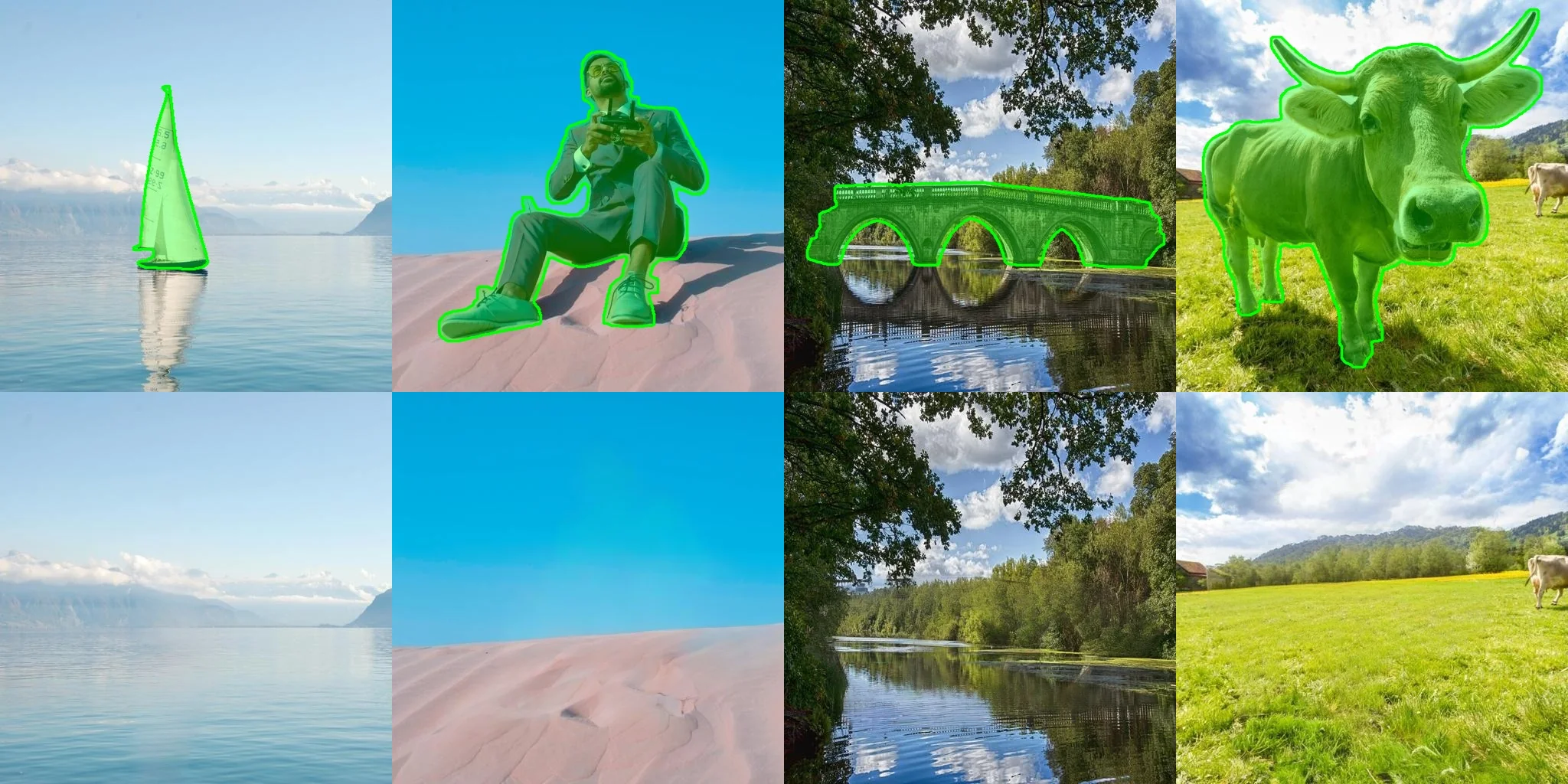
- One-step removal. TurboClear performs object-effect removal with one SDXL UNet evaluation.
- Region-Calibrated Distribution Matching. RDM calibrates the distillation signal across affected and preserved regions.
- Learnable Spatial Fusion. LSF combines removal-oriented generation with an identity-preserving reference stream.
- Efficient inference. TurboClear substantially reduces denoising computation while maintaining competitive visual quality.
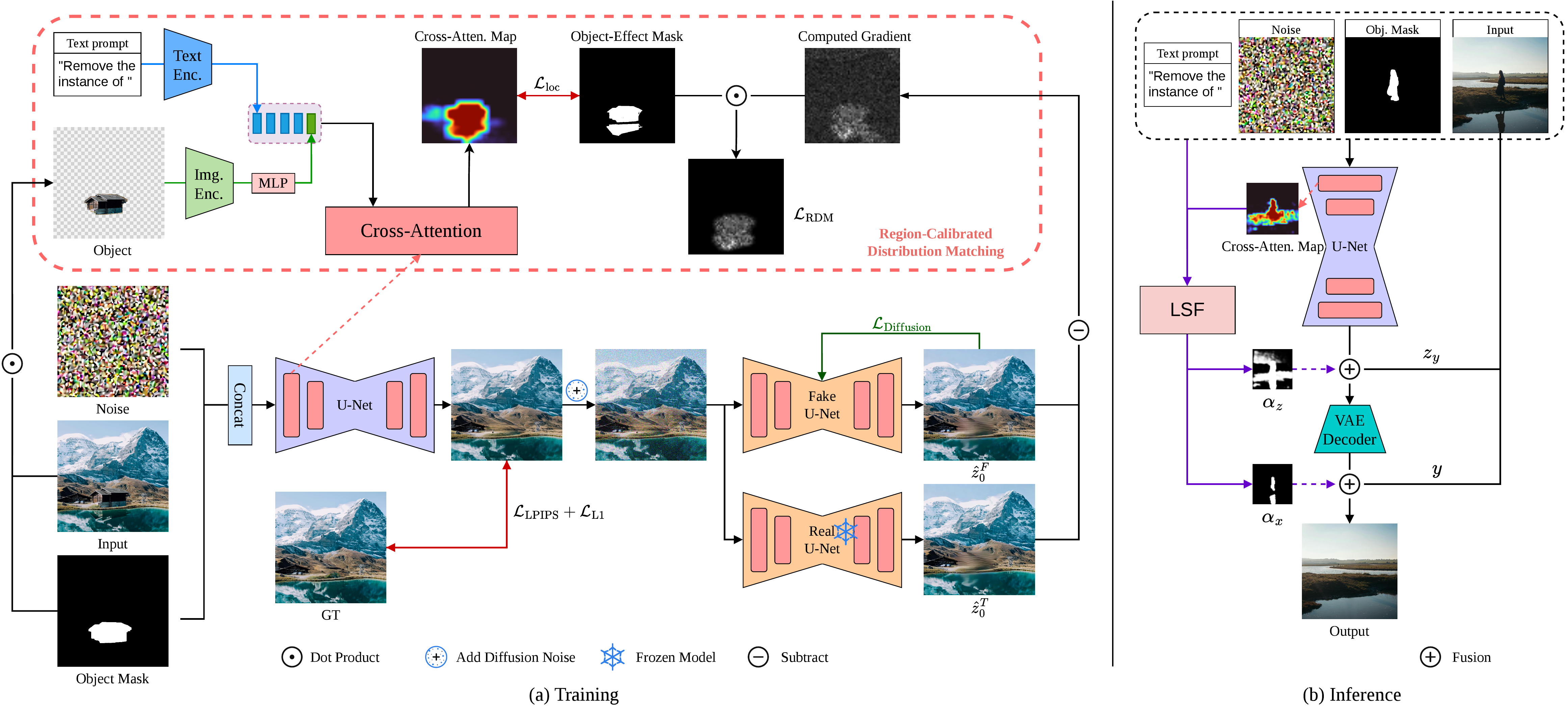
TurboClear addresses the spatial asymmetry of object-effect removal: regions influenced by the target object should be regenerated, while the remaining image should stay unchanged. RDM provides region-aware supervision during one-step distillation, and LSF learns spatial gates for lightweight fusion at inference time.
| Resource | Status |
|---|---|
| Paper | arXiv:2608.01288 |
| Model weights | TBD |
| Code | TBD |
| Usage guide | TBD |
@article{guo2026turboclear,
  title={TurboClear: One-Step Object-Effect Removal via Region-Calibrated Distribution Matching and Fusion},
  author={Guo, Jiawei and Li, Junxian and Tang, Yixin and Zhang, Bingya and Lu, Jiaxin and Zhang, Yulun and Zhou, Shangchen},
  journal={arXiv preprint arXiv:2608.01288},
  year={2026}
}TBD