
33 merged pull requests since 0.11.10. No function was removed and the layout of every public struct is unchanged, so
existing code and existing binaries keep working. A few functions now reject input they used to accept; see
Behaviour changes. If you decode histogram logs that you do not
control, upgrade: the heap overflow in #146 is reachable from
hdr_log_decode.
Performance improvements
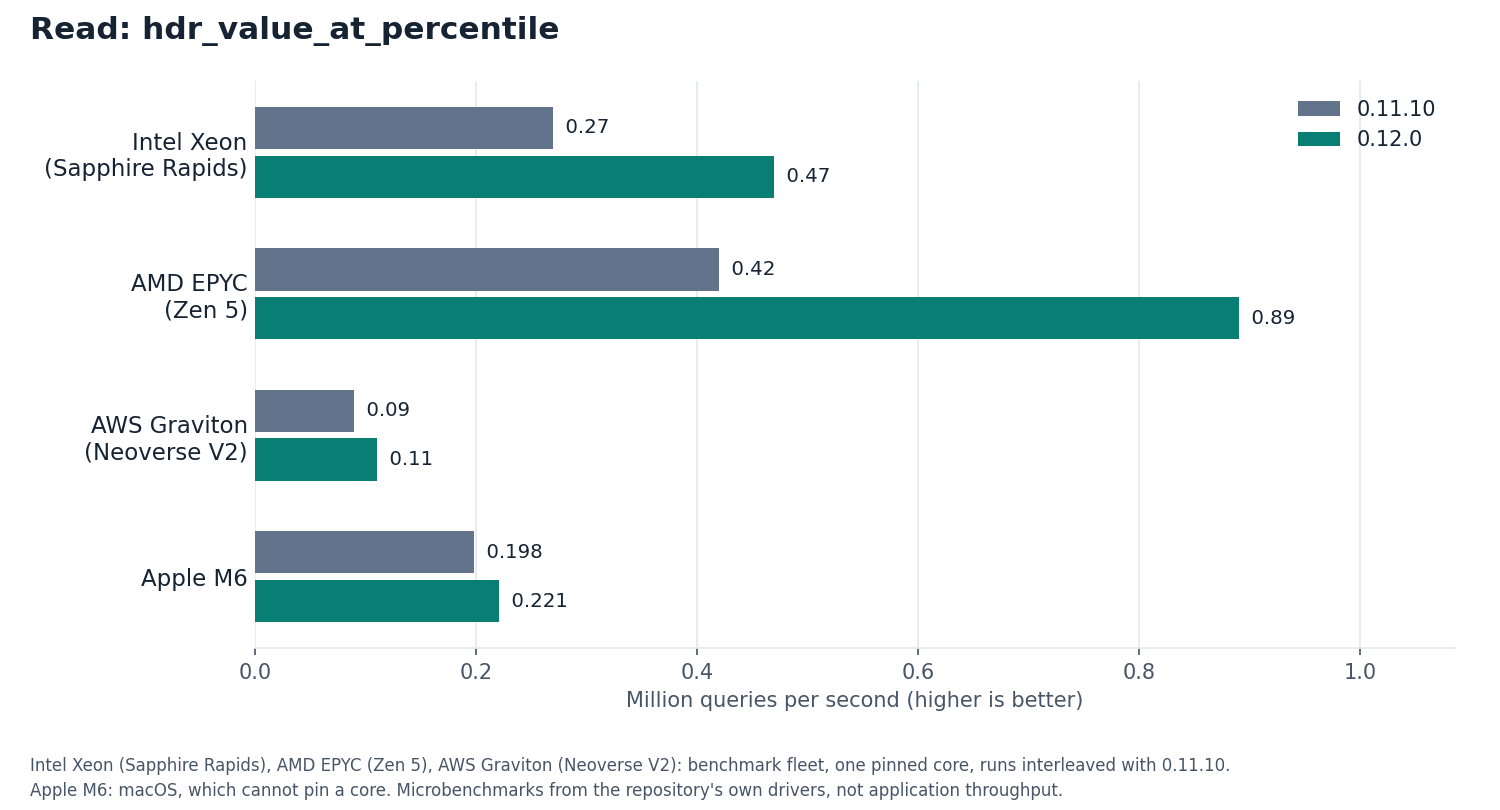
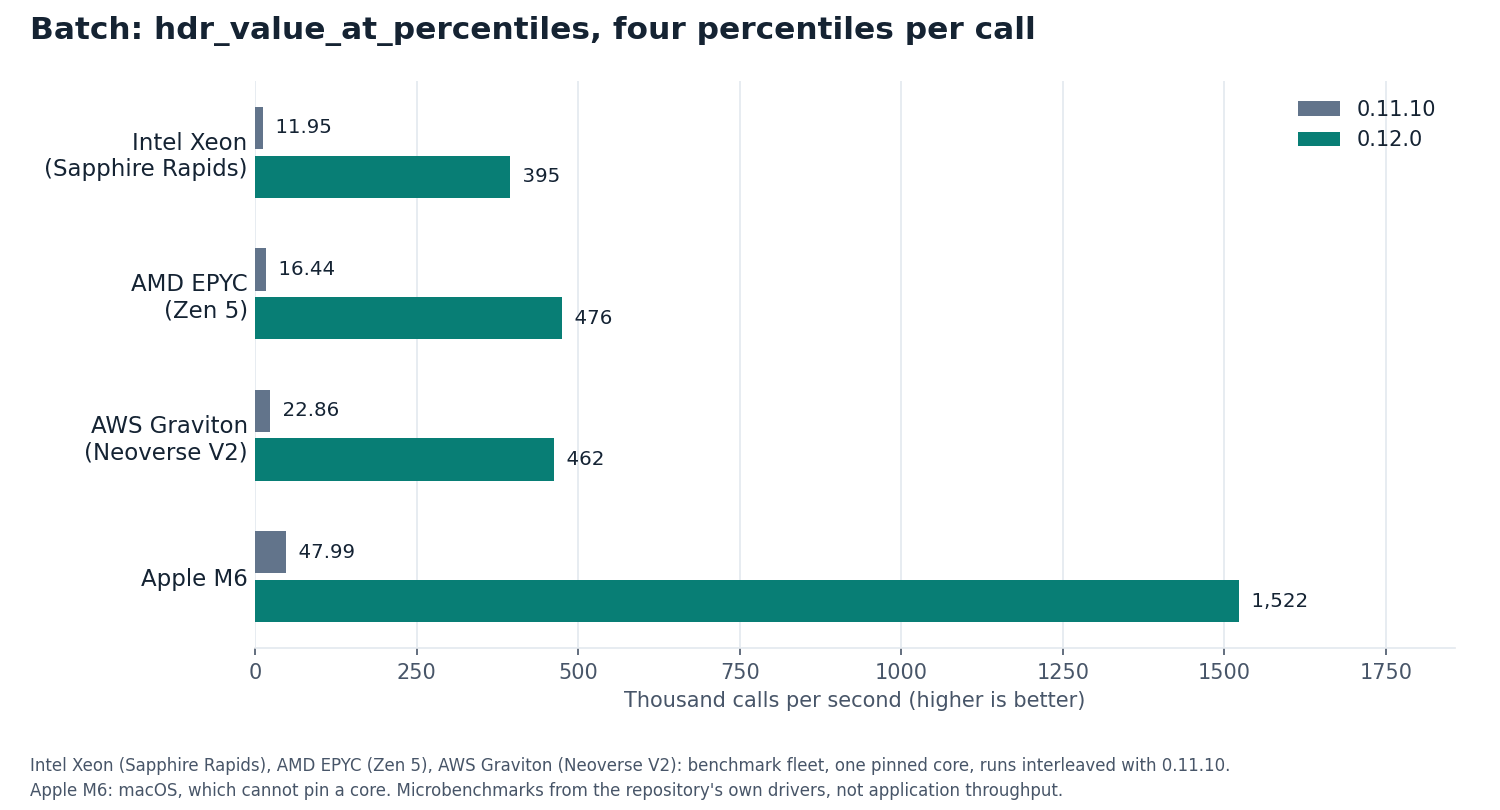
Percentile queries are much faster, most of all hdr_value_at_percentiles (the batch call). Recording is unchanged.
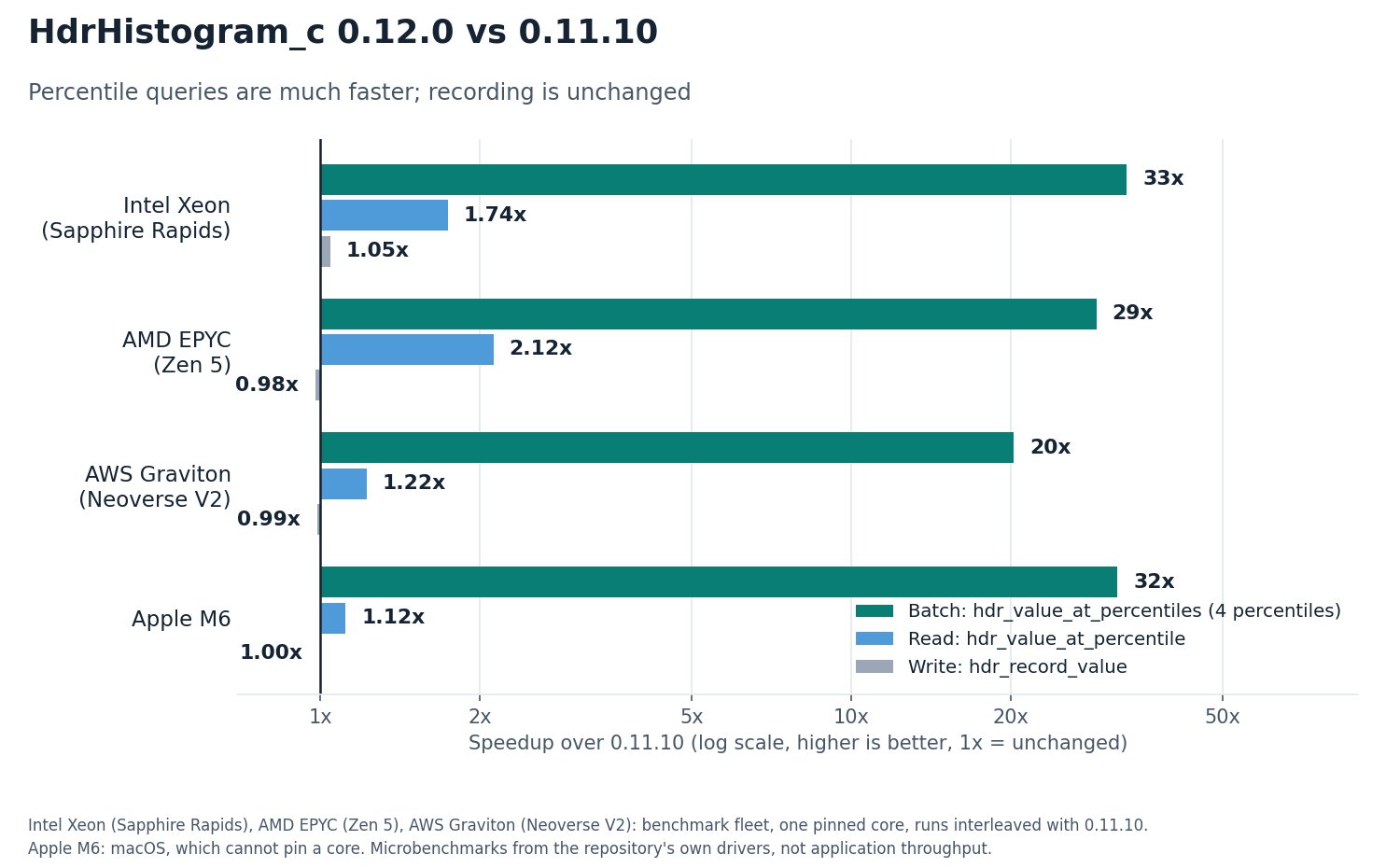
| 0.12.0 vs 0.11.10, higher is better | hdr_value_at_percentile (read) |
hdr_value_at_percentiles, 4 percentiles (batch) |
hdr_record_value (write) |
|---|---|---|---|
| Intel Xeon (Sapphire Rapids) | 1.74x | 33x | 1.05x (inside run-to-run spread) |
| AMD EPYC (Zen 5) | 2.12x | 29x | 0.98x |
| AWS Graviton (Neoverse V2) | 1.22x | 20x | 0.99x |
| Apple M6 | 1.12x | 32x | 1.00x |
Measured with the repository's own benchmark drivers, interleaved with the old release on the same machine (pinned to one
core on the three Linux machines; macOS cannot pin). These are microbenchmarks (a predictable write sequence, a fixed
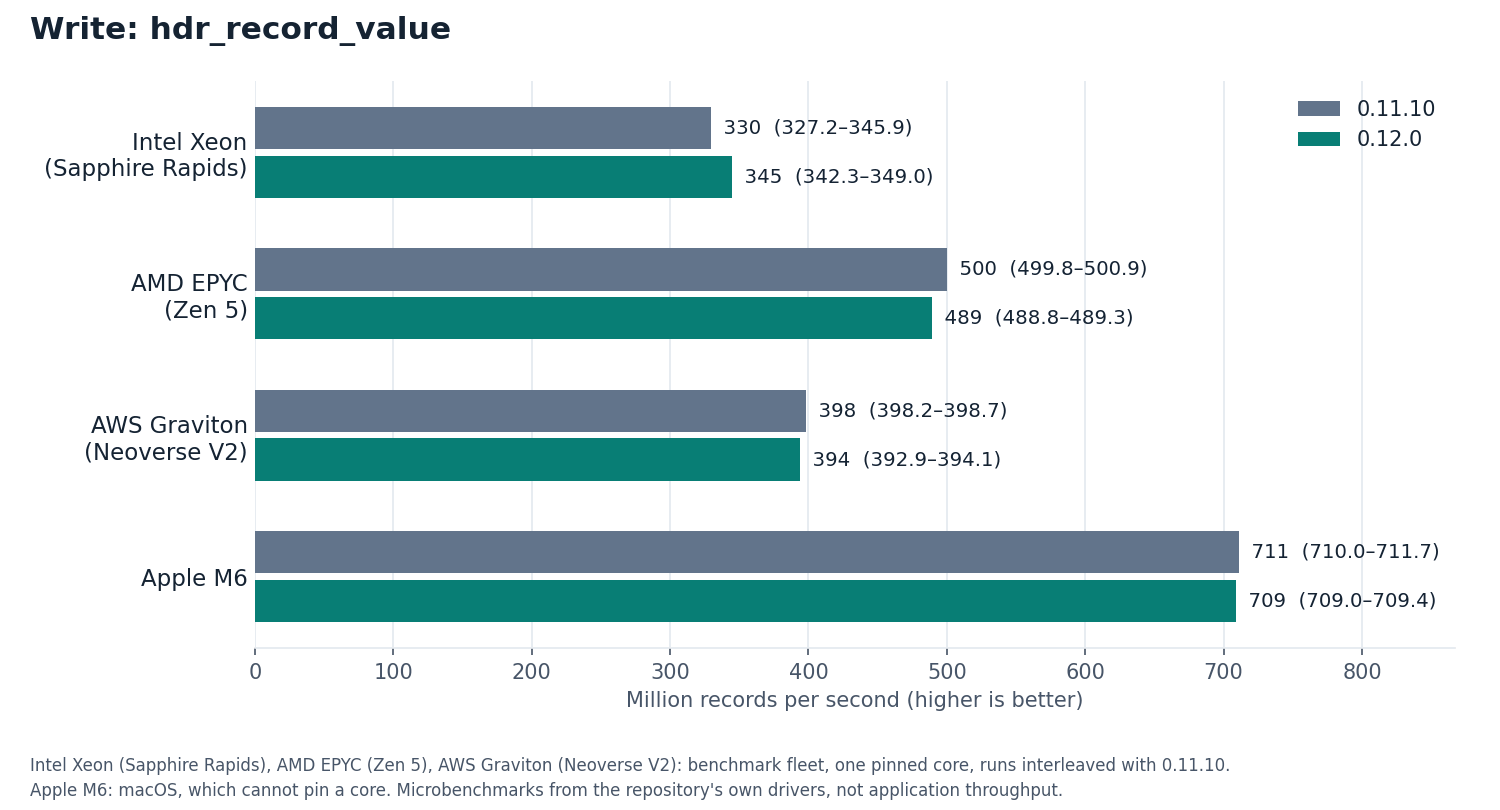
four-percentile array), not application throughput. The write path is intentionally unchanged: the AMD result is a stable
~2% codegen difference, not a regression you should expect to see in an application.
Measured at d21d084 (write) and bcb5c1f (read and batch) on Intel, AMD and Graviton, and at 102aefb on Apple M6.
The code those paths run has not changed since, apart from the AArch64 Clang directive described below.
Absolute numbers per machine
- Percentile scan: summed in blocks with a scalar fallback (#137),
a wider 16-element AVX2 accumulator (#138), and a scan that
assumes counts are non-negative (#158); the record path keeps
the negative-count check out of the single-value hot path. The AVX2 scan also prefetches ahead
(#139). hdr_value_at_percentilesnow answers all percentiles in a single pass
(#140) and skips whole blocks that cannot reach the next
target (#141). In 0.11.10 the batch call was no faster than
asking for the same percentiles one at a time, and on the Intel and AMD machines it was several times slower.- Linux AArch64 with Clang at
-O3: the compiler turned the scan into a serial chain of dependent additions. A loop
directive restores the independent block sum (#167); the
full read driver ran 2.12x faster with it than without. It is limited to non-Apple AArch64 Clang: on Apple silicon the
same change helped long scans (2.6x) but made very short scans about 19% slower, so it is left out there. Other
compilers and architectures generate identical code. How this compares with 0.11.10 on that one configuration has not
been measured.
Security improvements
Found by the new fuzzing, by code review, and (for #118) by an issue report. No CVE has been assigned to any of them.
- Heap buffer overflow when decoding a crafted V1/V2 log (a bad payload length or word size could write past the counts
array): rejected withHDR_ENCODED_INPUT_TOO_LONG(#146). - Out-of-bounds read in
hdr_count_at_valuefor a value far above the highest trackable value, past the end of the
counts array (it now returns 0), and a signed overflow inhdr_mean, which fedhdr_stddev(#147). - Negative bucket counts in V0/V1 logs were accepted and poisoned every later query; they are now rejected with the new
errorHDR_NEGATIVE_COUNT_INVALID(#162). - Count total overflowing
int64on import (an imported histogram with counts like three times 2^62) was signed-overflow
undefined behaviour; decode now fails withEOVERFLOW, andhdr_reset_internal_counterssaturates
(#159, fixes #118). - Undefined behaviour (signed overflow, oversized shifts, out-of-range float conversions) reachable from untrusted input,
fixed in the bucket configuration (#145), the top-bucket value
range used byhdr_max, percentiles and the iterators (#148),
the linear and logarithmic iterator levels nearINT64_MAX(#149),
and log timestamp parsing (#153,
#154). - Fuzzing: the number of ClusterFuzzLite targets went from 1 to 5 (decode, record, log reader, count overflow, packed
histogram) and there is now a deep weekly run. Unit tests went from 65 to 125 cases, and the suite also runs under
ASan/UBSan, including on macOS Intel and Apple silicon.
Bug fixes
hdr_reset_internal_countersignorednormalizing_index_offset, giving a wrong min and max for decoded logs whose
counts were shifted (#155).hdr_timespec_from_doublecould produce an invalidtv_nsec(exactly 1e9, or negative)
(#156).- The log timestamp seconds field was bounded by
longinstead of bytv_sec, wrongly rejecting timestamps after 2038 on
32-bit Linux (#157). - On 32-bit Windows
hdr_atomic_load_64andhdr_atomic_store_64were not atomic, which could tearmin,maxand
the phaser epoch under concurrent recording (#168). - Fix the ClangCL build on Windows (#142, thanks @StefanStojanovic,
found while updating Node.js) and stop trying AVX2 on i386
(#143, thanks @K900); both are now covered by CI
(#144).
New APIs
All additions; nothing existing changed signature. 27 new public functions.
hdr_packed_histogram(#150), in
<hdr/hdr_packed_histogram.h>: a separate histogram whose storage grows with the number of populated buckets instead
of the full counts array. For many sparsely populated histograms it is far smaller (1,000 histograms with 10 populated
buckets each, range 1 to 3.6 billion at 3 significant digits: 188 MB dense, 144 KB packed). The cost is that recording is O(log n) plus an insert for a new bucket, it has
no atomic record function, and it serialises to the standard V2 compressed format. The dense histogram is untouched.
Functions:hdr_packed_init,_init_shared,_close,_reset,_config_create,_config_destroy,
_config_memory_size,_record_value,_record_values,_total_count,_min,_max,_mean,_stddev,
_count_at_value,_value_at_percentile,_value_at_percentiles,_get_memory_size,_populated,_count_width,
_encode_compressed,_decode_compressed.hdr_record_value_cappedandhdr_record_value_capped_atomic: likehdr_record_valuebut values above the highest
trackable value are clamped to it instead of rejected, and negatives are clamped to 0
(#166).hdr_total_count: NULL-safe getter that uses an atomic load, so it can be polled while other threads record
(#166).hdr_iter_linear_set_value_units_per_bucket: change a linear iterator's bucket width mid-iteration, for example to use
coarser buckets in the tail (#165).hdr_timespec_from_double_checked: reports-EINVALor-ERANGEinstead of silently producing a zero time
(#161).HDR_NEGATIVE_COUNT_INVALIDerror code (#162).
Build and packaging
- Amalgamation:
script/amalgamate.pygenerates a self-contained copy of the core (hdr_histogram.cplus
hdr_histogram.h), and optionally the log codec (--with-log), for projects that vendor the library; the output is
attached to each release ashdr_histogram-amalgamation-<version>.zipand...-with-log-<version>.zip, with checksums
(#164, #169).
It can bake in your allocator header (--malloc-include) and supports trees that keep headers inhdr/
(--include-prefix). Seedocs/AMALGAMATION.md, which also covers moving an existing vendored copy over. - Minimal static core:
-DHDR_HISTOGRAM_CORE_ONLY=ONbuilds only the record and percentile engine as
hdr_histogram_core_static, with no zlib or thread dependency;-DHDR_HISTOGRAM_DISABLE_AVX2=ONalways uses the scalar
scan (#163). Seedocs/EMBEDDING.md. - CI now also covers 32-bit x86, ClangCL, macOS Intel and Apple silicon with sanitizers, and native Linux AArch64 with
Clang (#144, #160,
#167); CMake is fetched from the Kitware releases
(#152); automated PR review and issue triage were added
(#151).
Behaviour changes to know about when upgrading
These are the visible differences for code that used to get away with something. All are in the direction of rejecting
invalid input.
| Call | 0.11.10 | 0.12.0 |
|---|---|---|
hdr_record_values(h, v, -1) |
returned true and subtracted from the total | returns false, histogram unchanged |
| decoding a log with a negative bucket count (V0/V1) | succeeded | fails with HDR_NEGATIVE_COUNT_INVALID, no histogram |
decoding a log whose counts add up past INT64_MAX |
undefined behaviour | fails with EOVERFLOW |
hdr_count_at_value(h, v) with v far above the highest trackable value (past the end of the counts array) |
read out of bounds | returns 0 |
hdr_timespec_from_double(&t, NaN) |
undefined behaviour (we saw tv_sec = INT_MIN) |
t is set to zero |
hdr_timespec_from_double(&t, 0.9996) |
tv_nsec = 1000000000 |
tv_sec = 1, tv_nsec = 0 |
hdr_log_read_header with a non-finite or out-of-range StartTime |
converted without a range check | -EINVAL or -ERANGE |
counts[] must now hold non-negative values: the percentile scans rely on it. Code that writes counts[] directly
should not store negatives.
Shared library version
The shared library is now libhdr_histogram.so.6.4.4 (it was 6.3.3). The SONAME stays libhdr_histogram.so.6, so
binaries linked against 0.11.x keep loading. Every symbol exported by 0.11.10 is still exported (93 then, 121 now) and the
size and field offsets of every public struct are identical. REVISION and AGE were raised and CURRENT was kept, as
for earlier releases that only added interfaces.
Contributors
@StefanStojanovic and @K900 contributed the two Windows and i386 fixes. @paulorsousa reviewed the changes in this
release. Full changelog: 0.11.10...0.12.0


