Concept‐ Beamed Power
Beamed power begins with the obvious: The ability of a station or base to fire a collimated and immensely powerful photon or electron beam at a target vessel and that target vessel to efficiently receive and convert that beam to electricity, escaping the need to carry the great weight of its own (typically nuclear) energy source for long-term or heavy-duty operations. A sufficiently advanced civilization could detour (or could have detoured) from the path of nuclear fusion and tread the path of beamed power networking. A fully formed beamed power infrastructure would consist of many energy collector satellites focusing power from the star and beaming it to reflector satellite constellations at the homeworld and at other planets. Alternately, the reflector constellation at a planet may receive its beamed power from a beam source (still fusion powered or otherwise) on that planet.
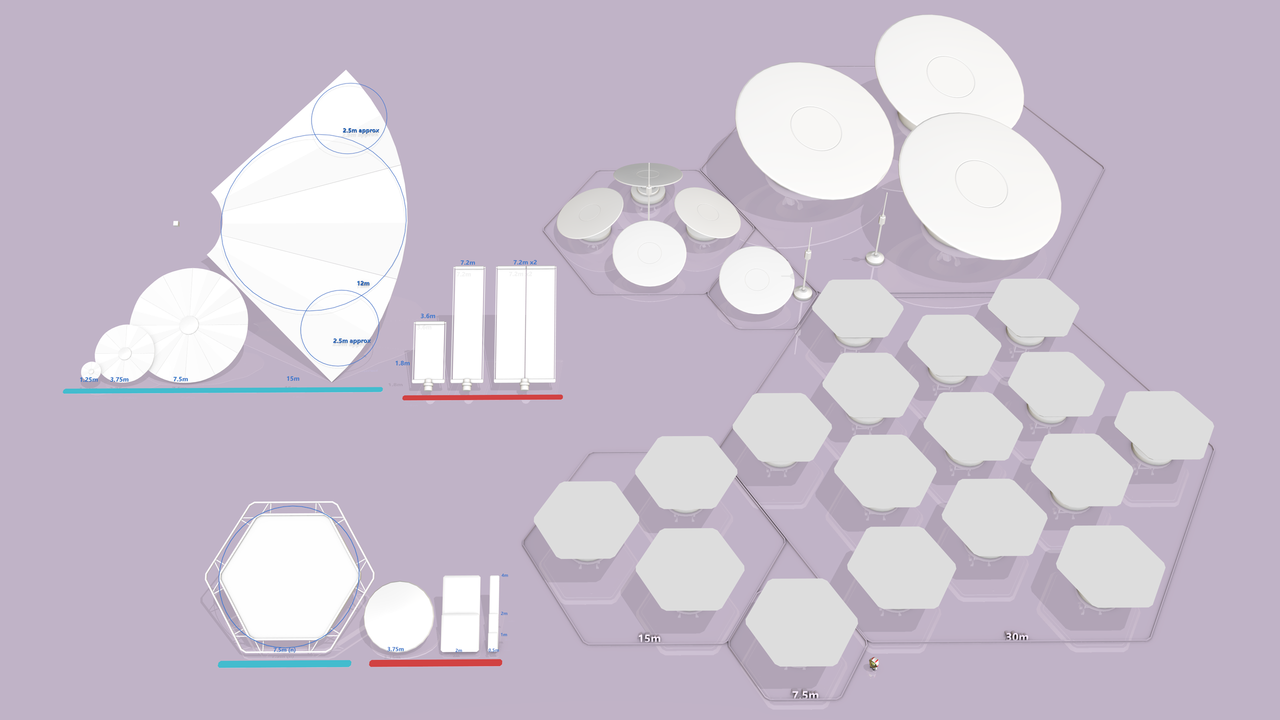
A wide selection of parts has already been drafted. Most of these are primarily receivers and may be upgrade-able through Infrared and the visible range of the electromagnetic spectrum. The transmitters here (not clearly distinguished as yet) populate the Microwave and Infrared phased array set and may be upgrade-able from the former to the latter. The transmitters here have short and medium range (with respect to this mod's package as a whole and not necessarily compared to stock and stockalike parts). Outside of beamed power, these parts should do well to fill the gameplay hole that's only marginally filled by the JX2 mod and the one giant antenna from DMagic Orbital Science.
The ones with hexagon bounds around them are meant for use in surface bases and the Sterling World Power system. The lower set of parts (the hexagon panels and the circular and rectangular boards are pretty much the dedicated high power transmitters.
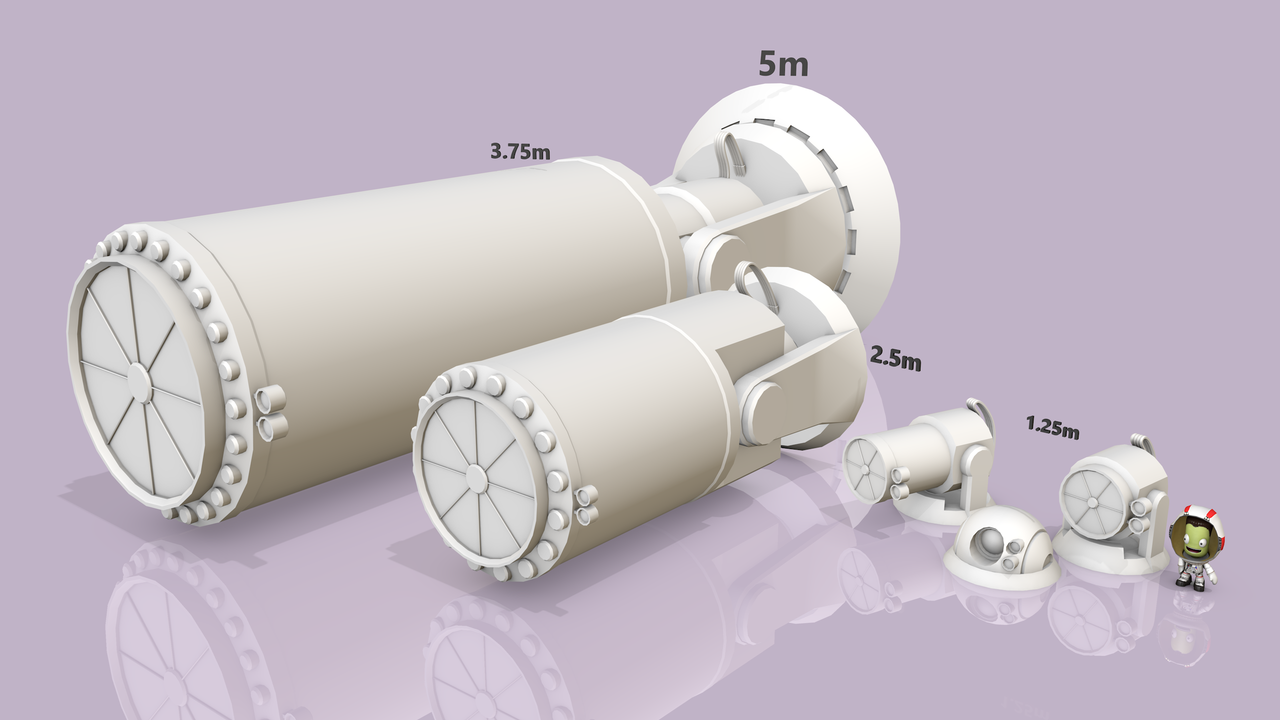
Included is a set of visible spectrum (laser) beam turrets for later progression, boasting long range transmission and sitting square in the niche between all stockalike antennas and pure interstellar grade antennas. World Power grid compatible versions are planned but not yet drafted.
A feature may be introduced where a beam source (the laser pump) will need to exist within the part itself if it has the volume or exist in a separate part (namely to provide for the ball turret). A laser pump is known to operate at hundreds of Kelvins depending on what it's built with and for, requiring some form of active cooling. The emitter may consume a LaserPower resource for transmitting while the laser pump will consume ElectricCharge and produce LaserPower and waste heat.
Also included is a suite of small and very large (very long) Extreme Ultraviolet or X-ray Free Electron Laser guns for a hopefully effective answer to interstellar ranges, or at minimum, a huge boost to in-system data transfer rates. For a communication device the large ones alone may require city scale power supplies (or thermal management). The small ones can be turreted while the large ones would need their host vessel to be aimed.
Rather than another set of photovoltaic panels (for which Near Future Solar is known) the solar panels here are all concentrating solar mirror panels. Most of which will be surface attached. The smallest of these will be akin to the quad-dish Restock+ HG-20 antenna while the largest of these can possess twin 30m diameter Solar Moth style parabolic mirrors or single 60m conventional mirrors. The underlying logic is that while photovoltaic panels only last around 25 years and consist of complex circuitry that may degrade faster under space radiation, a simple mirror panel consists of only the mirror material and has technically unhindered durability and its ability to concentrate incident energy makes it OP at the homeworld distance and remain very useful at outer system distances. Energy production at homeworld distance would range between potentially 0.026 and 141.4 MWth or ThP per panel.
Beamed Propulsion is an option for escape into interstellar space but goes quite unnoticed as a method for fast interplanetary travel. I'm not interested at all in solar sails. Those are too low-thrust. I'm interested in magnetic sails, particularly M2P2 (Mini-MagnetosPheric Plasma sail) and MagBeam which is when a magnetic sail craft is pushed by a plasma or particle beam instead of by solar wind. This system allows a traveling craft to not only escape from carrying a heavy power supply but also escape from having to carry most of its propellant. The reference situation given is that a 10 ton payload can be accelerated by 11 km/s by an HPP (High Power Platform) in Earth orbit and transfer to Mars in only 50 days, and Mars would ideally also have an HPP which would capture the payload. From extrapolation, the payload is also assumed to experience 0.6 TWR for 4 hours while receiving its dV on ejection or on capture.
The parts list is thus:
- Wrapper or top node attached magnetic coils which might expand to some generous radius but do deploy an invisible bubble of immense size (the magnetosphere) beyond that of the visible coil. This is treated as receiver area. Without the beamed power module this part may function as a constant low thrust engine (a passive thrust source) whose thrust vector will always point at the star, being aimed by a solar panel module, and whose thrust is dependent on whether its virtual propellant can be replenished through the solar panel module faster than it's being consumed by the engine module. The coil itself will have some use as a reentry rated aerobrake and heat shield.
- The plasma beam source which is an RF plasma generator with magnetic nozzle. The beam source will come in a few sizes, likely multiples of 2.5m and would typically top node attach onto a dedicated vessel which must hold a compatible gas resource and an energy source. This energy source may be internal but could also be external and exist within a linked Dyson swarm.