
| Approach | Setup cost | Flexibility | Privacy |
|---|---|---|---|
| Shared local admin password | Low initial effort, high audit risk | Limited once devices spread | Exposed across endpoints |
| Manual rotation spreadsheet | Admin hours for every change | Works only for small fleets | Depends on operator discipline |
| LAPS password management | Windows policy plus directory storage | Scales across managed PCs | Access controlled by delegation |
Download laps windows to manage local administrator credentials with reliable automation, simplified rotation, and clear policy control at scale. Strengthen LAPS security across Windows environments with a practical Microsoft solution for teams that need safer endpoint access.
LAPS helps teams secure Windows endpoints by rotating local administrator credentials and improving access control across managed devices.
Microsoft laps is designed for administrators who need safer control of built-in local administrator accounts. Instead of leaving one reusable secret on every workstation, LAPS software assigns unique passwords, rotates them on schedule, and stores recovery details where authorized help desk or security teams can retrieve them.
For teams asking what is laps, the practical answer is endpoint credential hygiene. The LAPS tool reduces lateral movement risk by making each laps password different, auditable, and easier to expire after support work. In environments that use laps active directory, policies define password length, age, backup location, and which operators can read sensitive values.
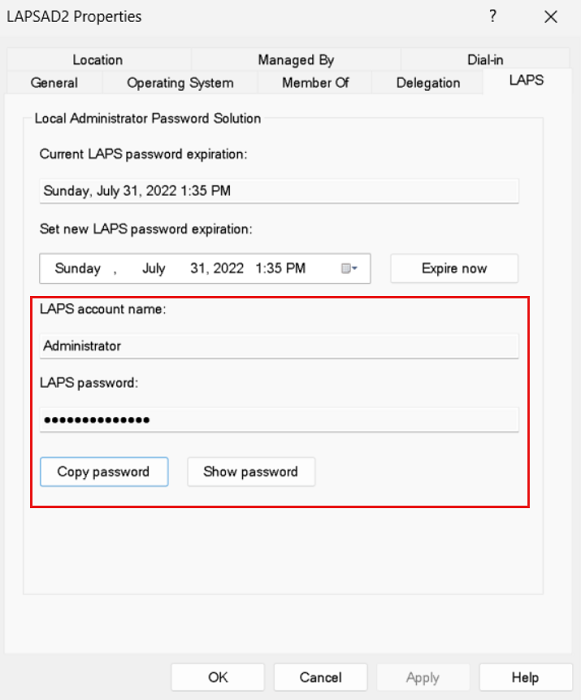
| Host type | Typical use |
|---|---|
| Domain joined workstations | Unique local administrator password rotation through policy |
| Help desk workflows | Temporary recovery of LAPS administrator password values |
| Security operations | Reduced reuse of privileged credentials during incident response |
| Deployment projects | Standardized LAPS deployment across new Windows builds |
Laps windows environments benefit most when administrators combine policy design with clear access delegation. Windows laps helps separate password storage from everyday user access, so support staff can recover a device without learning a shared organization-wide secret. That pattern strengthens LAPS security while preserving fast recovery for locked out or disconnected machines.
The LAPS documentation should be reviewed before rollout because permissions, schema readiness, and backup targets matter. A careful LAPS deployment confirms who can read each LAPS local admin password, how long credentials remain valid, and how password history is handled during audits or endpoint replacement.
Incident responders use microsoft laps when they need local access without reusing credentials from another endpoint. If a device is suspected of compromise, rotating the laps password limits follow-on abuse and gives analysts a cleaner administrative boundary.
Security teams also use LAPS password management to support least privilege programs. By keeping local admin credentials unique, laps security reduces the chance that one exposed workstation becomes a path into an entire fleet. The LAPS tool works best alongside endpoint detection, patch management, and routine access reviews.
Help desk technicians often need a reliable way to unlock or repair devices that cannot reach standard remote management tools. LAPS administrator password retrieval gives them a controlled support path while still preserving logs and permission boundaries.
For common service events, windows laps lets teams replace informal notes and shared vault entries with a repeatable process. A technician can locate the authorized secret, complete the repair, and allow policy to rotate the value afterward. That keeps LAPS local admin password handling consistent across branches, labs, and remote staff.
Administrators planning LAPS deployment usually start with a pilot group, confirm policy application, then expand by device class. Workstations, kiosks, and lab machines may need different password ages or reader groups, especially when support ownership varies.
LAPS active directory planning should include schema status, delegated read permissions, and backup verification. Teams should document recovery steps in LAPS documentation so operators understand where the value lives, when it rotates, and which approvals apply before use.
- Confirm supported Windows versions and management model
- Review Microsoft LAPS documentation for policy prerequisites
- Define who can read each LAPS administrator password
- Configure password length, age, and backup location
- Pilot LAPS software on a limited device group
- Validate laps active directory permissions and audit visibility
- Train support teams on authorized laps password retrieval
- Expand LAPS deployment after rotation and recovery tests pass

| Component | Minimum | Recommended |
|---|---|---|
| OS | Supported Windows client or server | Current Windows release with Microsoft LAPS support |
| Directory | Active Directory or supported cloud backup | Tested directory policy with delegated access |
| CPU | Standard endpoint processor | Business-class workstation or server hardware |
| RAM | Standard Windows baseline | Capacity aligned with endpoint role |
| Disk | Minimal policy footprint | Normal free space for Windows management logs |
| Access | Domain or device administrator planning | Role-based retrieval with documented approvals |
Policy not applying: confirm the device is in the targeted scope, refresh policy, and verify the LAPS tool settings are linked correctly.
Password unavailable: review read permissions, backup location, and whether the endpoint completed its first successful LAPS password management cycle.
Unexpected access denied: compare delegated groups against the intended LAPS administrator password readers and remove stale assignments.
Rotation concerns: check password age settings, endpoint connectivity, and event logs before changing LAPS deployment policy.
what is laps, laps windows, microsoft laps, laps password, windows laps, LAPS software, LAPS tool, LAPS security, LAPS administrator password, LAPS local admin password, LAPS password management, LAPS active directory, LAPS deployment, LAPS documentation