You signed in with another tab or window. Reload to refresh your session.You signed out in another tab or window. Reload to refresh your session.You switched accounts on another tab or window. Reload to refresh your session.Dismiss alert
Display live AgentJail protection state when Codex sessions start and stop, including startup, resume, clear, and compact boundaries.
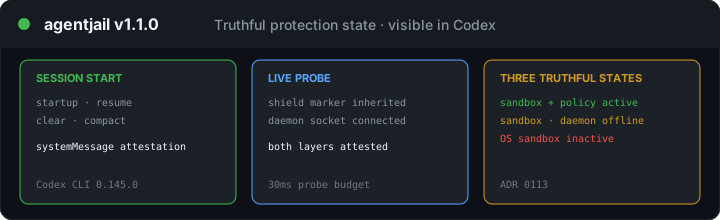
Distinguish full protection, shield-only operation, and unshielded sessions by probing both enforcement layers before attesting.
Launch Codex and Cursor through the same default OS sandbox as Claude Code, with PATH shims, hook installation, status reporting, and uninstall support for all three agents.
Preserve policy meaning across agent protocols by recording the canonical policy action separately from the effective action rendered to Claude, Codex, or Cursor.
Harden custom Rego rules so extensions can add candidates but cannot override the resolver, suppress locked rules, or mutate policy evaluation.
Fix daemon recovery and uninstall targeting so restart uses the installed supervisor and uninstall probes only the daemon belonging to the requested home.
Added
Codex lifecycle attestation (ADR 0113-cursor-status-line): matcher-free SessionStart and Stop hooks display sandbox + policy active, sandbox active, policy daemon offline, or OS sandbox inactive through Codex's supported systemMessage channel.
Codex and Cursor PATH shims: detected installations now receive the same automatic shield activation as Claude Code; macOS grants the agent-specific runtime paths from the shared sandbox contract.
Complete Codex hook integration: registers PreToolUse, PermissionRequest, and PostToolUse, normalizes their wire shapes, and preserves Codex-native approvals when Codex independently opens a permission request.
Complete Cursor hook integration: handles shell, MCP, and file-read hook events with typed normalization and binary allow/deny rendering.
Cursor status line (ADR 0113-cursor-status-line): installs an AgentJail protection badge while preserving and restoring a user's existing status command byte-for-byte.
Agent decision adapters (ADR 0115-agent-decision-adapters): decision records, logs, and UI state expose policy_action, effective_action, adapter provenance, and translation reason.
Cross-agent clean-VM conformance scenario covering installed Claude Code, Codex, and Cursor hook behavior.
Bounded decision snapshots: agentjail logs --latest N selects the newest matching SQLite decisions and prints them chronologically, including JSON output.
Changed
Codex asks fail closed at PreToolUse (ADR 0117-codex-ask-boundary): because Codex hooks cannot create an approval prompt, AgentJail records canonical ask and renders an explicit effective deny; an ask can never silently continue.
Policy inputs normalize at the adapter boundary so file paths, shell commands, MCP calls, session identity, and tool-call correlation have one canonical shape across supported agents.
Daemon restart uses the installed supervisor instead of treating restart as daemon process arguments and accidentally starting an unconfigured resolver-default daemon.
Fixed
Uninstall target-home isolation: daemon liveness checks now probe the socket under the requested home, rather than the process user's daemon, preventing false aborts that leave hooks and shell RC entries installed.
Fail-open recovery reporting: doctor recognizes a later recorded decision as proof that policy evaluation resumed instead of leaving a permanent outage warning.
Development deployment: refreshes all multicall role symlinks and the hook binary consistently.
Complete non-follow logs: agentjail logs --no-follow now traverses every matching SQLite page instead of stopping after the oldest 1,000 decisions.
Truthful sandbox outcomes: successful tool output that merely discusses EPERM or sandbox denials is no longer recorded as an OS-enforced block; Claude failures now use PostToolUseFailure, while Codex attribution requires structured failure evidence.
Inert commit-message paths: static, non-expanding git commit -m text no longer triggers the Bash sensitive-path rule, while expansions, other arguments, and chained commands remain protected.
Security
Custom rule surface validation (ADR 0116-custom-rule-surface): OPA AST validation accepts only partial candidate entries and rejects resolver/helper declarations, both at policy add and daemon load; invalid manually installed rules are quarantined without weakening the baseline.
Canonical/effective action separation prevents protocol limitations from being misreported as policy decisions and keeps final sandbox attribution independent.