You signed in with another tab or window. Reload to refresh your session.You signed out in another tab or window. Reload to refresh your session.You switched accounts on another tab or window. Reload to refresh your session.Dismiss alert
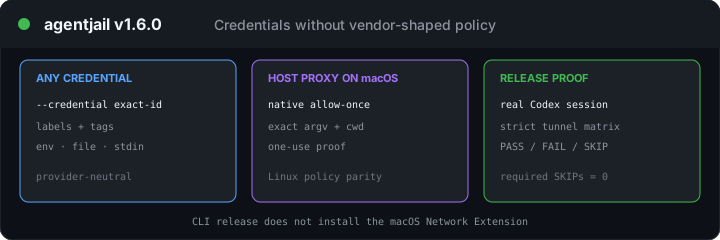
Store credentials under arbitrary IDs with optional labels and tags,
then deliver explicit environment variables or private session files without
teaching AgentJail what vendor or tool consumes them.
Run eligible host commands from shielded Codex sessions on macOS through
the same native allow-once host-proxy contract already used on Linux.
Prove macOS tunnel enforcement instead of accepting SKIPs with an approved
Tart golden image, strict policy matrix, structured scenario results, and a
real Codex release gate.
Keep the distribution boundary explicit: the CLI release does not install
or activate the macOS Network Extension.
Added
Generic credential records: agentjail credential set ID imports named
environment variables, mode-0600 file bindings, or one stdin value. Optional
labels and tags are discovery metadata, while the exact ID remains the only
selection key.
Agent credential discovery: shielded coding agents receive a session-only
MCP surface that lists non-secret IDs, labels, and tags and requests one exact
credential. Eager launches use agentjail run --credential ID -- <command>.
macOS host proxy: agentjail proxy -- <argv...> shares the Linux policy,
evidence, audit, timeout, output, and failure contracts while using Darwin
process-group primitives behind the platform interface.
Fail-closed tunnel assertions: --require-tunnel and AGENTJAIL_REQUIRE_TUNNEL=1 refuse fallback when a test or release claim
requires the transparent tunnel.
Changed
Credential identity is provider-neutral: IDs such as aws-read-only-cred-prod, cluster-dev, or slack-channel-read-token are
opaque names. AgentJail no longer requires a tool, provider, account, or
context field and never infers permissions from a name or tag.
Credential delivery shares one audited domain path: eager launch and
agent-requested delivery use the same exact-selection, authorization,
durable-audit, issuance, expiry, revocation, and cleanup contract.
macOS testbeds use one approved golden: all Tart workflows clone golden-macos-mitm; non-tunnel scenarios leave its inactive extension alone,
while tunnel assertions require it to be activated and enabled.
Distribution stays CLI-only: release tarballs contain agentjail and agentjail-hook. They do not package, install, activate, or approve the
separately built macOS Network Extension application.
Fixed
Darwin tunnel session selection: live registered PIDs survive permission
errors from kill(pid, 0) and are reaped only when the process no longer
exists, preventing valid sessions from silently bypassing the gateway.
Darwin temporary staging: tunneled sessions use the same validated
per-user temporary-directory renderer as ordinary macOS shield sessions, so
image paste and other agent staging no longer fail under the tunnel.
Codex test teardown and daemon readiness: release scenarios drain probe
process groups, isolate subprocess state, wait for launchd readiness, and use
typed health evidence instead of one-shot terminal text.
Credential residue cleanup: scenario credentials are removed and verified
absent, fixture values are scanned across raw AgentJail storage, and the
release evidence manifest fails when required artifacts or prompts are absent.
Security
No credential values in argv: imports read from trusted environment
variables, stdin, or files. Bindings that could replace PATH, dynamic loaders,
proxy or TLS controls, shell startup, module paths, or SSH-agent state are
rejected before storage.
Host execution remains exact and one-use: the daemon binds native approval
to the authenticated session, executable, argv, cwd, project root, PATH,
broker PID, and fresh process ancestry. Shells, interpreters, missing proofs,
replay, timeout, and rejection fail closed.
No all-SKIP tunnel passes: the macOS release gate requires an activated
extension, at least one executed tunnel scenario, strict allow/deny/bypass
policy evidence, and zero required SKIPs.