You signed in with another tab or window. Reload to refresh your session.You signed out in another tab or window. Reload to refresh your session.You switched accounts on another tab or window. Reload to refresh your session.Dismiss alert
Show Claude Code and Codex the governed host-access path through one
AgentJail-owned global instruction block, without teaching either agent to
route MCP or credential operations around their normal approval flows.
Model runtime authority as an exact session-bound grant with typed
lifecycle, scope, expiry, policy epoch, activation, and audit semantics for
commands, files, network access, MCP calls, and credentials.
Describe and diagnose configured host connectors while keeping production
MCP forwarding fail closed until native approval evidence and a grant-aware
data plane can bind the route to the grant lifecycle.
Restore Codex 0.150.1 native command approval when Codex sends the rewritten
AgentJail broker through PreToolUse a second time.
Added
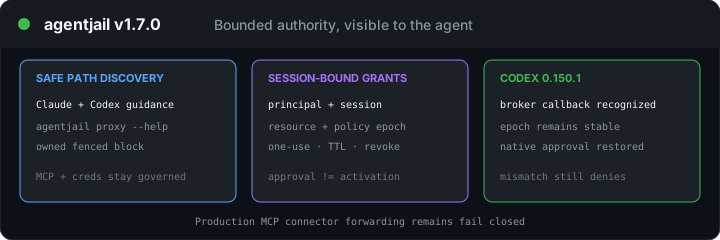
Managed Claude Code and Codex guidance: install and update reconcile one
fenced block in ~/.claude/CLAUDE.md or ~/.codex/AGENTS.md. The block points
required host file and CLI access to agentjail proxy --help, while MCP and
credentials stay on their existing governed paths.
Typed runtime-grant lifecycle: grants bind the principal, session, action,
canonical resource, scope, policy epoch, and timestamps across requested,
approved, active, denied, consumed, expired, revoked, and activation-failed
states.
Configured host-connector foundation: trusted global policy can define
typed connectors such as loopback Chrome CDP, with fixed readiness probes and
rejection of duplicate, non-loopback, invalid, or project-overlay definitions.
Runtime-grant diagnostics: agentjail doctor reports grant,
authorization, activation, transport, and upstream capability separately,
without exposing destinations, capabilities, or approval evidence.
Changed
Approval and activation are separate: authority is usable only after any
required connector bridge and readiness probe succeed.
Guidance follows the installed release: manual, Homebrew, and daemon
updates invoke the newly installed CLI to refresh owned instructions. A
guidance failure warns without rolling back otherwise healthy, attested
binaries.
Uninstall owns its cleanup result: Claude Code and Codex uninstall remove
only AgentJail's fenced block or exact pre-release two-line form. Malformed
fences and cleanup failures identify the path, return non-zero, and prevent a
false success summary.
Lifecycle transitions carry audit evidence: authorizing approval and
activation records must be durable before authority is exposed; terminal and
non-authorizing transitions retain best-effort evidence.
Fixed
Codex 0.150.1 approval loops: an exact pending broker callback no longer
advances the original tool-call epoch. Unknown, stale, observed, malformed,
or mismatched broker invocations still deny before execution.
Exact grant expiry: session and network authority deny at the expiry
boundary rather than remaining usable for one additional instant.
Approval-audit deadlock: netproxy reserves pending approval, emits durable
audit outside its mutex, and exposes authority only after audit succeeds.
Connector lifecycle races: activation is serialized with revocation,
launch capabilities are session-bound, and broker routes are revoked before
session cleanup.
Unsafe Linux connector roots: symlinked, incorrectly owned, or incorrectly
permissioned runtime roots and sockets are rejected.
Security
Policy denies still win: a runtime grant may satisfy an eligible ask; it
cannot override an explicit or locked deny.
Authority is exact and non-transferable: grants are constrained by agent,
principal, session, action, canonical resource and arguments, policy epoch,
scope, expiry, and one-use state.
Host connectors are configuration-bound: guests name a trusted connector
ID rather than choosing a host or port, and guest loopback is never treated as
host loopback.
Launch capabilities remain opaque: connector capabilities are ephemeral,
excluded from persistence and generic errors, and revoked during teardown.
Guidance is discovery, not enforcement: coding-agent hooks, command and
MCP policy, credential controls, network policy, and OS-native sandboxing
remain the security boundary.