
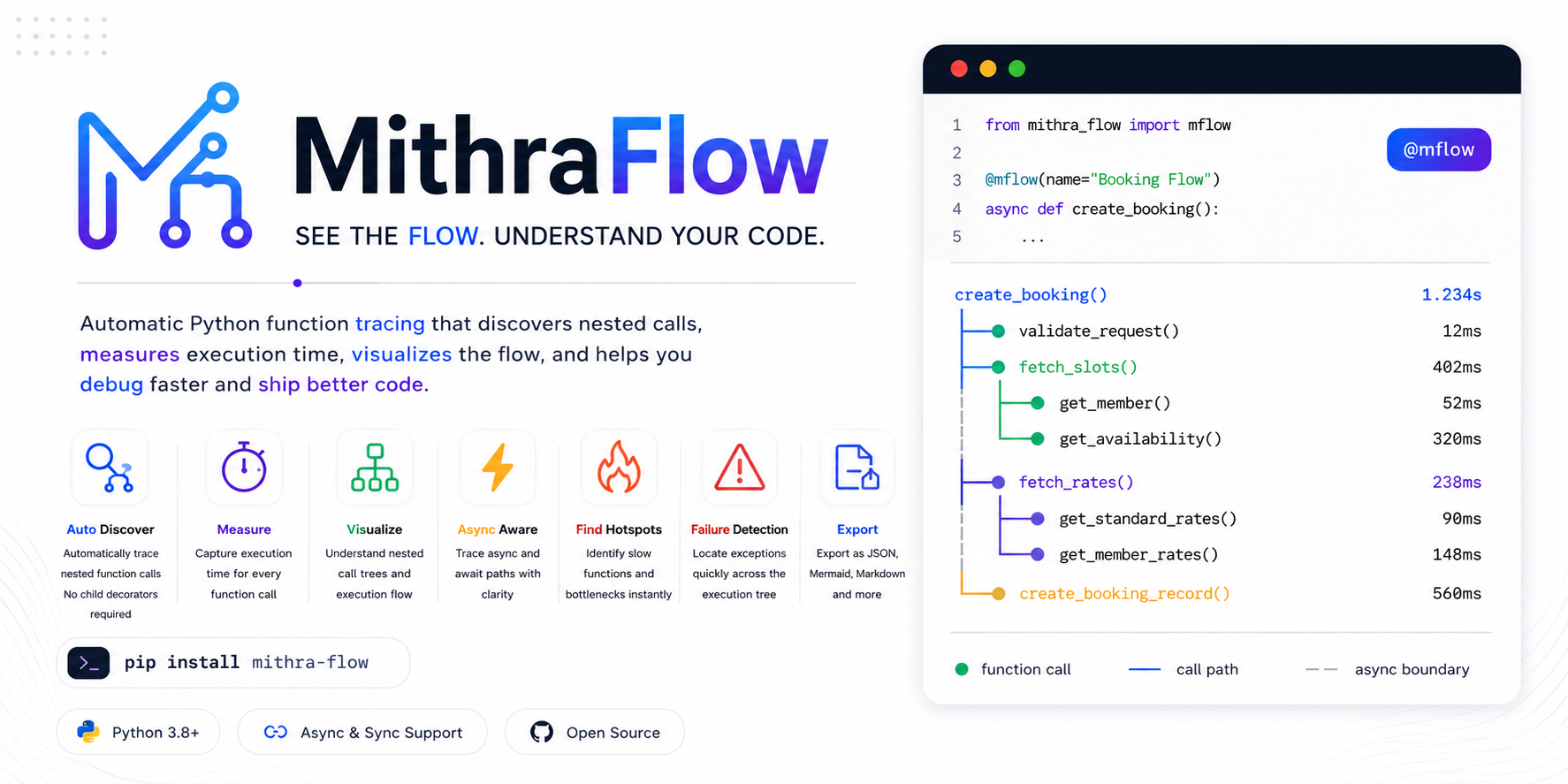


mithra-flow is a terminal-first Python tracing decorator. It shows the nested function calls executed inside one sync or async entry point, with timings, filters, manual spans, and export formats.
It is designed for debugging and code-flow understanding, without adding a web UI, database, agent, or framework integration.
──────── MITHRA FLOW  v1.0 ─────────
● basic_trace()  43.43 ms
┗━━ ● parent_flow()  43.42 ms
    ┣━━ ● child_one()  32.17 ms
    ┃   ┣━━ ● grandchild_a()  11.90 ms
    ┃   ┗━━ ● grandchild_b()  20.25 ms
    ┗━━ ● child_two()  11.24 ms
        ┗━━ ● grandchild_c()  11.23 ms
────────────────────────────────────
- Traces sync and async decorated functions.
- Captures nested project-local child function calls with
sys.setprofile. - Isolates each trace with
contextvars. - Measures duration with
time.perf_counter. - Prints a colored Rich tree in the terminal.
- Supports filters, depth limits, duration thresholds, args, return values, errors, JSON, Mermaid, files, manual spans, and context manager traces.
- PyPI: https://pypi.org/project/mithra-flow/
- GitHub: https://github.com/MITHUNMITS/mithra-flow
- Changelog: CHANGELOG.md
- License: LICENSE
mithra-flow is useful when you need to understand what your code is doing without opening a full profiler, adding a web UI, or wiring a database.
| Use Case | How It Helps |
|---|---|
| Debug complex flows | See the exact nested function path that ran during one request, job, or script execution. |
| Understand a new codebase | New developers can trace one entry function and quickly see the project flow. |
| Check performance hotspots | Durations make slow child calls visible without running a heavy profiler. |
| Compare before and after changes | Run the same function before and after a refactor to check if the call tree or timing changed. |
| Debug async behavior | See nested async calls across await points in one readable tree. |
| Investigate API requests | Decorate a FastAPI route and inspect the internal service/helper calls behind that endpoint. |
| Find noisy helper calls | Use min_duration_ms and max_depth to reduce clutter in large call trees. |
| Explain business logic | Export Mermaid or JSON traces to show how a workflow moves through functions. |
| Review errors faster | Use on_error=True to print traces only for failed executions. |
| Trace manual work blocks | Use span(...) for database queries, cache writes, external API calls, or other blocks that are not standalone functions. |
| Generate debugging artifacts | Use save_to="trace.json" to keep trace data for later review. |
| Teach project architecture | Include trace examples in onboarding docs so new team members see real runtime structure. |
Typical places to use it:
- FastAPI route handlers.
- CLI commands.
- Background jobs.
- Data processing pipelines.
- Test/debug scripts.
- Service-layer functions.
- Async workflows.
- Refactor verification.
From PyPI:
python3 -m pip install mithra-flowWith FastAPI example dependencies:
python3 -m pip install 'mithra-flow[examples]'For local development:
python3 -m pip install -e '.[test,examples]'Run tests:
python3 -m pytest -qThe library is intentionally small. The first published wheel is roughly 11 KB, and the source distribution is roughly 12 KB.
Tracing uses sys.setprofile, so it is intended for debugging, local development, staging, tests, and targeted diagnostics. For production systems, keep it disabled by default and enable it only for specific routes, jobs, or error investigations.
Useful controls for larger projects:
@mflowautomatically traces code under the detected project root.include=[...]to narrow tracing further to specific app folders.exclude=[...]to hide noisy helpers.min_duration_ms=...to focus on slower calls.max_depth=...to keep output compact.MITHRA_FLOW=0to disable globally.
from mithra_flow import mflow

def child():
    return "ok"

@mflow
def parent():
    return child()

parent()
Output:
──────── MITHRA FLOW  v1.0 ─────────
● parent()  0.04 ms
┗━━ ● child()  0.01 ms
────────────────────────────────────
import asyncio
from mithra_flow import mflow

async def child():
    await asyncio.sleep(0.01)
    return "ok"

@mflow
async def parent():
    return await child()

asyncio.run(parent())
Output:
──────── MITHRA FLOW  v1.0 ─────────
● parent()  11.20 ms
┗━━ ● child()  11.14 ms
────────────────────────────────────
| Option | Purpose |
|---|---|
name="checkout" |
Sets a custom banner title. |
title="checkout" |
Alias-style title input. |
include=["examples"] |
Trace only matching module/function/path values. |
exclude=["grandchild_b"] |
Hide matching module/function/path values. |
enabled=False |
Disable tracing for that function. |
min_duration_ms=15 |
Hide calls faster than the threshold. |
max_depth=1 |
Limit displayed/exported child depth. |
show_args=True |
Show function arguments. |
show_return=True |
Show return values. |
show_file=True |
Show source file names. |
show_line=True |
Show source line numbers. |
on_error=True |
Print only when an exception happens. |
output="terminal" |
Print a Rich tree. |
output="dict" |
Return a trace dictionary. |
output="json" |
Return a JSON trace string. |
output="mermaid" |
Return a Mermaid graph string. |
output="none" |
Collect/save without terminal printing. |
save_to="trace.json" |
Write trace output to disk. |
return_trace=True |
Return MFlowResult(value, trace). |
trace_dependencies=True |
Also trace dependency/library frames such as .venv and site-packages. Off by default. |
root_path="/path/to/project" |
Override automatic project-root detection. Usually not needed. |
Disable globally:
MITHRA_FLOW=0 python3 your_script.pyBy default, mithra-flow is code-level only. @mflow automatically detects the project root from the decorated function file, then traces only files under that root. It ignores dependency, cache, and build folders by path, including .venv, venv, site-packages, dist-packages, __pypackages__, .tox, .nox, node_modules, build, and dist. Dependency internals are included only when you explicitly enable trace_dependencies=True.
Run the example API:
python3 -m uvicorn examples.nested_flow:app --reloadOpen docs:
http://127.0.0.1:8000/docs
Or call endpoints directly:
curl http://127.0.0.1:8000/flow/basic| Endpoint | Demonstrates |
|---|---|
/flow/basic |
Default nested async tracing. |
/flow/title |
Custom banner title with name=. |
/flow/args |
Arguments and return values. |
/flow/location |
File name and line number display. |
/flow/max-depth |
Depth-limited tree. |
/flow/min-duration |
Duration filtering. |
/flow/json |
JSON trace response. |
/flow/mermaid |
Mermaid graph response. |
/flow/return-trace |
Return value plus trace data. |
/flow/include-exclude |
Include/exclude filtering. |
/flow/save-to |
Save trace to /tmp/mithra-flow-example.json. |
/flow/manual-span |
Manual spans inside a trace. |
/flow/context |
Context manager tracing. |
/flow/on-error |
Print only when an error happens. |
/flow/disabled |
Disabled tracing. |
Code:
@app.get("/flow/basic")
@mflow(include=["examples"])
async def basic_trace():
    return {"result": await parent_flow()}
Call:
curl http://127.0.0.1:8000/flow/basicResponse:
{"result":[["grandchild-a","grandchild-b"],["grandchild-c"]]}Terminal graph:
──────── MITHRA FLOW  v1.0 ─────────
● basic_trace()  43.43 ms
┗━━ ● parent_flow()  43.42 ms
    ┣━━ ● child_one()  32.17 ms
    ┃   ┣━━ ● grandchild_a()  11.90 ms
    ┃   ┗━━ ● grandchild_b()  20.25 ms
    ┗━━ ● child_two()  11.24 ms
        ┗━━ ● grandchild_c()  11.23 ms
────────────────────────────────────
Code:
@app.get("/flow/title")
@mflow(name="checkout request", include=["examples"])
async def custom_title():
    return {"result": await parent_flow()}
Terminal graph:
────── checkout request  v1.0 ──────
● custom_title()  43.26 ms
┗━━ ● parent_flow()  43.26 ms
    ┣━━ ● child_one()  32.09 ms
    ┃   ┣━━ ● grandchild_a()  10.88 ms
    ┃   ┗━━ ● grandchild_b()  21.18 ms
    ┗━━ ● child_two()  11.16 ms
        ┗━━ ● grandchild_c()  11.15 ms
────────────────────────────────────
Code:
@app.get("/flow/args")
@mflow(include=["examples"], show_args=True, show_return=True)
def args_and_returns(amount: int = 100):
    return sync_receipt(amount)
Call:
curl "http://127.0.0.1:8000/flow/args?amount=100"Terminal graph:
──────── MITHRA FLOW  v1.0 ─────────
● args_and_returns()(amount=100)  0.05 ms -> {'amount': 100, 'total': 105.0}
┗━━ ● sync_receipt()(amount=100)  0.03 ms -> {'amount': 100, 'total': 105.0}
    ┗━━ ● sync_price()(amount=100, tax=0.05)  0.01 ms -> 105.0
────────────────────────────────────
Code:
@app.get("/flow/location")
@mflow(include=["examples"], show_file=True, show_line=True)
async def file_and_line():
    return {"result": await parent_flow()}
Terminal graph:
──────── MITHRA FLOW  v1.0 ─────────
● file_and_line()  43.56 ms  nested_flow.py:75
┗━━ ● parent_flow()  43.55 ms  nested_flow.py:37
    ┣━━ ● child_one()  32.35 ms  nested_flow.py:26
    ┃   ┣━━ ● grandchild_a()  11.14 ms  nested_flow.py:11
    ┃   ┗━━ ● grandchild_b()  21.20 ms  nested_flow.py:16
    ┗━━ ● child_two()  11.19 ms  nested_flow.py:32
        ┗━━ ● grandchild_c()  11.18 ms  nested_flow.py:21
────────────────────────────────────
Code:
@app.get("/flow/max-depth")
@mflow(include=["examples"], max_depth=1)
async def max_depth():
    return {"result": await parent_flow()}
Terminal graph:
──────── MITHRA FLOW  v1.0 ─────────
● max_depth()  42.98 ms
┗━━ ● parent_flow()  42.97 ms
────────────────────────────────────
Code:
@app.get("/flow/min-duration")
@mflow(include=["examples"], min_duration_ms=15)
async def min_duration():
    return {"result": await parent_flow()}
Terminal graph:
──────── MITHRA FLOW  v1.0 ─────────
● min_duration()  43.54 ms
┗━━ ● parent_flow()  43.54 ms
    ┗━━ ● child_one()  32.37 ms
        ┗━━ ● grandchild_b()  21.20 ms
────────────────────────────────────
Code:
@app.get("/flow/json", response_class=PlainTextResponse)
@mflow(include=["examples"], output="json", show_args=True)
def json_trace():
    return sync_receipt(50)
Response:
{
  "name": "json_trace()",
  "duration_ms": 0.03,
  "args": "()",
  "exception": null,
  "is_span": false,
  "children": [
    {
      "name": "sync_receipt()",
      "duration_ms": 0.01,
      "args": "(amount=50)",
      "exception": null,
      "is_span": false,
      "children": [
        {
          "name": "sync_price()",
          "duration_ms": 0.0,
          "args": "(amount=50, tax=0.05)",
          "exception": null,
          "is_span": false,
          "children": []
        }
      ]
    }
  ]
}Code:
@app.get("/flow/mermaid", response_class=PlainTextResponse)
@mflow(include=["examples"], output="mermaid")
async def mermaid_trace():
    await parent_flow()
Response:
graph TD
  N0["mermaid_trace() 43.50 ms"]
  N1["parent_flow() 43.50 ms"]
  N2["child_one() 32.30 ms"]
  N3["grandchild_a() 11.15 ms"]
  N2 --> N3
  N4["grandchild_b() 21.15 ms"]
  N2 --> N4
  N1 --> N2
  N5["child_two() 11.13 ms"]
  N6["grandchild_c() 11.13 ms"]
  N5 --> N6
  N1 --> N5
  N0 --> N1
Rendered shape:
mermaid_trace()
└── parent_flow()
    ├── child_one()
    │   ├── grandchild_a()
    │   └── grandchild_b()
    └── child_two()
        └── grandchild_c()
Code:
@app.get("/flow/return-trace")
@mflow(include=["examples"], return_trace=True, show_return=True)
async def return_trace():
    result = await parent_flow()
    return result
Response shape:
{
  "value": [["grandchild-a", "grandchild-b"], ["grandchild-c"]],
  "trace": {
    "name": "return_trace()",
    "duration_ms": 43.459,
    "children": []
  }
}Code:
@app.get("/flow/include-exclude")
@mflow(include=["examples"], exclude=["grandchild_b"])
async def include_exclude():
    return {"result": await parent_flow()}
Terminal graph:
──────── MITHRA FLOW  v1.0 ─────────
● include_exclude()  42.71 ms
┗━━ ● parent_flow()  42.70 ms
    ┣━━ ● child_one()  32.33 ms
    ┃   ┗━━ ● grandchild_a()  11.17 ms
    ┗━━ ● child_two()  10.36 ms
        ┗━━ ● grandchild_c()  10.35 ms
────────────────────────────────────
grandchild_b() still executes, but it is hidden from the trace.
Code:
@app.get("/flow/save-to")
@mflow(include=["examples"], save_to="/tmp/mithra-flow-example.json")
async def save_to_file():
    await parent_flow()
    return {"saved_to": "/tmp/mithra-flow-example.json"}
Call:
curl http://127.0.0.1:8000/flow/save-to
cat /tmp/mithra-flow-example.json
On macOS, /tmp/mithra-flow-example.json resolves to:
/private/tmp/mithra-flow-example.json
Code:
@app.get("/flow/manual-span")
@mflow(include=["examples"])
async def manual_span():
    with span("manual database query"):
        await asyncio.sleep(0.01)
    with span("manual cache write"):
        await asyncio.sleep(0)
    return {"ok": True}
Terminal graph:
──────── MITHRA FLOW  v1.0 ─────────
● manual_span()  11.54 ms
┣━━ ◆ manual database query()  11.30 ms
┗━━ ◆ manual cache write()  0.22 ms
────────────────────────────────────
Manual spans use ◆ instead of ●.
Code:
@app.get("/flow/context")
async def context_manager():
    with trace("context managed flow", include=["examples"], show_return=True) as traced:
        result = sync_receipt(25)
    return {"result": result, "trace": traced.result}
Terminal graph:
──── context managed flow  v1.0 ────
◆ context managed flow  0.12 ms
┗━━ ● sync_receipt()  0.01 ms -> {'amount': 25, 'total': 26.25}
    ┗━━ ● sync_price()  0.01 ms -> 26.25
────────────────────────────────────
Code:
@app.get("/flow/on-error")
@mflow(include=["examples"], on_error=True)
async def on_error_only():
    try:
        await failing_child()
    except RuntimeError as error:
        raise HTTPException(status_code=500, detail=str(error)) from error
Response:
{"detail":"example failure"}Terminal graph:
──────── MITHRA FLOW  v1.0 ─────────
● on_error_only()  0.12 ms ! HTTPException: 500: example failure
┗━━ ● failing_child()  0.10 ms
────────────────────────────────────
Code:
@app.get("/flow/disabled")
@mflow(include=["examples"], enabled=False)
async def disabled_trace():
    return {"result": await parent_flow()}
Response:
{"result":[["grandchild-a","grandchild-b"],["grandchild-c"]]}Terminal graph:
No trace is printed.
Use trace(...) when you do not want to decorate a function.
from mithra_flow import trace

with trace("batch job", include=["jobs"]) as traced:
    run_job()

print(traced.result)Use span(...) to mark work that is not naturally represented by a function call.
from mithra_flow import mflow, span

@mflow
def process():
    with span("database query"):
        query_database()
Output:
──────── MITHRA FLOW  v1.0 ─────────
● process()  12.30 ms
┗━━ ◆ database query()  11.80 ms
────────────────────────────────────
from mithra_flow import mflow

@mflow(return_trace=True)
def parent():
    return "ok"

result = parent()

print(result.value)
print(result.trace)
result is an MFlowResult:
MFlowResult(value="ok", trace={...})The banner version comes from the installed package version:
from mithra_flow import __version__

print(__version__)
Package versions are generated from Git tags.
Examples:
| Git Tag | PyPI Version |
|---|---|
v1.0 |
1.0 |
v1.0.1 |
1.0.1 |
v2.0.0 |
2.0.0 |
Normal code changes:
- Make changes.
- Commit in VS Code Source Control.
- Push
mainfrom VS Code.
Publish a new PyPI version:
- Open the GitHub repository.
- Go to
Releases. - Click
Draft a new release. - Create a new tag, for example
v1.0.1. - Publish the release.
GitHub Actions will build and publish that tag to PyPI automatically.
Terminal version if you prefer commands:
git tag v1.0.1
git push origin v1.0.1
You do not need to edit src/mithra_flow/version.py for every release.