Repository navigation
Battery Pack
A single cell rarely matches a project's needs, so cells are combined into packs. This tool shows what a series and parallel layout gives you.
- Cells in series (end to end) add their voltage, and the capacity stays the same.
- Cells in parallel (side by side) add their capacity (current-delivering ability), and the voltage stays the same.
The layout is written xSyP: a 3S2P pack has 3 groups in series, each with 2 cells in parallel, for 6 cells. Then:
- Nominal voltage = cell nominal voltage × S
- Capacity = cell capacity × P
- Energy (Wh) = nominal voltage × capacity in amp-hours
- Maximum current = C-rate × pack capacity (for example, 2C on 5 Ah is 10 A)
Typical per-cell voltages used here (check the cell datasheet): Li-ion/LiPo 3.7 nominal, 4.2 full, 3.0 empty; LiFePO4 3.2, 3.65, 2.5; NiMH 1.2, 1.45, 1.0; alkaline 1.5, 1.6, 0.9; lead-acid per 2 V cell 2.0, 2.35, 1.75.
- Open the Battery Pack tab.
- In Cell chemistry, choose the type of cell.
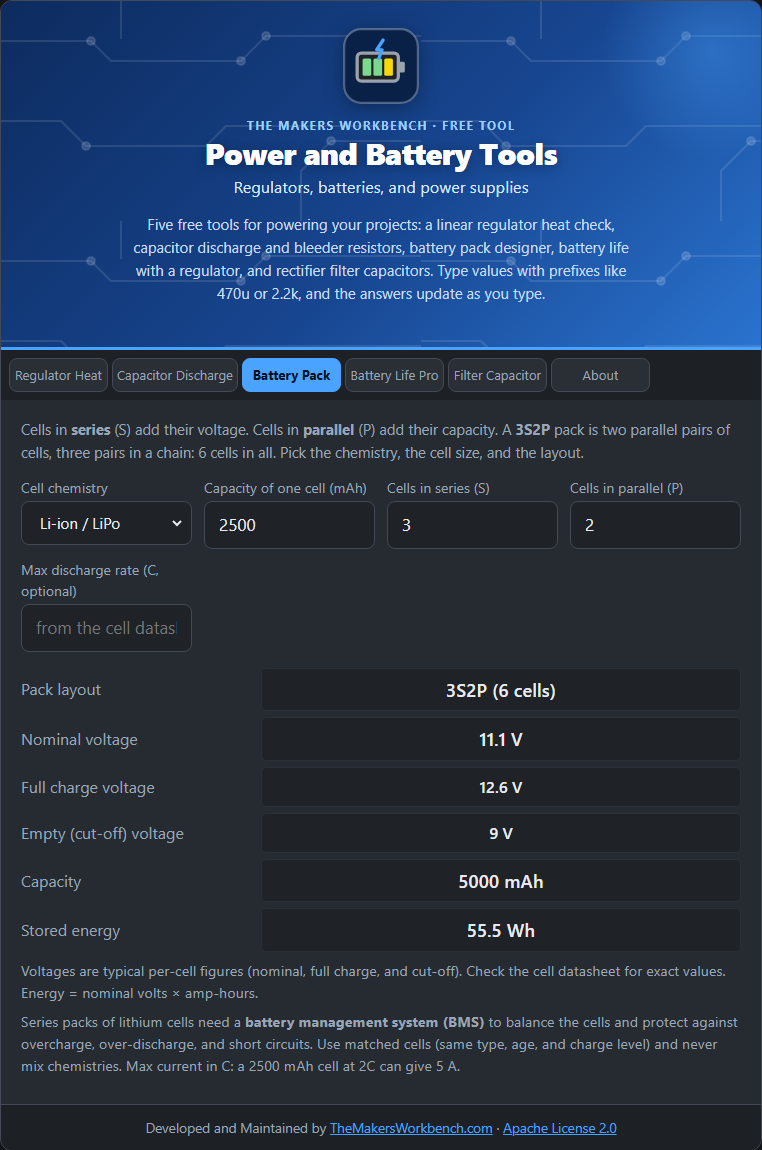
- In Capacity of one cell (mAh), type it, for example
2500. - In Cells in series (S) and Cells in parallel (P), type your layout, for example
3and2. - Optionally, in Max discharge rate (C, optional), type the cell's continuous C-rating from its datasheet.
- Read the layout, the voltages, the capacity, and the stored energy.
Six 2500 mAh Li-ion cells as 3S2P: a nominal 11.1 V (12.6 V full, 9.0 V empty), 5000 mAh, and 55.5 Wh. At a 2C rating it can supply 10 A.
- Series lithium packs need a battery management system (BMS) to balance the cells and protect against overcharge, over-discharge, and short circuits.
- Use matched cells: the same type, brand, age, and charge level. Never mix chemistries.
- Parallel cells should be connected at the same voltage first, or large currents will flow between them.
- Lithium cells can catch fire if mistreated. Follow the manufacturer's guidance.