An Agentic Document Generation Engine for Automated Engineering Compliance
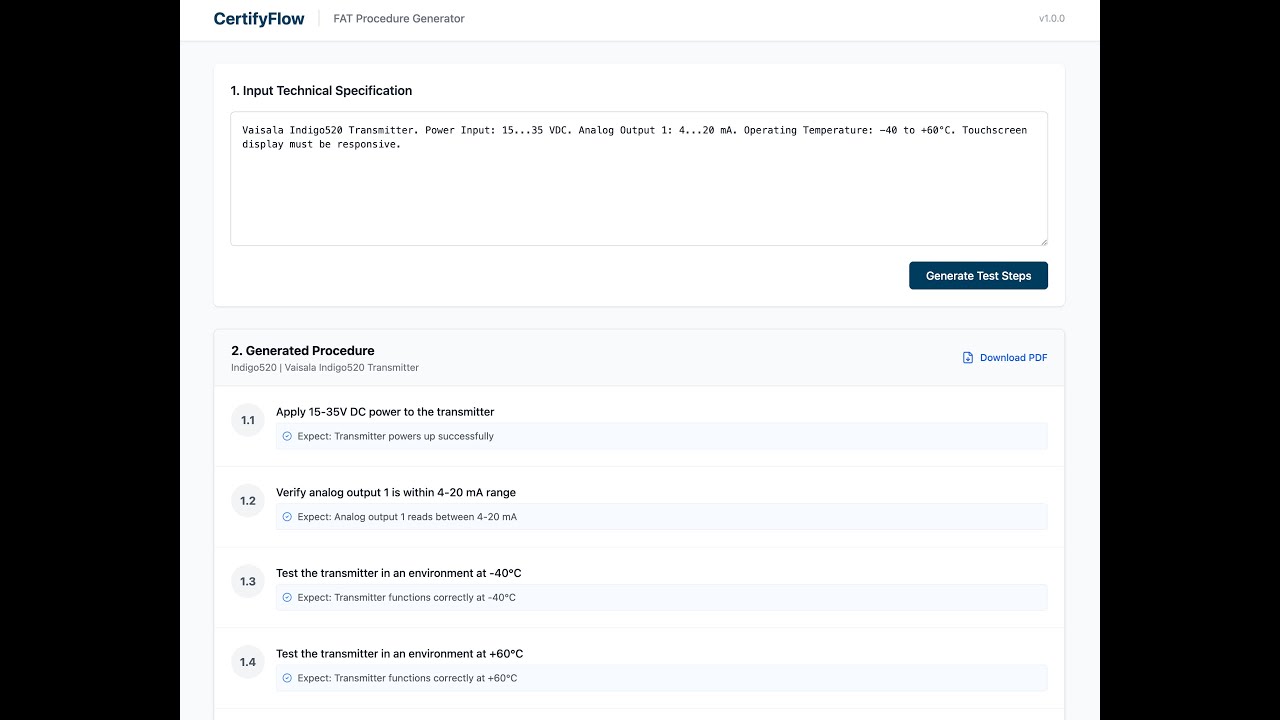
📺 Watch the System Demo featuring Structured JSON Extraction and Deterministic Safety Guardrails.



- The Problem: Industrial engineers spend hundreds of hours manually translating Technical Specifications (Datasheets) into Factory Acceptance Test (FAT) procedures.
- The Trap: Generic "Chat with PDF" tools produce conversational text that is legally unusable and prone to hallucinating sensor values (e.g., inventing a -50°C threshold for a -40°C sensor).
- The Solution: CertifyFlow. A Structured Extraction Engine that uses Pydantic to force LLMs into rigid JSON schemas, backed by a deterministic Regex Validator to guarantee safety compliance.
- Engine: Python 3.11 + FastAPI
- Orchestration:
Instructor+OpenAI(Forces JSON output, prevents "Chatty" responses). - Guardrails:
ComplianceValidator(Regex-based logic that auto-flags High Voltage steps if the AI misses them). - Artifacts:
WeasyPrint+Jinja2(Renders strictly formatted PDF reports).
- Framework: React 18 + TypeScript + Vite
- State: TanStack Query (Server state management).
- Styling: Tailwind CSS (Blue theme).
- Containerization: Docker Compose (Full stack isolation).
- Testing: Pytest (Backend) + Vitest (Frontend) with 100% Code Coverage.
| Decision | Alternative Considered | Rationale |
|---|---|---|
| Schema Enforcement | Pure Prompt Engineering | Prompts fail at scale. Instructor patches the LLM to validate output against Python classes before returning, guaranteeing valid JSON every time. |
| PDF Rendering | Browser/Client-side PDF | Engineering docs require strict pagination (ISO headers on every page). Server-side WeasyPrint (CSS Paged Media) is the only robust way to achieve this. |
| Monorepo | Multi-repo | Simplified delivery for the Pilot phase. Easier for IT to audit a single Docker Compose file. |
Model: GPT-3.5-Turbo (0125)
- Average Input (Spec): 500 Tokens ($0.00025)
- Average Output (Procedure): 300 Tokens ($0.00045)
- Total Cost per Document: $0.0007 (less than 1/10th of a cent)
Comparison: Engineer time (1 hour) vs. CertifyFlow (5 seconds).
The "Hallucination" Guardrail:
We do not trust the LLM blindly. The ComplianceValidator runs post-generation:
- Regex Scan: Scans for "VAC", "230V", "High Voltage".
- Logic Check: If found, checks
safety_criticalboolean. - Override: If the AI marked it
False, the code forces it toTrueand appends[AUTO-FLAGGED].
- Docker & Docker Compose
- OpenAI API Key
git clone https://github.com/Nibir1/CertifyFlow.git
cd CertifyFlow
# Create .env file in backend/
echo "OPENAI_API_KEY=sk-..." > backend/.env
make build
# App will be live at http://localhost:5173
make test
To verify the system's "Enterprise Readiness," run the following test cases in the UI to see the difference between a Chatbot and an Engineering Tool.
Input:
Technical Spec: "Vaisala Indigo520 Transmitter. Power Input: 15...35 VDC. Analog Output 1: 4...20 mA. Operating Temperature: -40 to +60°C. Touchscreen display must be responsive."
- Why this matters: A generic LLM would write a paragraph. CertifyFlow uses Instructor (Pydantic) to force specific atomic steps.
- Success Indicator: The system generates a rigid list of steps. It correctly separates "Apply 15...35 VDC" as an Instruction and "Device powers on" as the Expected Result. The PDF export matches the ISO-standard template.
Input:
Technical Spec: "Relay Output: Max load 250 VAC. Connection via screw terminals." (Note: Do not explicitly ask for safety warnings in the input)
- Why this matters: LLMs can "forget" safety context. This tests the ComplianceValidator (the regex engine).
- Success Indicator: Even if the AI fails to mark this as dangerous, the Backend Validator detects "250 VAC", forces the step to Safety Critical, and appends
[AUTO-FLAGGED]to the instruction. The UI displays a Red Safety Badge.
We utilize a Makefile to standardize the development lifecycle across the engineering team.
| Command | Description |
|---|---|
make build |
Rebuilds all containers from scratch (Backend + Frontend) |
make up |
Starts the full system at http://localhost:5173 |
make logs |
Streams live logs from the FastAPI backend and React frontend |
make test |
Runs the 100% Coverage suite (Pytest + Vitest) |
make clean |
Nuclear option: Removes containers, volumes, and cache artifacts |
A clean "Monorepo" architecture designed for easy auditing by Vaisala IT.
certifyflow/
├── backend/
│   ├── app/
│   │   ├── core/
│   │   │   ├── generator.py   # AI Logic (Instructor + OpenAI)
│   │   │   └── validator.py   # Compliance Guardrails (Regex)
│   │   ├── models/            # Pydantic Schemas (The "Brain")
│   │   ├── services/          # WeasyPrint PDF Renderer
│   │   └── api/               # FastAPI Routes
│   ├── tests/                 # Pytest Suite (100% Coverage)
│   └── templates/             # Jinja2 Engineering Templates
├── frontend/
│   ├── src/
│   │   ├── components/        # InputForm, ProcedureView
│   │   ├── api/               # Axios Client & Endpoints
│   │   └── types/             # TypeScript Interfaces (Mirroring Pydantic)
│   └── vite.config.ts         # Build Configuration
├── docker-compose.yml         # Container Orchestration
└── Makefile                   # Automation Scripts
Architected by Nahasat Nibir