JavaScript (JS): Condition and Function Concepts
JavaScript (JS) is a versatile, high-level programming language primarily used for creating interactive web pages. Two fundamental concepts in JavaScript are conditions and functions. Here's a breakdown of each:
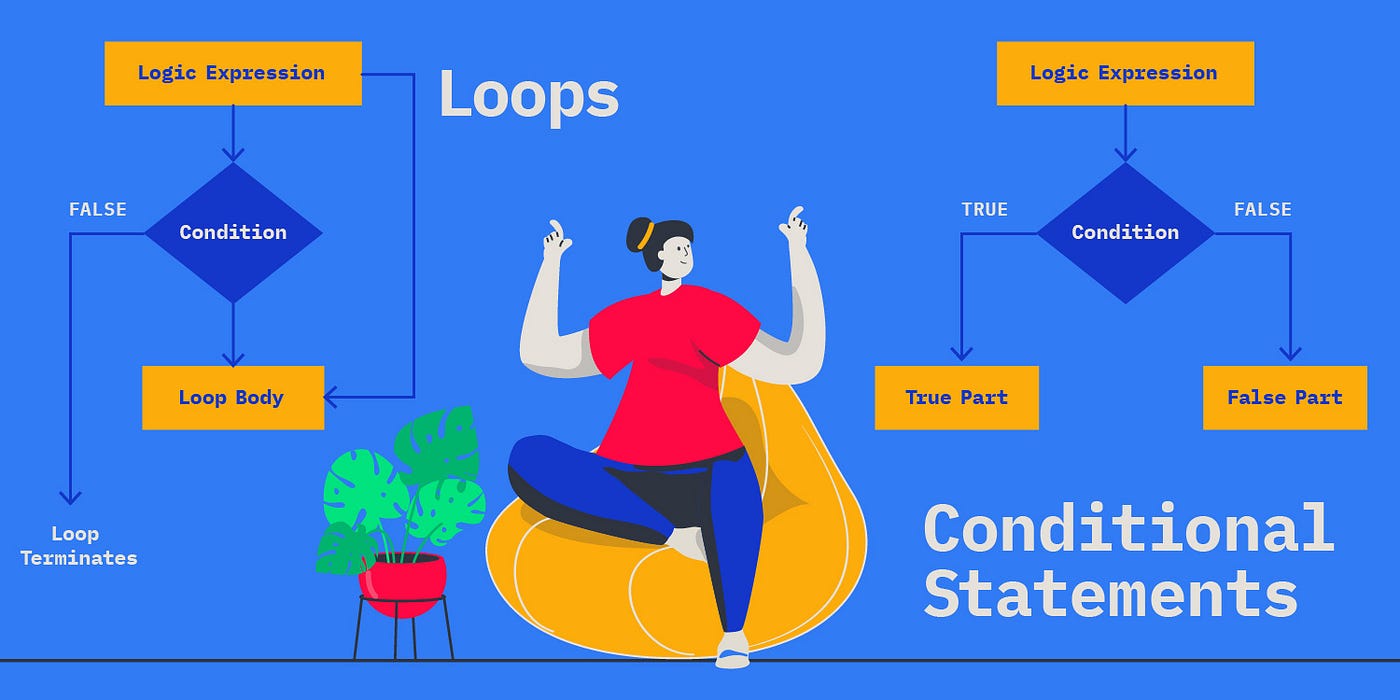
Conditions are used to control the flow of a program by executing specific blocks of code based on whether a statement is true or false.
Types of Conditional Statements if statement: Executes a block of code if the condition is true.
let age = 18; if (age >= 18) { console.log("You are an adult."); } if...else statement: Executes one block of code if the condition is true, otherwise executes another block.
let age = 16; if (age >= 18) { console.log("You are an adult."); } else { console.log("You are a minor."); } if...else if...else statement: Used to test multiple conditions.
let score = 85; if (score >= 90) { console.log("Grade: A"); } else if (score >= 80) { console.log("Grade: B"); } else if (score >= 70) { console.log("Grade: C"); } else { console.log("Grade: F"); } Switch statement: Tests a value against multiple possible cases.
let day = 'Monday'; switch (day) { case 'Monday': console.log('Start of the work week.'); break; case 'Friday': console.log('Weekend is near!'); break; case 'Saturday': case 'Sunday': console.log('It’s the weekend!'); break; default: console.log('Midweek days.'); } Logical Operators Used in Conditions AND (&&): Both conditions must be true. OR (||): At least one condition must be true. NOT (!): Reverses the condition's value (true becomes false, false becomes true). Example:
let age = 20; if (age >= 18 && age <= 65) { console.log("You are of working age."); }
A function is a reusable block of code designed to perform a specific task. Functions allow you to organize, reuse, and maintain your code more efficiently.
Types of Functions Function Declaration: Uses the function keyword and can be called before it is defined.
function greet(name) {
return Hello, ${name}!;
}
console.log(greet('Alice')); // Hello, Alice!
Function Expression: Assigned to a variable, and the function can only be called after its definition.
const greet = function(name) {
return Hello, ${name}!;
};
console.log(greet('Bob')); // Hello, Bob!
Arrow Function (ES6): A more concise syntax for writing functions.
const greet = (name) => Hello, ${name}!;
console.log(greet('Charlie')); // Hello, Charlie!
Anonymous Function: A function without a name, typically used as a callback.