Pair decision audit for pi coding agent · 结对决策审计插件


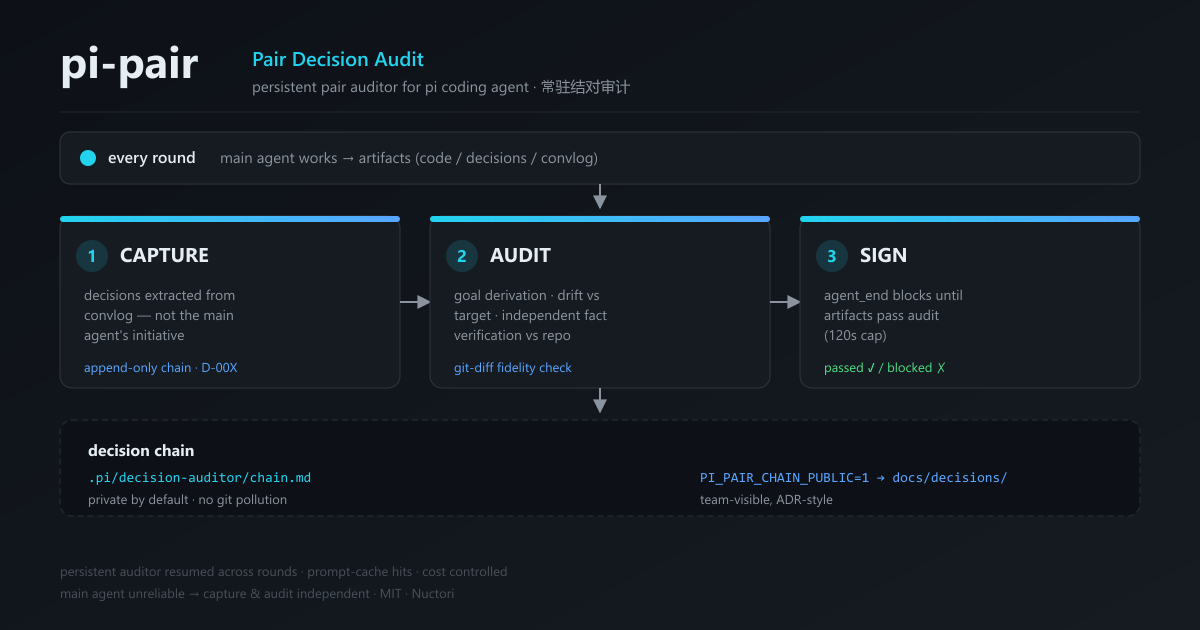
A persistent "pair auditor" (举灯人 / holder of the lamp) for every pi session. It holds the task goal across rounds, cross-audits each round's artifacts against a decision chain, and blocks agent_end until the artifact passes the audit signature.
A single agent's thinking and output have limited precision — and two failure modes in particular:
- Intention-execution instability: the agent drifts from what you actually asked, or silently reinterprets the goal.
- Reasoning instability: it fabricates numbers, over-engineers, or confidently ships wrong logic.
A second agent ("pair") cleans up after it. But an independently-invoked audit has its own cost — time and tokens. pi-pair is built around one question:
Under tight time/cost control, can a pair auditor measurably raise output precision?
Core premise: the main agent is not reliable. Decisions aren't recorded by its initiative (the auditor extracts them from the conversation log), and audit judgement doesn't trust its self-description (it trusts the conversation record and repository facts).
pi install npm:pi-pairThat's it. Start working normally — pi-pair hooks in automatically:
- Each round, your work is audited at
agent_end(blocking, ≤120s): goal derivation → adversarial 5-dimension attack → signature. Un-audited work can't be presented as "complete". - Your decisions are captured into
.pi/decision-auditor/chain.md(append-only, auto-numbered) — extracted from the conversation log, not from your initiative. - On delivery ("submit / publish / merge / deploy"), 3 fresh reviewers fan out for a deep cross-check.
Requires pi-subagents (spawns/resumes the auditor). See Installation.
- How it works
- Capabilities
- Installation
- Components
- Audit protocol
- Tools
- Environment
- Decision chain format
- Design notes
- Known limitations
- Roadmap
- License
each session (session_start)
  └─ persistent auditor (runId persisted, resumed across rounds, hits prompt cache)

L0 — chain maintenance (non-blocking, batched, same auditor run)
  └─ every round: accumulateRound (convlog delta) — zero cost
  └─ threshold hit (6 rounds / 8000 chars / max 15): resume the SAME
     resident auditor run (one holder of the lamp, shared context)
      · capture incremental decisions into chain (append-only, auto-numbered)
      · adversarial chain review (5 elegance dimensions: atomicity / correctness /
        consistency / cohesion / completeness)
      · findings → chainFindings → injected to main agent next round (low priority)

L1 — artifact gate (agent_end, blocking, hard gate)
  └─ has artifacts? → resume/spawn auditor → audit this round's artifacts in window
     → await (120s cap)
      · adversarial 5-dimension attack on artifacts (guilty until proven innocent)
      · independently verify Context facts vs repository
      · in-window Q&A with main agent (contact_supervisor, 60s cap)
      · passed → end ✓
      · blocked → fix round (followUp, fix now) → re-audit → up to 3×
      · 3× still blocked → passed-with-warning release (end is end)
      · timeout (120s) → negotiated stop: steer auditor to sign current findings
        as blockers early (fix immediately) — hard kill only as fallback

L2 — delivery review (on "submit/publish/merge/deploy")
  └─ parallel fanout 3 fresh reviewers (correctness / goal-alignment / security-robustness)
Hard gate: agent_end blocks until the audit signature. A blocked artifact triggers an immediate fix round (follow-up message, max 3×), then releases with a warning — end is end. Un-audited work can never be presented as "complete".
Layered cost control: L1 audits every round's artifacts (the gate, cannot be skipped); L0 batches chain capture/review (6 rounds / 8000 chars) so chain maintenance doesn't run every round; L2 runs once per delivery. A high-signal process log (decision-intent summaries, ≤200 chars each, roll-trimmed) lets the auditor check artifacts against your reasoning trajectory instead of reverse-engineering it — CI bench confirms zero measurable time cost for this communication channel.
| Capability | Description |
|---|---|
| Artifacts must be cross-audited | agent_end blocks until audit signature; blocked artifacts trigger an immediate fix round (max 3×), then release-with-warning |
| Persistent pairing | one resident auditor run per session — L0 (chain maintenance) and L1 (artifact gate) resume the same instance, sharing context; no second agent |
| Not dependent on main agent | decisions extracted from convlog, facts verified from repo, by an independent agent |
| Decision chain | default .pi/decision-auditor/chain.md (private, no git pollution); PI_PAIR_CHAIN_PUBLIC=1 → docs/decisions/chain.md (team-visible) |
| In-window communication | auditor talks to the main agent only inside the agent_end window (contact_supervisor, 60s cap); negotiated stop on timeout — no out-of-window wake-ups |
| Adversarial, calibrated | 7-dimension attack (5 elegance + mechanism integrity + runtime-mode behavior), calibrated on real defects the same-model auditor missed |
| Cost control | batched L0 + once-per-delivery L2 + prompt-cache session reuse; CI bench regression guard on wall time |
| cwd adaptive | finds the real project root from any start dir (Cargo.toml/package.json/.git etc) |
pi install npm:pi-pair          # npm dist
pi install ./pi-pair            # local dev
pi install git:github.com/Nuctori/pi-pair   # git source
Requires: pi-subagents (spawns / resumes the auditor).
Local-path note: pi-subagents usually auto-discovers agents in local-path package roots. If
agents/decision-auditor.mdisn't found, copy it manually:mkdir -p ~/.pi/agent/agents && cp agents/decision-auditor.md ~/.pi/agent/agents/
| Component | Path | Role |
|---|---|---|
| Extension | extensions/decision-chain.ts |
hooks (session_start / agent_end / message_end / agent_settled) + tools (decision_add decision_list decision_signoff) + /pair-audit command |
| Storage | lib/chain-store.ts |
decision chain read/write (append-only, auto-numbering, supersede) + audit state (.pi/decision-auditor/state.json) + convlog + process log + project-root resolution |
| Auditor | agents/decision-auditor.md |
pairing audit protocol: goal derivation, capture, adversarial cross-audit, signoff |
| Discipline | skills/decision-chain/SKILL.md |
writer-side rules: when to record decisions, audit phases, signoff semantics |
Each round the auditor:
- Derive goal: read the conversation log (
convlog.md), derive the task goal from user prompts — main agent's self-description is untrusted, user's words win - Read the process log (
process.md): the main agent's intent trajectory (decision-signal summaries) — verify artifacts against it instead of reverse-engineering intent - Audit: adversarial attack in 7 dimensions — atomicity / correctness / consistency / cohesion / completeness + mechanism integrity (trigger chains have live call sites) + runtime behavior vs claim (blocking/async claims hold across print/TUI/RPC, or mode differences are flagged)
- Sign: artifacts pass →
signature=passed; findings →signature=blockedwith actionable blockers (the main agent fixes them immediately)
Window rules: the auditor runs only inside the agent_end blocking window. It may contact_supervisor for clarification (60s cap — otherwise decide from evidence). On window timeout, the extension negotiates: the auditor signs current findings as blockers early, or confirms abort. Outside the window it never contacts the main agent.
| Tool | Role |
|---|---|
decision_add |
main agent proactively records a key decision (auto-numbered D-00X, append-only, supersede) — optional; auditor also auto-captures |
decision_list |
read the decision chain |
decision_signoff |
sign after audit passes (use the tool, avoid hand-writing state.json) |
/pair-audit |
manual full/targeted/--diff audit |
| Var | Default | Description |
|---|---|---|
PI_PAIR_BATCH_ROUNDS |
6 | rounds threshold for L0 chain-maintenance trigger |
PI_PAIR_BATCH_CHARS |
8000 | char threshold for L0 trigger |
PI_PAIR_MIN_INTERVAL |
2 | min rounds between audits |
PI_PAIR_MAX_BATCH |
15 | forced-audit fallback when decisions are sparse |
PI_PAIR_CHAIN_PUBLIC=1 |
off | write chain to docs/decisions/chain.md (team-visible); default is .pi/decision-auditor/chain.md (private) |
PI_PAIR_PROCESS_LOG=0 |
on | disable intent-signal process log (CI bench baseline) |
PI_PAIR_PROJECT_ROOT |
— | explicit single authoritative project root (cross-drive / complex setups); default auto-detects upward from cwd |
PI_DECISION_AUDITOR_INJECT=off |
on | disable chain-status injection (legacy, ignore) |
## D-001: 采用 Redis 做读缓存 [Accepted]
- Context: QPS 峰值 2k;PG 读路径 60ms     ← verifiable facts (with numbers/source)
- Decision: 引入 Redis 缓存读路径
- Rationale: 缓存命中 <5ms;写路径失效策略   ← reasoning derived from Context
- Alternatives: Memcached(否决:功能少)    ← rejected options + reason
- Confidence: high                          ← calibration: don't say high without data
- Supersedes: D-00X ← revising an old decision = new entry declares it- Main agent unreliable: decisions recorded by the auditor, facts verified by the auditor, judgement independent of main-agent self-description
- Persistent + cached: auditor resumed across rounds (session history hits prompt cache) — continuous across rounds while controlling cost
- Append-only + tamper-proof: old decisions never edited; revision = supersede
- Context is fact, Rationale is reasoning: the auditor checks "does the reasoning derive from the facts", catching fabricated numbers and over-engineering
- End is end: the audit gate exits deterministically — pass, fix-loop (max 3×), or release-with-warning. No deadlock, no out-of-window wake-ups
- Information before frequency: strengthen communication density (process log), not audit frequency — zero measurable cost, same trigger points
pi -p(print mode):agent_endaudit does not block — pi drops the extension handler at the spawn await; the auditor completes in the background and still signs, but the gate's blocking semantics are fully effective only in interactive mode (TUI / RPC).- Same-model auditor: the auditor uses the main agent's model by default — the adversarial stance mitigates groupthink, but shared blind spots (both miss the same thing) are still possible. Cross-model auditing is on the roadmap.
- CI E2E uses a free no-key model (opencode CLI); audit verdicts are model-dependent by nature — the CI asserts mechanisms (capture / signature / lock), not verdict quality.
- Cross-model auditor (
PI_PAIR_AUDITOR_MODEL) — break same-model groupthink at the root - Benefit measurement — audit records defect categories caught; recall/false-positive stats make "precision gain" quantitative
- L1 tiering — lightweight fast audit for routine rounds, deep audit for high-risk rounds
MIT © Nuctori