The End to End Lifecycle
Status: Complete · The canonical SAE operating loop — how a single operator takes an idea from intent to production and keeps it healthy.
Modules 1–5 define the principles. This page is the operating model: the repeatable cycle you run for every unit of work, the persona that owns each phase, the artifact it produces, and the gate it must pass.
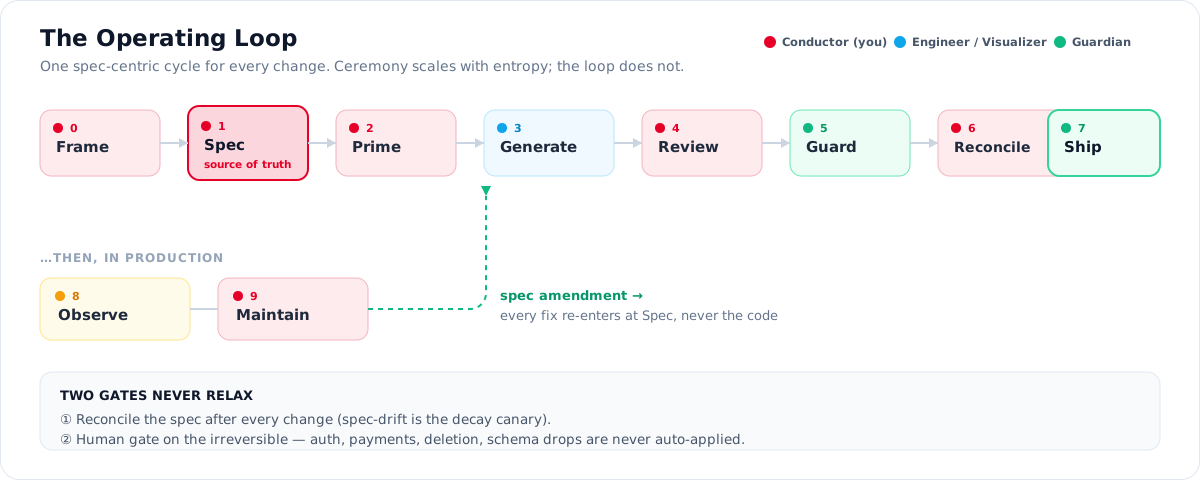
Text version of the loop
   ┌──────────────────────────────────────────────────────────────────────┐
   │                                                                        │
   ▼                                                                        │
0 FRAME ─▶ 1 SPEC ─▶ 2 PRIME ─▶ 3 GENERATE ─▶ 4 REVIEW ─▶ 5 GUARD ─▶ 6 RECONCILE ─▶ 7 SHIP
   │          ▲                                    │           │            │
   │          │                                    └──fail─────┘            │
   │          └──────────────── spec amendment ◀─── 9 MAINTAIN ◀── 8 OBSERVE ◀───────┘
   │                                                                        ▲
   └────────────────────────── telemetry / incidents ──────────────────────┘
The loop is spec‑centric: every change — feature, fix, or refactor — re‑enters at Spec, never at the code. That single discipline keeps the source of truth authoritative (see SDD in Module 2).
| # | Phase | Owner | Input | Output | Exit gate |
|---|---|---|---|---|---|
| 0 | Frame | Conductor | Idea / business rule | Intent + entropy rating + blast radius | Scope and risk are explicit |
| 1 | Spec | Conductor | Intent | Bounded‑context spec (incl. edge cases) | Every behaviour & edge case written |
| 2 | Prime | Conductor | Spec + repo state | Loaded context window, .cursorrules
|
Agent has only what it needs |
| 3 | Generate | Engineer / Visualizer | Spec + context | Vertical slice (schema→API→state→UI) | Slice compiles & maps end‑to‑end |
| 4 | Review | Conductor | Generated slice | Approved or flagged diff | No structural drift; matches spec |
| 5 | Guard | Guardian | Slice + spec | Tests + adversarial findings | All edge cases covered & passing |
| 6 | Reconcile | Conductor | Findings / hot‑fixes | Updated spec | Spec ⇄ code back in sync |
| 7 | Ship | Zero‑Ops pipeline | Approved slice | Deployed change | Push‑to‑deploy succeeds |
| 8 | Observe | Telemetry | Production | Traces, errors, metrics | Signal flows back to operator |
| 9 | Maintain | Conductor + Engineer | Incident / change request | Spec amendment → re‑enter at 1 | Fix flows through the spec |
0 · Frame. Before any spec, name three things out loud: the business rule this serves, the blast radius (what breaks if it's wrong), and the Context Entropy (how much prep it needs). Frame is 60 seconds that prevents an afternoon of confident, wrong output.
1 · Spec. The highest‑leverage phase. The SDD Spec Template is your form. The edge‑cases section is where defects are prevented — a spec without edge cases is a wish.
2 · Prime. Give the agent the spec, the relevant slice, and .cursorrules — and nothing else. Context discipline is what keeps generation precise; see Operator Techniques.
3 · Generate. Build the whole vertical slice in one cycle so layers align by construction. UI‑heavy work routes through the Visualizer.
4 · Review. You are auditing for structural drift — does the API shape match the UI's expectations, do types match the schema, did the agent invent scope the spec didn't ask for?
5 · Guard. Open a fresh context and task it to break the slice, not bless it. This independence is the framework's only built‑in check against hallucinated correctness.
6 · Reconcile. If Guard or a hot‑fix changed behaviour, update the spec before moving on. Skipping this is the #1 way the framework decays (see stale‑spec failure mode).
7 · Ship. Git‑push deploy on a Zero‑Ops stack. Anything touching auth, payments, or data deletion gets an explicit human gate — never auto.
8–9 · Observe & Maintain. The self‑healing circle: telemetry feeds an agent that drafts a spec amendment, you approve, the loop re‑runs. Maintenance is just the loop re‑entering at Spec.
Not every change runs all ten phases at full weight. Match ceremony to risk:
| Entropy | Frame | Spec | Guard | Typical example |
|---|---|---|---|---|
| Low (1–3) | 1 line | Update existing spec | Smoke + edge tests | Add a field to an existing slice |
| Medium (5–8) | Explicit | New/expanded spec, reviewed | Full adversarial pass | New feature spanning schemas + webhook |
| High (13) | Written, with rollback plan | Re‑draft boundaries first | Multi‑lens adversarial + staged rollout | Framework migration, major integration |
Reality check. The loop is a default, not a cage. A one‑character typo fix doesn't need a frame meeting with yourself. The discipline that never relaxes regardless of entropy: reconcile the spec and keep the human gate on high‑blast‑radius changes. Everything else scales down for trivial work.
See also: Scenario Playbooks (the loop applied to real situations) · Operator Techniques (the tactical how) · KPIs & Metrics (measuring the loop).