sembr 1.0.0 — initial public release

sembr 1.0.0 — Reverse RAG, self-hosted.
sembr is a self-hosted intent radar. You describe what you care about once — "monitor Fed policy impact on emerging-market currencies" — and it continuously scans RSS feeds, news APIs, and social streams, matches articles to your intent via semantic vectors, and delivers LLM-analyzed digests from whatever angle you configure.
Apache-2.0. ~1 GB total image footprint. Runs on a 4 GB box.
git clone https://github.com/Peakstone-Labs/sembr.git
cd sembr && cp .env.example .env   # set EMBEDDER_API_KEY + SMTP creds
docker compose up --build
Or — paste this to your AI coding agent:
Read https://github.com/Peakstone-Labs/sembr/blob/main/agent/INSTALL.md and follow it to install sembr on this machine.
15 minutes from git clone to your first email digest. Live demo: panel.peakstone-labs.com/#news — what sembr is producing today.
What's in the box
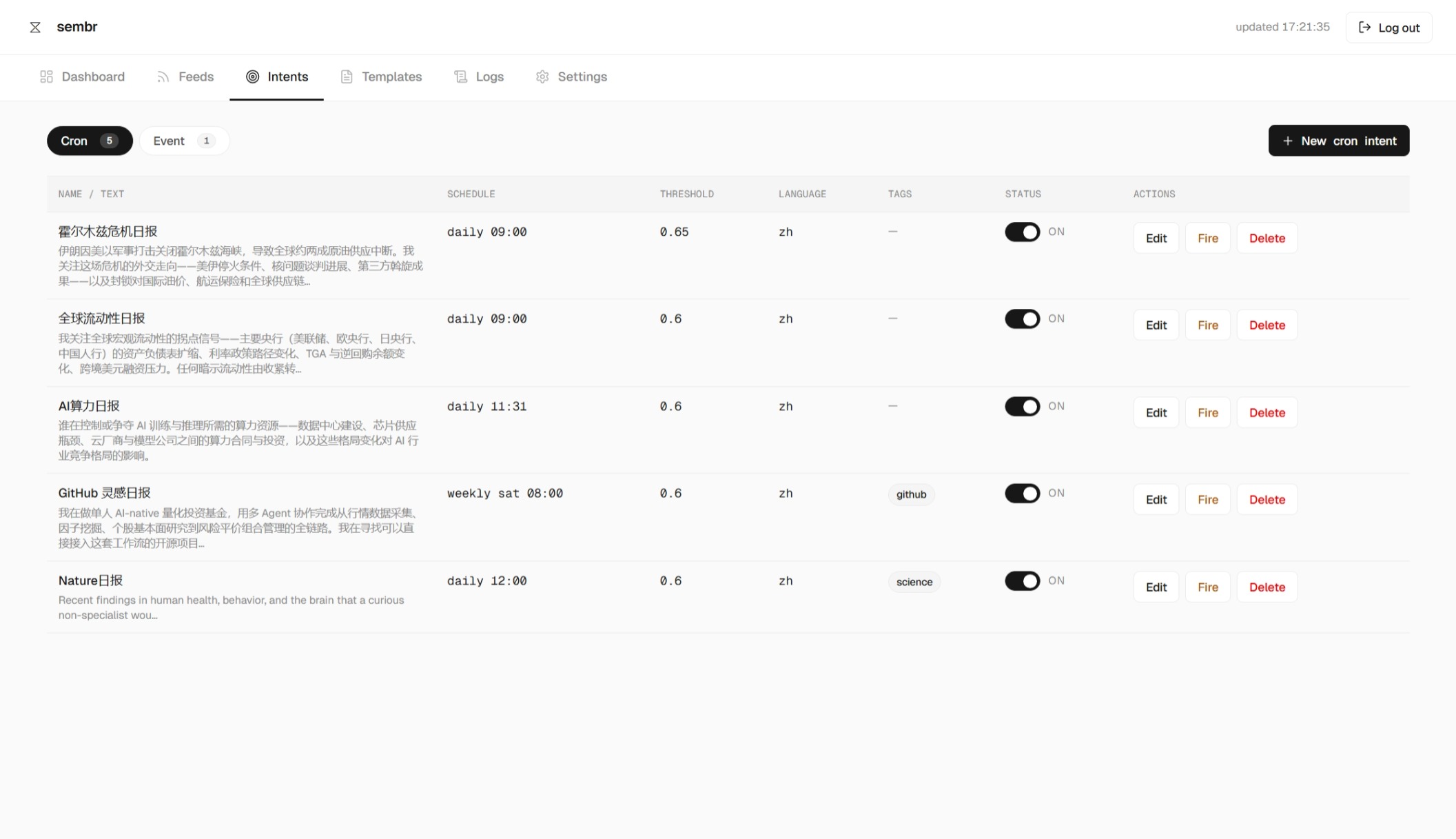
- Reverse-RAG matcher — cron + event modes; per-intent threshold (0.60–0.95); two-layer dedup (MD5 ingest + per-intent
match_seen). - 53 pre-loaded sources across three source types — 22 RSS feeds (Guardian / SCMP / NPR / Bloomberg Markets / 华尔街见闻 / 第一财经 / 36氪 / Nature ×3 / HelloGitHub / …), 30 NewsAPI.ai aggregator sources (Reuters / BBC / NYT / WSJ / FT / Economist / TechCrunch / Wired / …), 1 Twitter feed via bundled RSSHub sidecar.
- BGE-M3 embeddings on SiliconFlow — 1024-dim, 8192-token context, native bilingual EN/CN. Free at any volume on the BGE-M3 tier.
- DeepSeek-V4-Flash summaries — 1M-token context lets one digest ingest a hundred long articles for well under a cent.
- Custom prompt templates — system + instruction templates with strict-placeholder validation; per-intent template selection; edits take effect on the next scheduler tick.
- Email digest channel — SMTP multipart/related, inline assets, matcher-score badges, rendered in each intent's own timezone. Telegram / Discord / Slack scaffolded for post-1.0.
- Qdrant 1.17.1 dual-collection design (intents + news) with scalar int8 quantization,
always_ram=TrueANN over disk-resident raw vectors.
Built for agents
sembr was designed agent-first from day one:
agent/INSTALL.md— a 6-phase install protocol written for AI coding agents to read. Paste the URL to Claude Code / Cursor / Cline / Aider / Continue / Roo and walk away for 15 minutes.agent/sembr/— a full Agent Skills bundle (SKILL.md+ endpoint / schema / recipe / error references). Drop it into~/.claude/skills/sembr/and your agent can drive a running sembr instance: create intents, tune thresholds, edit templates, trigger diagnostic fires.POST /api/external/intents/{id}/fire— synchronous endpoint returning matched articles + LLM summary in one round-trip. No notification side-effects, nomatch_seenwrites, per-call overrides for lookback / threshold / feed scope. Hermes / OpenClaw / LangGraph / your own orchestrator can treat sembr as a tool node.
Deploy sembr with an agent. Drive it as an agent's tool. Both work out of the box.
Why "Reverse RAG"?
In classic RAG, you ask a question; the system retrieves and answers.
In Reverse RAG, you describe a long-running intent once; the system retrieves forever, scanning incoming articles against your intent vector on a schedule you set.
Attention Is All You Need — AI is your attention.
The matcher is built literally on attention-based BGE-M3 embeddings. Out the back: the digest comes through whatever framing you wrote into the prompt template. Same engine, different angle per intent.
Live demo
panel.peakstone-labs.com/#news — two production intents (霍尔木兹海峡危机日报 / AI 算力日报) running on sembr right now, regenerated daily, anyone can read. What's on screen is what sembr produces.
Right-sized
| Component | Memory (default 53 sources) | mem_limit (4× headroom) |
|---|---|---|
api |
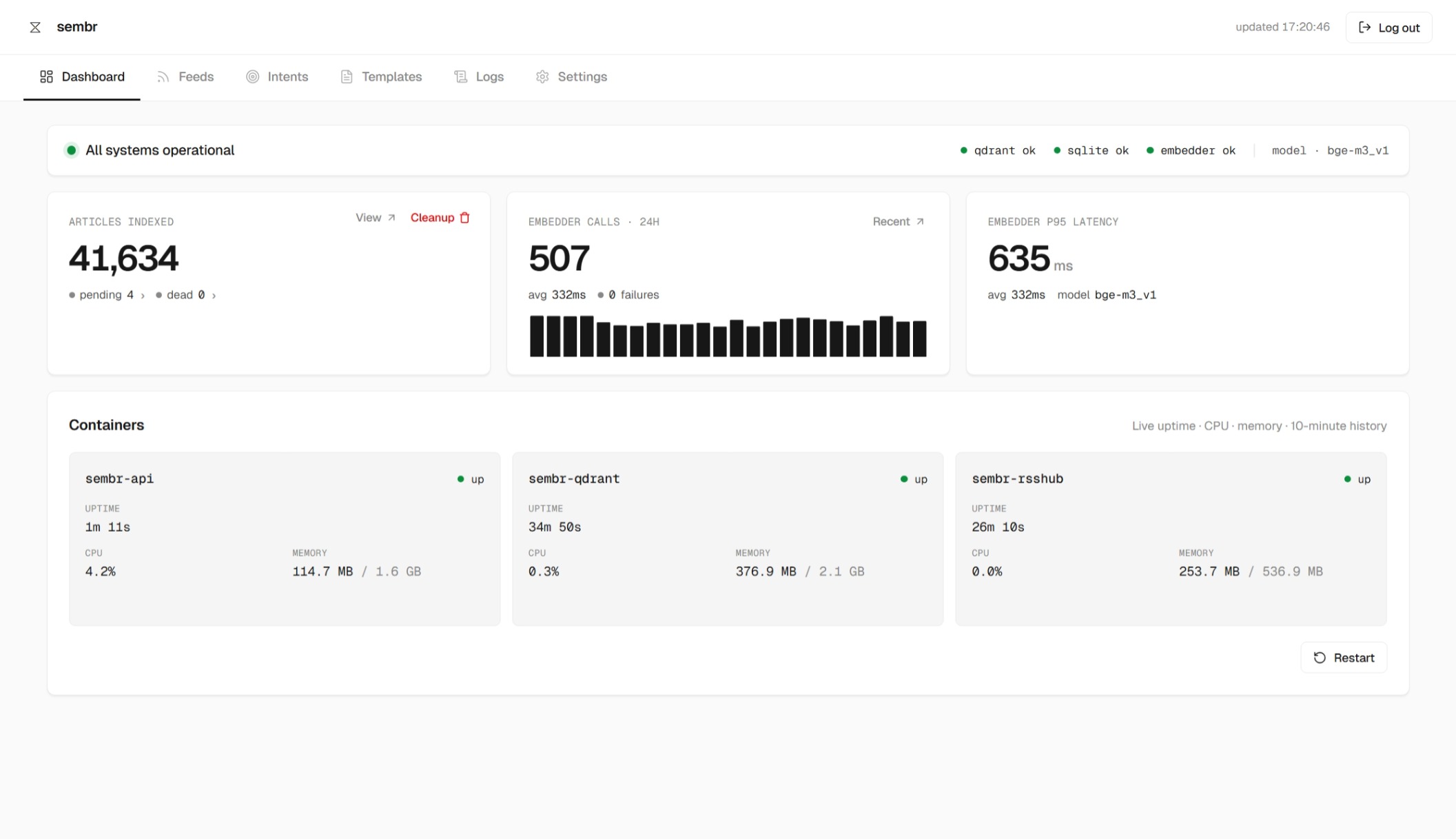
~125 MiB | 1.5G |
qdrant |
~520 MiB | 2G |
rsshub |
~355 MiB | 512M |
| Total | ~1 GB | — |
Homelab / Mac mini / NAS / $10 VPS all comfortable. First-pull total ~1 GB (Python 3.12 base + Qdrant + RSSHub).
Security model
DashboardTokenMiddlewaregates/api/*behindX-Dashboard-Token./healthis intentionally auth-free.- sembr logs an
ERRORifDASHBOARD_TOKENis empty — OK for localhost dev, unsafe for any host reachable beyond loopback. - See
docs/deployment/public.mdfor the end-to-end public-deployment guide: reverse-proxy samples (Caddy / nginx / Cloudflare Tunnel), ufw, SSH hardening, nmap verification. - Private Vulnerability Reporting enabled — please report security issues via the Security tab, not public issues. See
SECURITY.md.
Tech stack
Python 3.12 · FastAPI 0.115 · Pydantic v2 · APScheduler 3.11.2 · Qdrant 1.17.1 · aiosqlite 0.20 · httpx 0.27 · feedparser 6 · BGE-M3 (SiliconFlow) · DeepSeek-V4-Flash (SiliconFlow).
Links
- Quickstart: README.md · zh-CN
- Agent install protocol:
agent/INSTALL.md - Docs: peakstone-labs.github.io/sembr
- Live demo: panel.peakstone-labs.com/#news
- Full changelog: CHANGELOG.md
- Contributing: CONTRIBUTING.md · zh-CN
Acknowledgments
Built by Peakstone Labs. sembr is our first open-source project — and not the last.
We're a quant research outfit. The problems sembr solves (information overload, unstructured-source tracking, agent-callable monitoring) are the ones we hit ourselves every day. Open-sourcing them is the cheapest way to make them better — for us and for everyone facing the same problems.
License: Apache-2.0 · See NOTICE for attribution.
Issues: GitHub Issues · Discussion: GitHub Discussions · Security: PVR