Repository navigation
Snakemake and Scripts Reference
Where every rule and script lives, what each does, what it calls, and the conventions for writing new ones.
Changing one rule can change all 27 builds. Knowing how the files connect tells you what a change will touch.
Look things up here; follow the conventions when you add or change code. How to run the pipeline is on Step 2.
flowchart LR
    SF["Snakefile<br/>wildcards, min_lengths,<br/>rule all"] --> I["ingest.smk"]
    SF --> C["colors.smk"]
    SF --> S["segments.smk"]
    SF --> G["genomes.smk"]
    SF --> R["reports.smk"]
    SF --> SN["snapshot.smk"]
    I -->|"data/{subtype}/{segment}"| S
    I -->|"data/{subtype}/genome"| G
    S -->|"HA Nextclade calls"| G
    C -->|"colors.tsv"| S
    C -->|"colors.tsv"| G
    S --> R
    G --> R
    R --> SN
The Snakefile includes six rule files in this order; arrows show which
outputs feed which file. colors.smk must come before segments.smk and
genomes.smk, reports.smk after ingest.smk, and snapshot.smk after
reports.smk.
All rules live in workflow/snakemake_rules/.
| File | What it does | Calls | Main outputs |
|---|---|---|---|
Snakefile |
Wildcard constraints (subtype: h1n1/h3n2/vic, segment: pb2...ns), segment minimum lengths, rule all (27 builds + report) |
- | - |
ingest.smk |
Types JHH segments, builds fludb, writes per-build inputs |
scripts/flusort/flusort.py; fludb/scripts/fludb_inititate.py, upload_jhh.py, upload_vaccine.py; scripts/fludb_download_builds.py (→ fludb/scripts/download.py, download_concatenated.py; reads config/subtype_assignment.yaml) |
source/flusort_*, fludb.db, data/{subtype}/{segment}/, data/{subtype}/genome/
|
colors.smk |
Syncs subclade colors from nextstrain/seasonal-flu before any export | scripts/sync_subclade_colors.py |
config/{subtype}/colors.tsv, config/subclade_colors_source.tsv
|
segments.smk |
One build per subtype × segment |
nextclade; scripts/assign_clades.py; scripts/merge_quality_metrics.py; augur
|
results/{subtype}/{segment}/, auspice/{subtype}/{segment}.json, ..._tip-frequencies.json
|
genomes.smk |
Whole-genome build per subtype |
csvtk; augur
|
results/{subtype}/genome/, auspice/{subtype}/genome.json
|
reports.smk |
Surveillance report; run start/end handlers (provenance, data scan, run report) |
scripts/report.py; scripts/run_report.py; scripts/record_provenance.py; scripts/data_guard.sh
|
reports/, .run/run_logs/, .run/reports/
|
snapshot.smk |
Archive and clean the workspace | scripts/snapshot_clean.sh |
snapshots/{timestamp}.tar.gz |
ingest.smk: flusort → fludb_inititate → upload_genomes,
upload_vaccines → download_segments → download_genomes (+ ingest_complete).
segments.smk (per subtype × segment): fetch_hana_datasets (once per
run; downloads the git-ignored HA/NA datasets and logs their tags) → nextclade → assign_clades → merge_quality_metrics →
augur_filter → align → raw_tree → refine → annotate_traits,
infer_ancestral → translate → export; frequency.
genomes.smk (per subtype): genome_clades → genome_filter →
genome_align → genome_tree → genome_refine → genome_traits,
genome_ancestral → genome_translate → genome_export; genome_frequencies.
colors.smk: sync_subclade_colors (once per run, before the first
export; skip with --config sync_subclade_colors=false).
export and genome_export wait for sync_subclade_colors, then color
subclades from config/{subtype}/colors.tsv
(Subclade colors).
reports.smk: surveillance_report; handlers onstart, onsuccess,
onerror.
snapshot.smk: snapshot_clean (on demand), snapshot_clean_after_build
(with --config snapshot_clean=true).
Because wildcards are constrained by subtype and segment, this graph runs for H1N1, H3N2 and B/Victoria for all 8 segments, plus the 3 genome builds.
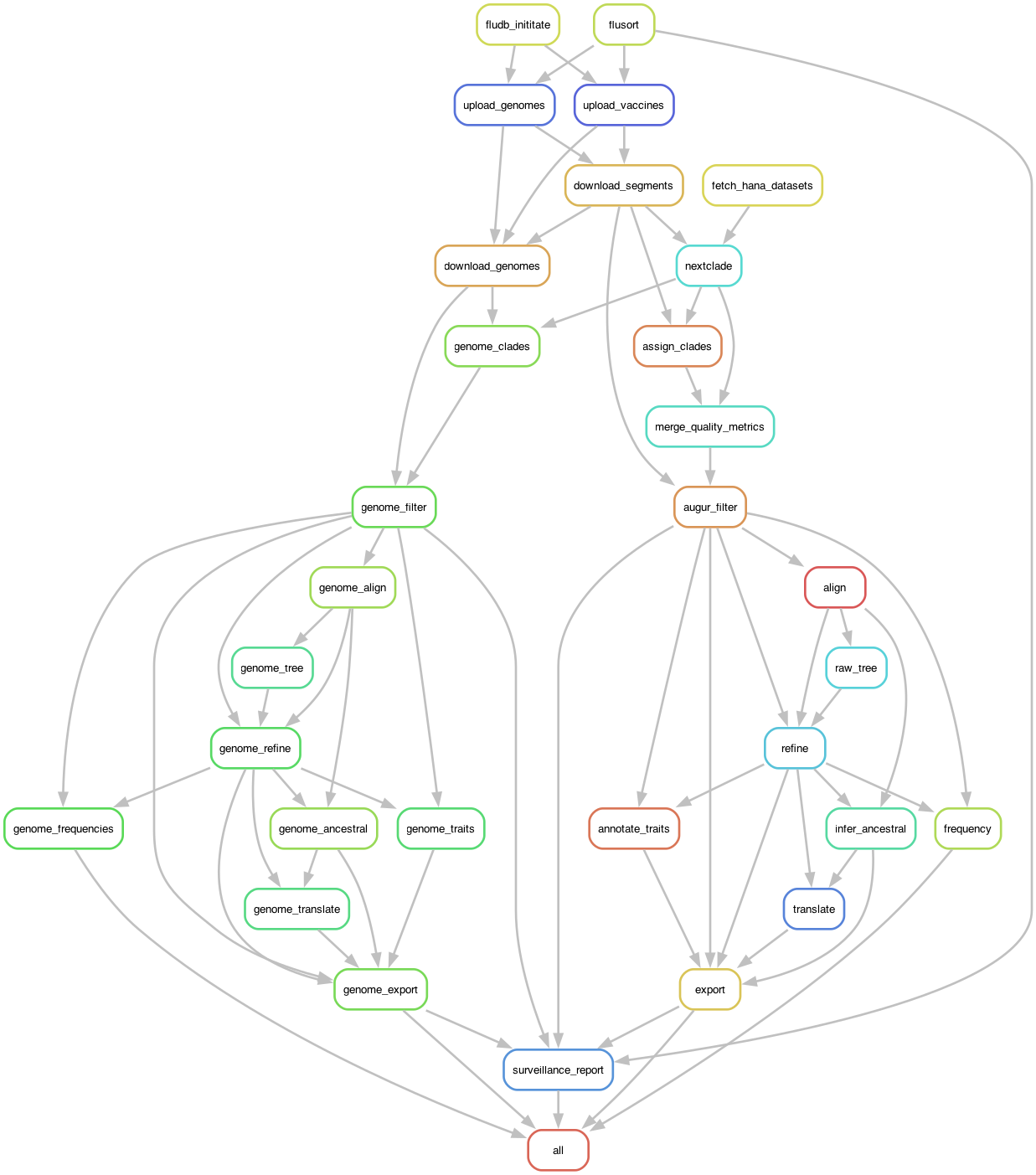
Regenerate after changing rules (graphviz: conda install -c conda-forge graphviz
if missing):
snakemake --rulegraph | dot -Tpng > rulegraph.png-
One
.smkfile per major feature. A new feature (e.g. t-SNE embeddings, reassortment analysis) gets its own file and oneinclude:line in theSnakefile; keep the include order. -
Keep
.smkfiles declarative: inputs, outputs, params and a shortshell:. Small helpers (likeclock_rate()) and one-line lambdas are fine; more than a few lines of Python belongs inscripts/.script:is fine for short pandas steps (seescripts/assign_clades.py). -
Every rule has
message:,input:,output:,log:(.run/logs/{rule}/{subtype}_{segment}.log), and ashell:starting withexec > {log} 2>&1, Python run aspython -u. Addbenchmark:(.run/benchmarks/...) for anything slower than a few seconds andthreads:for multithreaded tools. -
Outputs go to
results/(intermediate) orauspice/(final). Rules never write intosource/,config/ortutorial/(theflusort_*outputs insource/are a historical exception). -
Use the input variables from
ingest.smk(jhh_sequences, ...), not hard-codedsource/paths, so the tutorial config keeps working. -
Use the existing wildcards
{subtype}and{segment}(plusgenome); new targets inrule allare Tier 2. -
Keep filter values in sync with
config/report.yaml(Step 3). -
Name rules in
snake_caseafter their output. -
Test:
snakemake -n,snakemake --lint(no new warnings), a tutorial run, regeneraterulegraph.png, update the wiki (page map).
-
All functional code lives in scripts. Anything that calculates or
modifies metrics or data for the builds is a script in
scripts/(fludb's own infludb/scripts/), called by a rule. Never in a notebook, never as a long block inside a.smkfile. - Header docstring: what it does, which rule calls it, inputs, outputs, and, for adapted code, the original source and licence.
-
Arguments, not hard-coded paths:
argparsefor command-line scripts, thesnakemakeobject forscript:scripts. -
Small, named, commented functions; comment the why. No unused options,
no dead code, no
_v2copies. - Report what happened (rows read, written, dropped and why) into the rule's log. Fail loudly on bad input; never write partial output.
- No new dependencies without a Tier 3 environment change.
-
Naming:
snake_case.py, verb first (assign_clades.py). -
Retiring: move to
scripts/depreciated/in its own commit; remove the calling rule in the same PR.
| Script | Called by | Purpose |
|---|---|---|
scripts/prepare_source.py |
you (Tutorial 2) | Build JHH_sequences.fasta + JHH_metadata.txt from the run FASTAs in source_prep/
|
scripts/flusort/flusort.py |
rule flusort
|
BLAST typing/subtyping and completeness of JHH segments |
fludb/scripts/fludb_inititate.py |
rule fludb_inititate
|
Create the empty fludb.db
|
fludb/scripts/upload_jhh.py |
rule upload_genomes
|
Load JHH sequences + metadata (database_origin = mostafa_lab) |
fludb/scripts/upload_vaccine.py |
rule upload_vaccines
|
Load vaccine.fasta (database_origin = gisaid) |
scripts/fludb_download_builds.py |
rules download_segments (--segments), download_genomes (--genome) |
Writes data/{subtype}/ from fludb for one subtype: fludb/scripts/download.py per segment, or download_concatenated.py for the genome. Which fludb subtypes go into each build (incl. assumed H1xx/xxN1/H3xx/xxN2) is set in config/subtype_assignment.yaml. Replaces fludb_download_seasonal_build.py and fludb_download_seasonal_build_genomes.py
|
scripts/assign_clades.py |
rule assign_clades
|
Copies Nextclade HA clade/subclade onto each segment's metadata |
scripts/merge_quality_metrics.py |
rule merge_quality_metrics
|
Adds Nextclade coverage and QC status to metadata |
scripts/report.py |
rule surveillance_report; marimo run
|
Surveillance report (HTML, PowerPoint, tables) |
scripts/run_report.py |
run end handlers | Per-run timing/memory report in .run/reports/
|
scripts/record_provenance.py |
run start/end handlers; rule fetch_hana_datasets
|
Writes input-file checksums and record counts (start) and Nextclade dataset tags (end) to the provenance file |
scripts/snapshot_clean.sh |
rules snapshot_clean*
|
Archive and clean the workspace |
scripts/data_guard.sh |
git hooks; run start | GISAID/JHH data protection (maintainer only) |
scripts/build_env.sh |
you | Build/check the environment, enable hooks |
scripts/generate_tutorial_dataset.py |
maintainer | Rebuild the tutorial dataset from fludb |
scripts/sync_subclade_colors.py |
rule sync_subclade_colors; maintainer, by hand |
Copy the official Nextstrain subclade colors into config/{subtype}/colors.tsv; --check reports drift (Subclade colors) |
scripts/nextstrain_upload.py |
a person, by hand only | Upload all builds to the private group, or to the public group with --public; checks files, logs in, asks for typed confirmation (Step 5) |
scripts/shannon.py |
you | Per-position Shannon entropy of an alignment |
scripts/join-genbank.py, join-segments.py
|
you | Concatenate GenBank/FASTA segments (from nextstrain/avian-flu, unmodified) |
scripts/pyflute.py, scripts/flusort/flusort_split.py
|
you | Legacy segment sorting/filtering helpers |
fludb/scripts/upload_gisaid.py |
nothing | Bulk GISAID upload; not part of the pipeline |
scripts/depreciated/* |
nothing | Retired (incl. jhh_unique_strains.py); kept for reference. The folder is git-ignored: scripts retired there in October 2026 (the three old upload scripts, download_datasets.py) stay on the maintainer's computer only |
fludb's query options (filters, headers, segments) are documented in
fludb/README.md;
flusort's in scripts/flusort/README.md;
the custom Nextclade datasets in nextclade/README.md.
-
Snakemake wants to rerun everything after a small edit. You changed an
input, a rule's code or params used everywhere (e.g.
Snakefile). The dry run (snakemake -n) prints the reason for each job. -
AmbiguousRuleExceptionafter adding a rule: two rules can make the same file; tighten the output path or wildcard constraints. -
My
script:can't findsnakemake. That object exists only when run by Snakemake; test with a small rule, notpython script.py.
Next step → Glossary