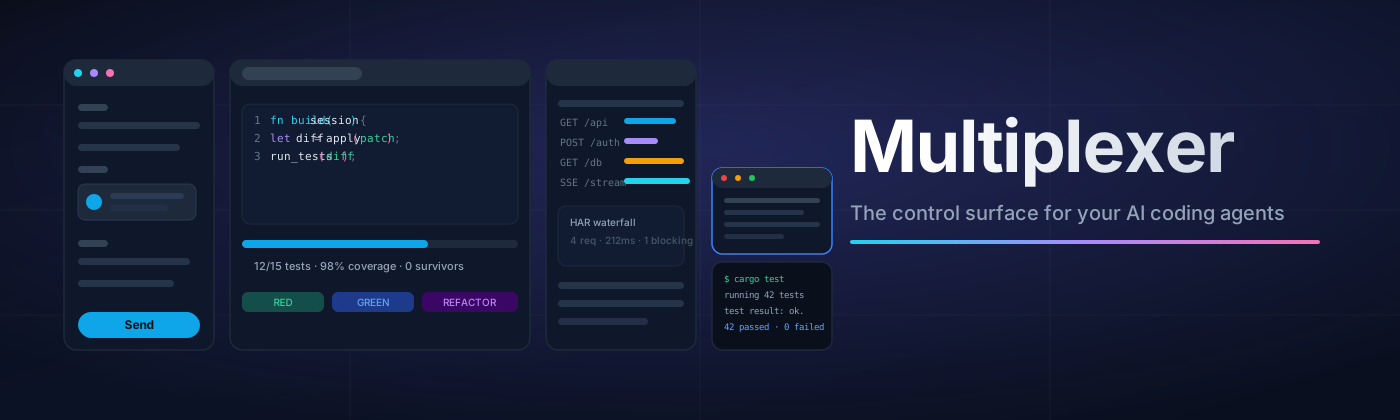
A beautiful, blazing-fast desktop control surface for your AI coding agents — a real editor, real performance, and real insight, built in Rust on a GPU-rendered UI.


-brightgreen.svg)
-success.svg)


Thesis · Why · Architecture · Status · Engineering · Roadmap
- Outlook workbench around Grok. Left list, center host, right inspector. Chat log is
grok -p. Grok TUI is the real pager in a console (not a GPUI clone). In-process embedding is the destination, not the running desktop today. - A review editor, not the center. Native GPU editor (rope, LSP, Vim) as a pane or pop-out. Grok edits. Multiplexer reviews.
$VISUALuntil that crate lands. - Your browsers, not a bundled one. Detect and import the browsers you already have, drive them over CDP. No bundled Chromium.
- Ships with a HAR profiler/replayer. Capture the network, visualize waterfalls, replay sessions, and feed the insight back to the agent.
- Panes that pop out. Chat, build, and an instrumentation bar that can each float to their own window.
- Strict TDD at 100/100. Every module lands at 100% coverage and 100% mutation score with zero survivors, enforced by CI. Today that gate is proven on
multiplexer-wire; every future module must clear it too.
Most agent tools treat the agent as a black box you talk to through a chat bubble. You watch text stream by and hope. Multiplexer's core idea is different: the agent is an instrument you hold, not a service you message.
By embedding the agent runtime in the same process, we get the runtime's internals — not just its stdout. By pairing that with a real editor, real performance, and real network insight, we turn the agent loop from something you observe into something you steer with confidence. A control surface, not a chat client.
Because the two strongest competitors are locked out of where we're going:
- Superset and Conductor are macOS-only. Multiplexer is cross-platform, Windows-first in practice.
- Orca and T3 Code drive agents as external processes. In-process embedding gives us lower latency, richer introspection, and HAR/orchestration that a process boundary can't.
| Multiplexer | Orca | T3 Code | Superset | Conductor | |
|---|---|---|---|---|---|
| In-process agent runtime | ✅ | ❌ | ❌ | ❌ | ❌ |
| Native editor | ✅ | ❌ | ❌ | ❌ | ❌ |
| System-browser import (no bundled Chromium) | ✅ | ❌ | ❌ | ❌ | ❌ |
| HAR profiler / replayer | ✅ | ❌ | ❌ | ❌ | ❌ |
| Windows-first | ✅ | partial | ✅ | ❌ | ❌ |
| Mutation tested at 100/100 | ✅ | ❌ | ❌ | ❌ | ❌ |
The center of gravity is a single native Rust binary that owns the agent runtime, terminals, git, filesystem, checkpoints, and HAR capture. Desktop, mobile, and web are thin shells over one authenticated JSON-RPC-over-WebSocket contract.
flowchart TB
    subgraph Clients["Thin clients"]
        Desktop[Desktop<br/>Rust + GPUI]
        Mobile[Paired mobile<br/>Expo / React Native]
        Web[Web]
    end

    subgraph Server["multiplexer-server (single native binary)"]
        direction LR
        Wire[multiplexer-wire<br/>JSON-RPC contract]
        Core[multiplexer-core<br/>orchestration · decider · projector]
        Provider[multiplexer-provider<br/>adapter + model registry]
        UI[multiplexer-ui<br/>GPUI surface]
        Terminal[multiplexer-terminal]
        Browser[multiplexer-browser]
        Har[multiplexer-har]
    end

    Embed[Grok Build<br/>xai-grok-shell embedded in-process]
    Acp[ACP fallback<br/>grok agent stdio / serve]

    Desktop <-->|JSON-RPC / WS| Wire
    Mobile <-->|JSON-RPC / WS| Wire
    Web <-->|JSON-RPC / WS| Wire
    Wire <--> Core
    Core <--> Provider
    Core --> Terminal
    Core --> Browser
    Core --> Har
    Provider --> Embed
    Provider -.->|fallback| Acp
The wire contract is the single source of truth — multiplexer-wire is planned to be codegen'd for Swift, Kotlin, and TypeScript clients, so the desktop, mobile, and web clients can never drift apart.
The Phase-0 spike is complete and green. The core go/no-go that gated the whole product — can we embed xai-grok-shell as a library and build it on Windows? — is proven: the Phase 0 spike built the vendored runtime on Windows and consumed it from an independent binary, loading the real user config. See docs/SPIKE-REPORT.md. The rest of Phase 0 (GPUI shell, wire skeleton, test harness, CI gates) is still in progress per plan/19-roadmap-and-milestones.md.
The full implementation plan lives in plan/ (21 authored docs, adversarially reviewed) with 40 locked decisions in docs/DECISIONS.md.
What exists today:
- ✅ Vendored
xai-org/grok-buildfork underthird_party/, building on Windows - ✅ Phase-0 spike proving in-process consumption (
spike/) - ✅
multiplexer-wirewith the approval-decision model, TDD at 100/100 - 🔲 Everything else — the editor, orchestration, terminal, browser, HAR, panes, mobile, remote
This is a real, working product in the making, not a mockup. The next milestone is the live in-process turn.
Every module is written test-first (RED → GREEN → refactor) and must clear a hard, CI-enforced gate before it is committed:
fmt → clippy (deny warnings) → unit + property → mutation → integration → component → e2e → coverage → perf
- 100% coverage (lines/branches/functions/regions) via
cargo-llvm-cov. - 100% mutation score via
cargo-mutants, with zero survivors. Coverage alone is a lie; mutation testing proves the tests actually catch real faults. A surviving mutant is fixed by strengthening the test, never by silencing it. - Property-based testing with
proptestfor state machines, deciders, projectors, and serializers — so we catch whole classes of bugs, not single instances. - Deep assertions, not shallow ones. We assert on the projected read model and the event stream, not on the return value of the triggering call. Tests prove invariants, round-trip identity, and cross-layer consistency.
- Mutation gates every subsystem, including the editor's buffer and diff-apply, the terminal's PTY and scrollback, the browser's security controls, and the pane system's layout engine.
- A dedicated performance stage enforces the hard gates: cold start
< 300ms, input latency< 16ms(p95), dozens of concurrent subagents without a serialization bottleneck. - E2E on the merge gate, full suite nightly. No "skip e2e for small changes" path.
The full testing strategy is in plan/15-testing-strategy.md.
Desktop reload. GPUI cannot swap code in a live window. Watch apps/ and crates/, rebuild, and restart:
pwsh -File scripts/hotreload.ps1
cargo mux
crates/
  multiplexer-wire/       shared JSON-RPC contract (single source of truth, codegen for clients)  [exists]
  multiplexer-provider/   provider adapter trait + model registry (Grok in-process + ACP)          [planned]
  multiplexer-core/       orchestration engine, decider, projector, read model                      [planned]
  multiplexer-server/     composition root: the single native binary                               [planned]
  multiplexer-ui/         GPUI desktop UI (editor, panes)                                          [planned]
  multiplexer-terminal/   embedded terminal                                                        [planned]
  multiplexer-browser/    system-browser import + CDP                                              [planned]
  multiplexer-har/        HAR profiler / replayer                                                  [planned]
third_party/
  grok-build/             vendored fork (SOURCE_REV tracked, Windows build supported)
spike/                    Phase-0 spike: in-process consumption proof
docs/
  DECISIONS.md            D1-D40 locked decisions (authoritative)
  PLAN-CONTEXT.md         shared plan context
  SPIKE-REPORT.md         the Phase-0 GO verdict
  REVIEW-SUMMARY.md       adversarial review findings
plan/                     00-20 implementation plan docs
gantt
    title Multiplexer roadmap
    dateFormat  YYYY-MM-DD
    axisFormat  %m-%d

    section Phase 0
    Embedding + Windows spike        :done, p0, 2026-08-12, 1d
    section Phase 1 (Core MVP)
    Wire contract + server           :active, p1a, 2026-08-12, 3w
    Orchestration engine             :p1b, after p1a, 3w
    Provider adapter                 :p1c, after p1a, 2w
    section Phase 2 (Editor + Panes)
    Native editor                    :p2a, after p1b, 4w
    Pane system                      :p2b, after p1b, 3w
    section Phase 3 (Browser + HAR)
    System-browser integration       :p3a, after p2b, 3w
    HAR profiler / replayer          :p3b, after p2b, 3w
    section Phase 4 (Mobile + Remote)
    Mobile thin client               :p4a, after p1a, 4w
    Remote / relay / SSH             :p4b, after p1a, 3w
    section Phase 5-6 (post-MVP)
    Multi-provider + scale           :after p4b, 4w
    GA                               :after p5, 3w
The MVP is Phases 1–4 (core runtime + editor/panes + browser/HAR + mobile/remote). The paired mobile app is a hard MVP gate. Matching the full Orca baseline across Phases 1–5 is roughly ~6–9 months with 3–5 engineers (≈ 20–40 person-months). See plan/19-roadmap-and-milestones.md.
This repo follows the rules in AGENTS.md (binding for every agent) and the plan in plan/. The short version:
- Strict TDD. Write the failing test first (RED), confirm it fails for the right reason, then implement (GREEN), then refactor.
- The 100/100 gate. No module merges unless it's at 100% coverage and 100% mutation score, with fmt/clippy clean.
- No survivor silencing. A surviving mutant is fixed by strengthening the test, never by weakening the code or adding ignore comments.
- Deep assertions. Assert on the read model and event stream, not on return values.
Apache License 2.0 © Premier Studio. See LICENSE.
Multiplexer embeds a vendored fork of xai-org/grok-build (Apache-2.0). See the fork's THIRD-PARTY-NOTICES and the in-tree notices for third-party code.