Repository navigation

279 commits from 25 contributors (11 new) since v0.9.0.
Highlights
1. Trainer Performance
One MoE runtime and checkpoint layout now serves every model. Runtime gate/up and QKV fusions are on by default, a SonicMoE BF16 backend is available, and MoE compute can be chosen per layer. MoE blocks now compile with fullgraph, FA4 runs through a custom op so compile can trace attention, and the loss is chunked torchtitan-style. CPU optimizer offload reuses pinned buffers, which cut a DeepSeek V4 Flash SFT step from 30.9 s to 6.5 s.
SFT max trainer perf: prime-rl vs torchtitan. Qwen3-235B-A22B, measured back to back on the same nodes (2026-10-02):
| run | s/step | tokens/s/GPU | MFU | peak memory |
|---|---|---|---|---|
torchtitan (9e159aed7) |
5.04 | 3253 | 40.7% | 144 GiB |
| prime-rl | 4.39 | 3732 | 46.6% | 141 GiB |
prime-rl is 1.15× faster with an identical setup: 4 × 8 B300, seq 16k, FSDP + EP 8, full AC, fp32 AdamW, balanced routing. The trainer defaults favor memory (optimizer and activation offloading, compile without fullgraph). For max throughput, keep everything on GPU and compile with fullgraph, as described in Scaling § Max Trainer Throughput Recipe. Reproduce with uv run sft @ examples/advanced/qwen3-235b-a22b/sft-max-perf.toml.
#3411 — Unified MoE runtime and checkpoint layout
#3451 — Runtime gate/up and QKV fusions
#3535, #3518 — SonicMoE backend and per-layer MoE compute
#3753 — Compiled MoE blocks with fullgraph
#3754 — FA4 through a custom op for compile
#3755 — Attention FLOPs with the real head dim, per-step SFT MFU
#3673 — torchtitan-style chunked loss
#3552 — Pinned buffers for CPU optimizer offload
#3419 — Operator-based activation checkpointing
#3917 — Background micro-batch preparation
#4046 — Max trainer throughput recipe and Qwen3-235B example
#4053 — Release the allocator cache after every checkpoint load, so resumed runs without offload no longer peak above a fresh run
GLM-5
- cuDNN + FlashMLA sparse attention (#3829): new
model.dsa_backend = "cudnn_flashmla"runs the DSA sparse attention forward with FlashMLA (1.9–3.6× faster than TileLang on H200) and the backward with cuDNN (3–4.7× faster).tilelangstays the default. - 12-node 16k SFT recipe (#3829): the GLM-5.3 SFT example uses
cudnn_flashmla, and a new16k-12-node.tomloverlay runs 12 nodes at 16k with no CP and no offloading, plusfullgraphand full AC. - RL example on the new kernels (#3968): the GLM-5.3 SWE RL example (131k seq, CP 4, EP 8, FP8 experts) switches to
cudnn_flashmla. Entropy and mismatch KL match TileLang to 4 decimals. - GLM-5.3 examples (#3666, #3607, #3605): SFT and SWE RL examples, BF16 serving with vLLM-side FP8, and the GLM-5.3 renderer.
Full GLM-5.3 (78 layers) SFT, H200, seq 16k, fake data:
| setup | nodes | tokens/s/GPU | MFU |
|---|---|---|---|
before: CP 2 + offloading, tilelang |
8 | 465 | 22.3% |
16k-12-node.toml, tilelang |
12 | 701 | 33.6% |
after: 16k-12-node.toml, cudnn_flashmla |
12 | 835 | 40.1% |
On real weights and data (INTELLECT-3-SFT-10K math, 12 nodes), a step drops from 31.2 s to 24.2 s (25.2% → 32.5% MFU). In the RL setting, a step drops from about 16 s to about 12.5 s (8-layer proxy on 1 × 8 H200), which extrapolates to about 22% faster steps for the full model.
DeepSeek V4 Flash
- Sparse attention kernel (#3479, #3644): a TileLang flash-style kernel with a dynamic slot count, per-query tile skipping, and no recompiles. On real data a step goes from 19.2 s to 17.8 s (46.7% → 53.6% MFU).
- Lightning Indexer (#3504, #3643): scored with the fused FP8 kernel, with autotuning bucketed so packed lengths no longer stall other ranks, and the CP KV gather overlapped with compute: 22.7 s → 19.0 s per step (40.2% → 47.8% MFU).
- Fused mHC chain (#3558): the Sinkhorn loop and write-back run as two Triton kernels, and the RMS norms go through quack.
- Fused RoPE (#3645): one Triton kernel for all five RoPE sites, bit for bit with vLLM, makes the SFT step 13–14% faster on B300.
- cuDNN + FlashMLA sparse attention (#4078):
model.dsa_backend = "cudnn_flashmla"runs the same FlashMLA sparse prefill forward vLLM uses for DeepSeek V4, with the cuDNN DSA backward.tilelangstays the default. - Trainer matches vLLM's FP8 numerics (#3956, #3955, #3647): the trainer reads the same FP8 KV cache as vLLM bit for bit, runs the grouped attention output projection (
wo_a) in FP8 like vLLM, and casts FP8 block weights exactly as vLLM's online quantizer does. Removing the DeepGEMM MoE wrapper overhead also makes FP8 MoE training faster than bf16 on H200.
Qwen3.8 Flash Next n-gram embeddings
The n-gram (engram) embedding tables are sharded by vocabulary rows across data-parallel ranks, independently of EP, instead of being replicated on every GPU (#3434).
2. RL Algorithms
IPO (INTELLECT Policy Optimization) is the new default loss (eps = 0.3, no KL term). In async RL the trainer and inference engine never agree exactly on a token's probability. IcePop masks a token when the ratio
A ratio misjudges both ends: a rare token going from 0.01 to 0.06 (6×) gets masked, while a likely token going from 0.90 to 0.20 (0.22×) is kept. The IPO mask is double-sided, ignores the advantage sign, and has one knob.
On agentic SWE RL with GLM-4.5-Air (no router replay, up to 64 steps off-policy), IcePop collapsed around step 1.2k when the trainer–inference KL blew up more than 20×. IPO at eps 0.2 and 0.3 trained through it. eps = 0.3 masks only about 0.25% of tokens, compared with 2% for the old 0.1.
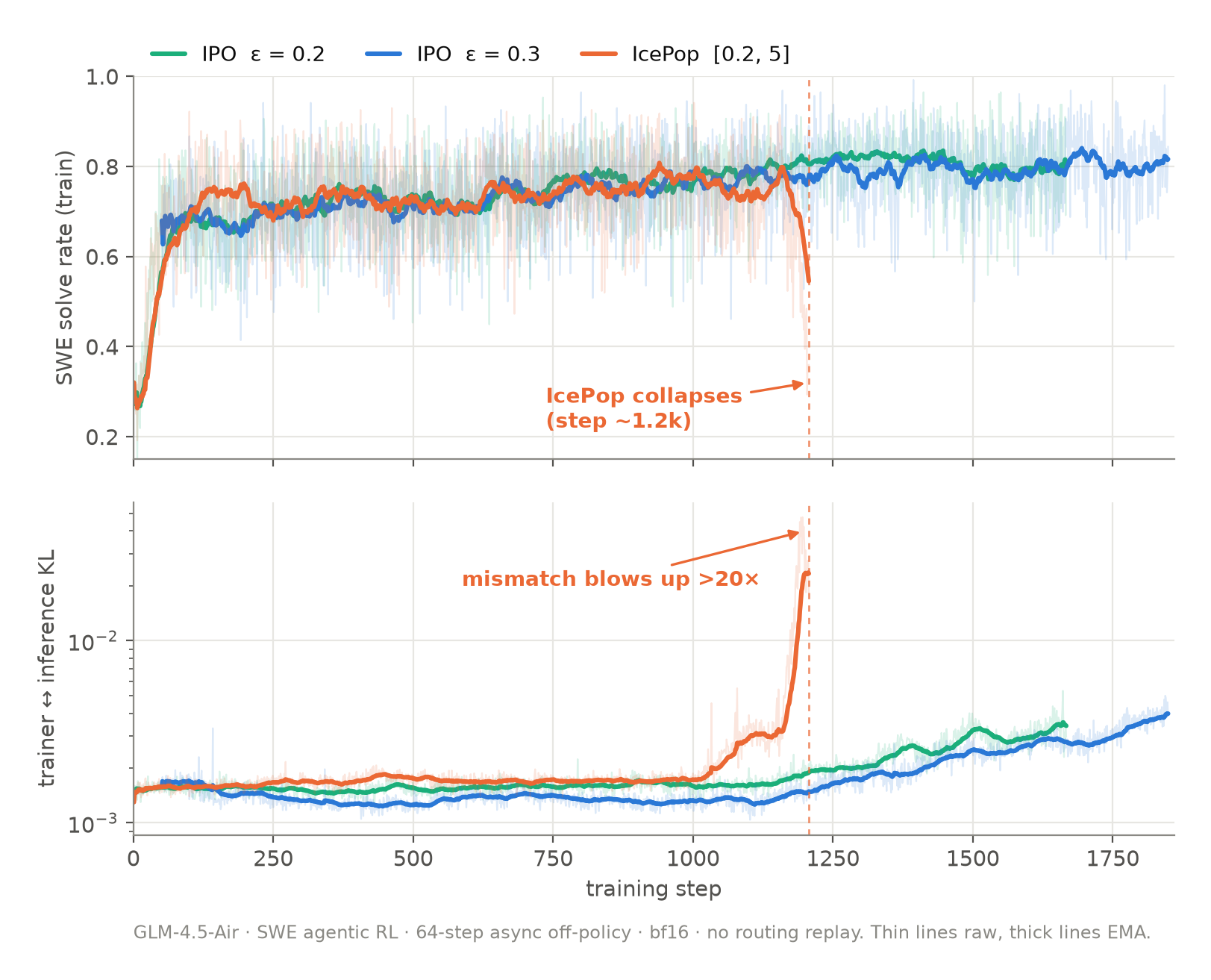
Full setup, how eps was chosen, and configs to reproduce are in docs/ipo.md (#4049).
IcePop, PPO, and CISPO remain supported as opt-in losses ([trainer.loss] type = ...). GRPO gains a length-weighted baseline and exact prompt-mean loss aggregation. Top-p/top-k sampling is replayed exactly in the trainer, the trainer batch stays a constant size by backfilling filtered samples, and RL freezes the MoE router by default.
#3418, #3586, #4049, #4052 — IPO as the default loss, and its docs
#3526, #3697 — IcePop, PPO, and CISPO losses
#3789, #3798 — Length-weighted baseline and prompt-mean aggregation
#3431 — Top-p/top-k sampling replay
#3463 — Constant trainer batch size
#3797 — Frozen MoE router in RL
3. uv run eval
The eval CLI moves from verifiers into prime-rl. One entrypoint evaluates any model on any environment, standalone or as the online evals of a training run. It runs through env servers with adaptive concurrency and the local dashboard, takes multiple [[source]] blocks, and --resume continues an interrupted run from its trace stream. Every train and eval source now has a select block for picking tasks, and source groups share env and select defaults.
#3471 — Consolidated eval CLI
#3413, #3690 — Resumable standalone evals
#3703 — Per-source task selection
#3695, #3714 — Shared group defaults for train and eval sources
#3702 — Timed-out rollouts as their own outcome
#3826 — Resume requires the saved resolved config to match (--resume.skip-checks to override)
4. New Models: DeepSeek V4 Flash, Qwen3.8 Flash Next, Nemotron-H, and Multimodal RL
Every supported architecture now runs on a PrimeRL implementation; the Hugging Face fallback is gone.
- DeepSeek V4 Flash: custom kernels for sparse attention, the FP8 Lightning Indexer, the mHC chain, and RoPE (see Trainer Performance). Supports ring context parallelism.
- Qwen3.8 Flash Next (text): engram support (n-gram embeddings sharded by vocabulary rows), indexed sparse attention kernels from
prime-kernels, Gated DeltaNet, hyper-connection residuals, and sigmoid-gated MoE. - Nemotron-H (Nano and Super): Mamba-2 on the upstream Triton SSD kernels, with state resets at packed-document boundaries and Ulysses context parallelism.
- Multimodal RL: images now stay inline through rollouts, packing, and transport, instead of being shipped as preprocessed pixel tensors. vLLM returns the expanded prompt IDs and image placeholder ranges, so each image token lines up exactly in training. The trainer builds vision inputs lazily through a per-family adapter (Qwen-VL, Kimi K2.5).
#3325, #3479, #3504, #3508, #3558, #3644, #3645, #4040 — DeepSeek V4 Flash, kernels, CP, and vLLM serving fixes
#3434 — Native Qwen3.8 Flash Next
#3426 — Native Nemotron-H
#3320 — RL from inline multimodal rollouts
#3773 — Remove the HF model fallback
5. Trace Viewer
Every episode is written once to an append-only stream, and the trainer annotates it afterwards. The dashboard overlays per-token entropy, the trainer↔sampler mismatch, and the IPO mask on the loss mask. New Semantic and Replay views show agent and subagent structure and replay a rollout in real time. Traces have persistent URLs, and the overview has a global filter.
#3444, #3465 — Trace annotations, overlays, and chunked streams
#3455 — Semantic agent traces
#3456 — Timed terminal replay
#3470, #3478, #3721 — Task/judge evidence, compactions, and subagent status
#3725, #3759 — Global filter and persistent trace URLs
6. Inference and Weight Transfer
vllm-router now defaults to sticky least-loaded routing, which sends new sessions to the least-busy engine and keeps each session on its engine for prefix-cache hits. NCCL updates always send HF-format weights and let vLLM apply its own FP8 quantization. NIXL transfers are pipelined through ModelExpress, and a Dynamo admin plane is available for weight sync.
#3563 — Sticky least-loaded routing
#3580, #3581 — Online inference quantization
#3340, #3341 — ModelExpress and pipelined NIXL pulls
#3491 — Dynamo admin plane
#3608 — EP weight filter on by default
#3900 — Packed /generate per-token payloads and tuned API-server GC, removing multi-second GC pauses under RL load
#3830 — Router replay with disaggregated P/D on the V2 runner
#4045 — MXFP8 online quantization ([inference.vllm] quantization = "mxfp8")
#4031 — Backport of vLLM's SHM buffer ownership fix, so router replay no longer reads overwritten expert IDs
7. Job Control and Batch Transport
Each component now exposes an HTTP control API, so a running RL or SFT job can be paused at a chosen step, saved, and stopped. Trainer ranks now pull each batch step from the orchestrator, so the trainer only holds the batch it is training on.
#3974 — Pause a running job through a control API on each component
#4065 — Trainer pulls each batch step
#4082 — RL component serialization exposed from the config package
Dependencies
- torch:
2.9→2.13, on CUDA 13. #3425 - vllm:
0.26→0.31.0. #3425, #3430, #3617, #3716, #3888 - verifiers:
0.3.1→0.4.0. #4056 - renderers:
0.1.10→0.1.12, with themultimodalextra. #3431, #4056 - vllm-router:
0.2.0→0.2.2. #3563, #3718 - prime:
0.6.19→0.8.0; the prime CLI replaces the directprime-sandboxesdependency. #3717 - prime-runs
0.1.4is a new dependency for platform runs. #3459, #3928 - New optional extras:
sonic-moe,flash-mla, anddynamo. Thegpt-ossextra andmamba-ssmdependency group are removed;mamba-ssmis now part of thegpuextra. #3535, #3829, #3491, #3424, #3856
Breaking
- Eval entrypoint:
uv run evalsis nowuv run eval. The verifiers in-process CLI isuv run vf-eval. Replacenum_exampleswithselect.limit. #3471, #3703 - Source groups: move
orchestrator.group_sizeandorchestrator.algointo[orchestrator.train]. Group-levelenv,select,sampling, andgroup_sizeare defaults that each source inherits. #3714 - RL loss: the DPPO
defaultloss is removed and IPO is the default. Renameipo_thresholdtoeps. Removedppo_mask_low,dppo_mask_high, andkl_tau. The DPPOis_masked_low/highandmasked_advantage_*metrics are removed; useis_masked. #3418, #3810 - CPU offload: replace
model.fsdp_cpu_offload,model.optim_cpu_offload, andmodel.full_offloadwithmodel.offload = "optimizer" | "full" | "none". The FSDP offload mode,full_offload.numa_bind, andfull_offload.cpu_optimizer_backendare removed. #3988, #3781 - Model implementation:
model.implis removed. Architectures without a PrimeRL implementation fail at setup, and the trainer no longer loadsqwen3_vl,qwen3_vl_moe, orgemma4. #3773 - MoE checkpoints: the runtime and checkpoint layout changed. Reusable
<conversion_dir>/primecaches need the.prime-v1marker, so legacy Prime layouts fail before loading. Reconvert from HF. #3411 - Batching:
orchestrator.token_batch_sizeis removed; usebatch_size.orchestrator.train.filter_zero_advantagesis removed, and zero-advantage samples are always filtered. #3775, #3463 - Weight transfer:
weight_broadcast.quantize_in_weight_transferis removed; set[inference.vllm] quantization = "fp8_per_block"instead.quantizationonly acceptsfp8_per_block,mxfp8, or unset.orchestrator.ckpt.wait_for_weights_timeoutis removed;weight_broadcast.timeout(now 3600 s) covers the startup wait. #3581, #3580, #3980 - Run directory: configs move to
configs/attempt_<n>/, withconfigs/latestpointing at the newest launch. Readconfigs/latest/resolved/instead ofconfigs/resolved/. Traces move fromrollouts/step_N/...tomonitors/file/traces/stream.jsonlplus annotation streams. #3405, #3444 - Kubernetes: the Helm chart and trainer
metrics_serverare removed. SLURM is the supported multi-node path. #3767 - Renamed or removed config fields:
tasks_per_minute→dispatch_per_minute. #3991model.index_cacheis removed. #3984model.ac_offloading.pin_memoryis removed; offloaded activations always use pinned CPU memory. #3972trainer.model.fusions.raise_on_failis removed. #3778optim.type = "sgd"andckpt.skip_progressare removed. #3770orchestrator.model.lora,orchestrator.ckpt.keep_last/keep_interval, anddynamoon non-policy clients are removed. #3983- Typed
[inference.vllm]fieldsseed,enforce_eager,dtype,trust_remote_code,enable_dbo,max_loras, andall2all_backendnow pass through to vLLM untyped, so--no-vllm.enforce-eagerbecomes--vllm.enforce-eager false. #3986
- Python API: import pathing helpers from
prime_rl.utils.pathing, notprime_rl.utils.utils.prime_rl.orchestrator.patchesis removed. #3769 /generateresponses: non-streaming responses return packed base64 payloads forrouted_experts,completion_logprobs, and the CSRsampling_mask, and no longer includetop_logprobs. Clients need verifiers>=0.4.0and renderers>=0.1.12. #3900- Installation:
uv sync --group mamba-ssmno longer works; use--extra gpu. #3856
Changed defaults
- IPO uses
eps = 0.3and no KL term. #3586 - RL freezes the MoE router (
freeze_moe_router = "auto"). Settrainer.model.freeze_moe_router = falseto train it. A frozen-router checkpoint cannot resume with the router unfrozen. #3797 optim.weight_decay = "auto"resolves to0.0for RL and0.01for SFT. #3815moe_router_dtype = "auto"resolves to fp32 for RL and bf16 for SFT. #3757orchestrator.constant_trainer_batch_size = truebackfills filtered samples. #3463vllm-routerrequest timeout rises from 30 minutes to 4 hours. Setrouter.request_timeout_secs = 1800for the old cutoff. #3654dist_timeout_secondsdrops from 3600 s to 900 s. #4019- FSDP reduce-scatter buffer cap is now configurable (
model.reduce_scatter_max_input_buffers) and defaults to 1; fp32-router MoE runs previously used 2. #3912 inference.vllm.enable_ep_weight_filter = true. #3608- DeepSeek V4 trains against vLLM's FP8 KV cache (
model.dsv4_kv_precision); set it to"bf16"for the old behavior. #3956 - RL
data.num_workers = 1. #3976
New Contributors
- @parkerpettit made their first contribution in #3390
- @yafshar made their first contribution in #3215
- @kcoopermiller made their first contribution in #3459
- @biswapanda made their first contribution in #3491
- @Alex-Shan made their first contribution in #3538
- @cabrinha made their first contribution in #3635
- @nxphi47 made their first contribution in #3684
- @akirillo made their first contribution in #3682
- @Apocrathia made their first contribution in #3889
- @artzhuravel made their first contribution in #4048
- @skpulipaka26 made their first contribution in #3974
Contributors
@mikasenghaas, @faresobeid, @samsja, @garrett361, @S1ro1, @hallerite, @xeophon, @JannikSt, @cabrinha, @MarioSieg, @kcoopermiller, @nxphi47, @eexwhyzee, @eligotts, @hubert-marek, @biswapanda, @JohannesHa, @parkerpettit, @yafshar, @Alex-Shan, @rasdani, @akirillo, @Apocrathia, @artzhuravel, @skpulipaka26
- Full comparison: v0.9.0...v0.10.0


