

Install · Tools · Timeouts · Configuration
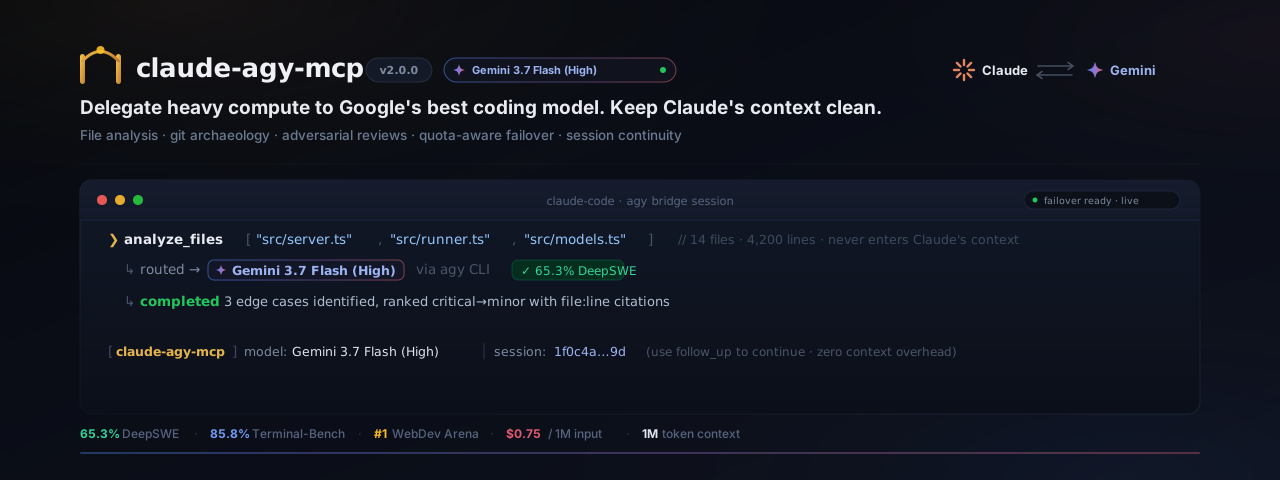
Claude Code delegates heavy tasks to the Antigravity CLI (agy) — saving Claude's context window and tokens for what matters.
Claude sends a task → the bridge routes it to the best available model via agy → only the answer comes back. Large files, deep git searches, and web lookups never touch Claude's context.
User → Claude Code → claude-agy-mcp (MCP) → agy CLI → Gemini / Claude / GPT-OSS
                   ←                      ←         ←
| claude-to-agy | claude-agy-mcp | |
|---|---|---|
| Tool surface | 1 generic delegate_to_agy |
6 purpose-built tools — Claude self-routes reliably |
| Model selection | none (agy default only) | per-tool routing across all agy models, with availability detection and fallback |
| Multi-turn | stateless | session continuity — follow_up resumes agy conversations without resending context |
| Output safety | unbounded | configurable truncation cap protects Claude's context |
| Sandbox | no | optional --sandbox mode |
| Install | uvx (Python) | npx (Node) — zero install |
- Node.js 18+
- Antigravity CLI (
agy) installed and authenticated - Claude Code
# 1. Register the MCP server (user scope = all projects).
#    add-json bakes in a generous client-side timeout so long analyze_files /
#    delegate calls don't trip Claude Code's tool-call deadline (see Timeouts).
claude mcp add-json -s user claude-agy-mcp \
  '{"type":"stdio","command":"npx","args":["-y","@pymodel/claude-agy-mcp"],"timeout":3600000}'

# 2. Add delegation rules to your project (or ~/.claude/CLAUDE.md for global)
curl -o CLAUDE.md https://raw.githubusercontent.com/PyModel/claude-agy-mcp/main/CLAUDE.md
The
"timeout": 3600000(60 min, milliseconds) is the client-side tool-call deadline, matched to the bridge's defaultAGY_MAX_RUNTIMEceiling. Without it, a cold-startanalyze_files(~40–50s) or a longdelegatehits Claude Code's default and returnstimed out waiting for responsewhile the agy run is still going — and raising the agy-side ceiling alone will not help, because the client aborts first. If your client doesn't honor a per-servertimeout, set the global env varMCP_TOOL_TIMEOUT=3600000instead. Details in Timeouts and cancellation.
| Tool | Use for | Model routing (first available) |
|---|---|---|
analyze_files |
Files >200 lines, >3 files at once, logs, dumps, generated code | Gemini 3.6 Flash (High) → Gemini 3.5 Flash (High) → Gemini 3.1 Pro (Low) |
deep_search |
git log/diff/blame archaeology, repo-wide greps | Gemini 3.6 Flash (Medium) → Gemini 3.6 Flash (High) → Gemini 3.5 Flash (High) |
web_lookup |
Docs, API references, external/current knowledge | Gemini 3.6 Flash (Medium) → Gemini 3.6 Flash (High) → Gemini 3.5 Flash (High) |
adversarial_review |
Plan critiques, design and code reviews | Gemini 3.1 Pro (High) → Claude Opus 4.6 (Thinking) → Gemini 3.6 Flash (High) → Gemini 3.5 Flash (High) |
follow_up |
Continue a prior session by session_id — no context resend |
inherits the session |
delegate |
Anything else heavy | Gemini 3.6 Flash (High) → Gemini 3.5 Flash (High) |
All tools accept optional cwd (project root) and model (exact name from agy models; validated, with available models listed on mismatch).
Every response ends with a footer:
---
[claude-agy-mcp] model: Gemini 3.6 Flash (High) | session: 1f0c…-d4 (use follow_up to continue)
On first use the bridge runs agy models (cached for the process lifetime) and picks the first available model in the tool's preference chain. If none is available it falls back to AGY_DEFAULT_MODEL, and finally to agy's own default. agy silently ignores unknown --model values, so the bridge validates names up front instead of letting requests land on the wrong model.
agy never surfaces quota exhaustion in print mode — it silently retries the 429 until its print-timeout, then exits 0 with empty output, which used to look like an indefinite hang. The bridge now watches each run's log file (via --log-file) and on RESOURCE_EXHAUSTED (code 429):
- kills the agy process group immediately (no waiting out the timeout),
- parses the reset time ("Resets in 4h24m") into an in-process cooldown registry,
- retries the same prompt on the next model in the tool's chain,
- skips cooled-down models on all subsequent calls until their quota resets.
Failovers are annotated in the response footer (failover: <model>: quota exhausted (resets in 4h24m)). Only when every candidate is exhausted does the call fail — in seconds, with reset times listed — instead of hanging.
The bridge does not kill a run for being slow. Elapsed time cannot distinguish a healthy long model call from a wedged process, and a wrong "stuck" verdict interrupts an agent mid-edit — leaving half-written files behind. So a run is killed only when something authoritative says so:
- the caller cancels (e.g. pressing Esc in Claude Code) — the agy run dies instead of being orphaned,
- quota is confirmed exhausted (a 429 in the run's log), which triggers failover, or
- the resource ceiling expires —
AGY_MAX_RUNTIME, default 3600s.
The ceiling is a resource cap, not a diagnosis. When it fires, the run still returns everything agy produced so far plus its session_id, and says so explicitly: any file changes agy already made are on disk, and follow_up resumes from where it stopped. AGY_TIMEOUT overrides the ceiling for every tool; AGY_TIMEOUT_<TOOL_NAME> overrides it for one (e.g. AGY_TIMEOUT_DEEP_SEARCH=900) and wins over the global. The full set is AGY_TIMEOUT_ANALYZE_FILES, AGY_TIMEOUT_DEEP_SEARCH, AGY_TIMEOUT_WEB_LOOKUP, AGY_TIMEOUT_ADVERSARIAL_REVIEW, AGY_TIMEOUT_FOLLOW_UP, and AGY_TIMEOUT_DELEGATE. The kill path escalates SIGTERM → SIGKILL across the whole process group, and fires even if agy's helper processes hold the output pipes open.
Two timeout layers — and the client one usually bites first. The ceiling above is the agy-side budget. Your MCP client (Claude Code) has its own, separate tool-call timeout, and if it is shorter, the client gives up first — you'll see Error: timed out waiting for response, while the bridge's own ceiling reads MAXIMUM RUNTIME EXCEEDED instead. Raising AGY_MAX_RUNTIME alone therefore changes nothing: the client still aborts on its own schedule. The work is not lost either way — the agy session persists, so follow_up with the returned session_id retrieves it — but the real fix is to make the client wait at least as long as the ceiling. The Install command sets a per-server timeout of 3600000ms (scoped to this server only). If you registered the server without it, re-run the add-json command from Install, or set the global env var MCP_TOOL_TIMEOUT=3600000. Rule of thumb: client timeout ≥ AGY_MAX_RUNTIME.
Expected latency. Most of the perceived "slowness" is cold start: the first call in a session spawns the agy CLI and warms the model. A simple analyze_files over 3 files measures around 40–50s cold (≈46s observed), dropping on subsequent same-session calls. A first call that also hits a quota 429 takes longer while the bridge fails over. So a client timeout below ~60s will intermittently trip on cold starts even for "simple" questions — size it generously.
All optional, via environment variables:
| Variable | Default | Description |
|---|---|---|
AGY_PATH |
agy |
Path to the agy binary |
AGY_MAX_RUNTIME |
3600 |
Seconds; absolute runtime ceiling. The bridge never kills for inactivity — only cancellation, quota, or this |
AGY_TIMEOUT |
AGY_MAX_RUNTIME |
Seconds; overrides the ceiling for every tool, passed as --print-timeout, enforced with a 15s kill grace |
AGY_TIMEOUT_<TOOL> |
AGY_MAX_RUNTIME |
Seconds; overrides the ceiling for a single tool, e.g. AGY_TIMEOUT_DEEP_SEARCH=900. Wins over AGY_TIMEOUT |
AGY_MAX_OUTPUT_CHARS |
50000 |
Truncation cap for tool output |
AGY_DEFAULT_MODEL |
Gemini 3.6 Flash (High) | Fallback model when no chain entry is available |
AGY_SKIP_PERMISSIONS |
true |
Pass --dangerously-skip-permissions to agy |
AGY_SANDBOX |
false |
Run agy with --sandbox |
AGY_ON_FAILURE |
fallback |
strict appends an instruction to failed-tool errors telling the calling agent not to absorb the work itself |
Warning
The defaults trade sandboxing for reliability. AGY_SKIP_PERMISSIONS defaults to true and
AGY_SANDBOX to false, so every delegated task runs agy with --dangerously-skip-permissions
and no sandbox — the delegated model gets unapproved read, write and execute access inside the
cwd you pass it. That is what stops agy from blocking forever on an interactive approval prompt
in a non-interactive MCP context, but it is a real grant. Set AGY_SKIP_PERMISSIONS=false (expect
prompts) or AGY_SANDBOX=true if you are delegating into a directory you do not fully trust.
The bridge always fails loudly: agy errors surface as MCP tool errors with agy's actual stderr, and degraded model routing is annotated in the response footer. By default the calling agent (Claude) will typically do the work itself after a failure — visible in the transcript, but easy to stop noticing in a long session. Set AGY_ON_FAILURE=strict to append an explicit "do NOT perform this work yourself — report the failure to the user" instruction to every delegation error, so you keep control over when token savings are silently lost.
npm install
npm test           # vitest unit tests (exec mocked — no agy needed)
npm run typecheck
npm run build # tsup → dist/index.jsRead CONTRIBUTING.md — conventional commits, prettier, and a test per behaviour change. Vulnerabilities go through SECURITY.md, never a public issue.
MIT