Repository navigation
Releases: RamenFast/holographic-eye
Release list
Holographic Eye 1.3.0 — clearer labels and staged memory editing

Holographic Eye 1.3.0
A local cockpit for Hermes memory, with clearer labels and a friendlier editor.
| Area | 1.2 | 1.3 |
|---|---|---|
| Labels | Could sit beside or above unrelated nodes | Below-node captions with stems and quiet overview |
| Preview content | Content snippets | Progressive content, entity and tag previews |
| Colors | Key buried in the manual | Visible renderer-backed Color key |
| Editing | Scattered prompts and immediate trust slider | Unified staged editor with explicit saves |
| Capacity warning | Native tooltip | Persistent explanation and Copy prompt |
| Native frame | GTK/system decoration | Undecorated window with draft-safe WM close |
| Provider/API | 1.1.0 | Unchanged 1.1.0 |
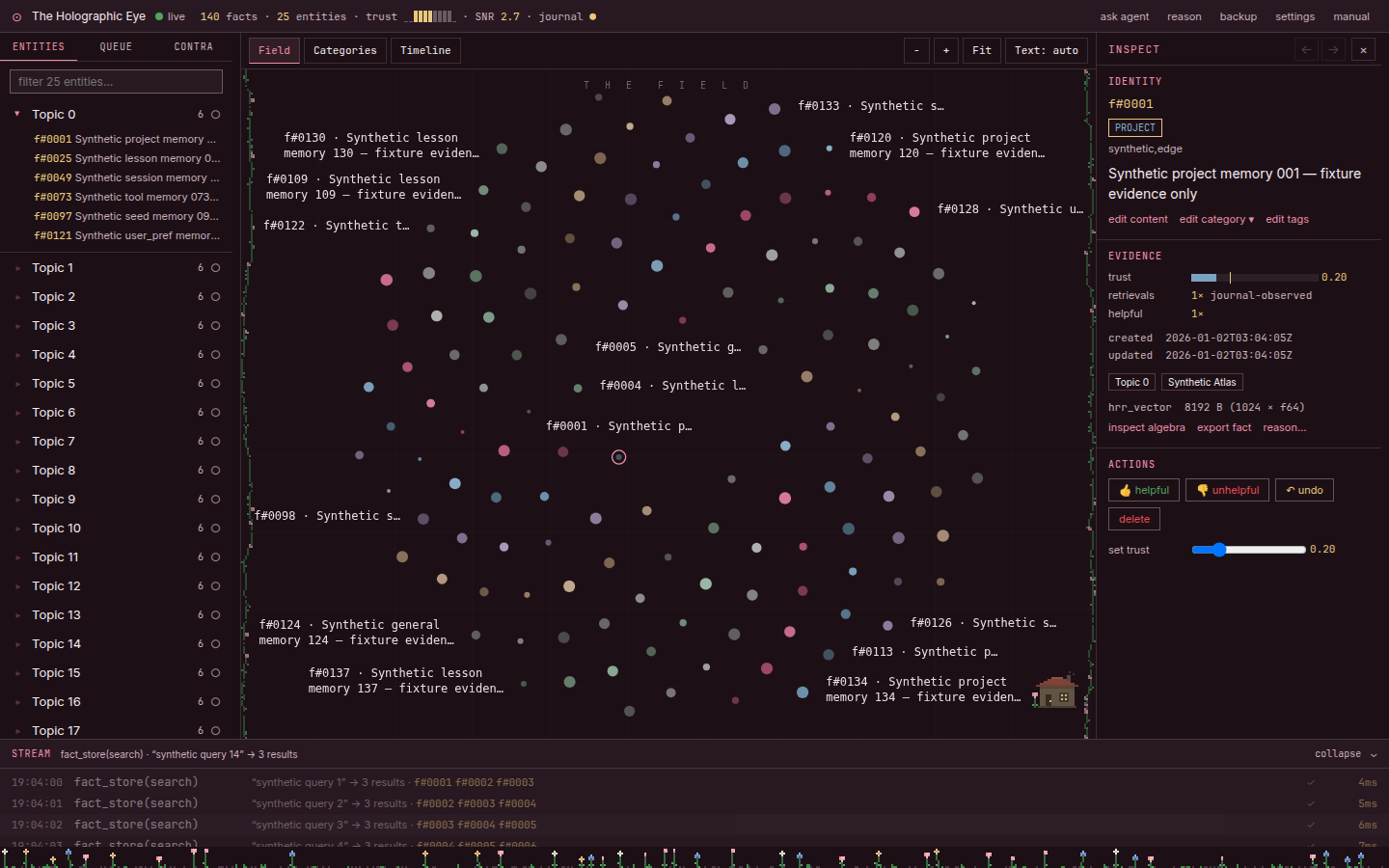
Screenshots and the full gallery are in README.md in the repository and source archive.
Highlights
- Find Color key beside Text in the Field.
- Use Inspect → Edit memory for content, category, tags and separately staged Fact trust.
- Open SNR for the persistent capacity explanation. Copy prompt copies text for Hermes; it does not send or modify anything.
- Reload and native-close guards keep dirty, kept, busy and uncertain drafts from disappearing without a decision.
The exact DEB passed 54 native WebKit/Openbox checks in a private synthetic network/display. Full UI 1,788, high-DPI/high-contrast 344, legacy GUI 107 and transport 194 checks passed. Existing backend and Zig contracts also passed. Installed binary/assets and unchanged provider files were independently verified.
Removed, honestly
The immediate trust-slider write and native metadata prompts are replaced by staged controls. Ordinary labels are intentionally omitted at the overview and in crowded areas; full content is not forced onto every node. Native title-bar buttons are removed; use your window manager’s close/move/resize actions.
No retrieval or mutation feature was silently removed. Persistent engine settings, raw vectors and derived fields remain read-only here. Quarantine/UMAP and live restore remain unbuilt. Drafts are page-local, not crash-persistent. Preflight is not a server lock; detail and absolute-trust actions are separate, not an atomic Save-all.
Exact pixel/hit checks passed, but synchronous draw medians increased 5.3 → 5.8ms in the longer component comparison. Warm label layouts were fast; one first-use layout reached 22.7ms. No speedup or universal 8ms cold bound is claimed. Detailed receipts are included in docs/dev/label-editor-pass.
Install
| System | Command |
|---|---|
| Debian / Ubuntu / Mint | sudo apt install ./holographic-eye_1.3.0_amd64.deb |
| Fedora / RHEL | sudo dnf install ./holographic-eye-1.3.0-1.x86_64.rpm |
| Source | Extract holographic-eye-1.3.0-source.tar.gz; follow README’s pinned Zig and native build instructions |
Packages install the shell, desktop entry, icons and man page. Existing installations also need the frontend-only update described in README. Provider/API remains 1.1.0; no gateway restart is needed. Native builds require WebKitGTK 4.1 version 2.40 or newer. Linux Mint is tested; RPM payload validation is not a Fedora runtime claim.
Verify:
holographic-eye version --json
holographic-eye status --json
Expected shell version: 1.3.0. Launch a fresh Eye window for the new code.
Checksums
Download all desired assets and SHA256SUMS, then run sha256sum -c SHA256SUMS. Keep the prior frontend backup until verification succeeds.
GPLv3. System-resolved fonts. Original implementation: Claude (Fable 5). Refinement: Prime and GPT workers, built with Ben.
Repository visibility remains private; use your existing GitHub access to download.
Holographic Eye 1.2.0 — responsive exploration
Holographic Eye 1.2.0
A local cockpit for Hermes holographic memory, with clearer exploration on both narrow and wide windows.
| Area | 1.1 | 1.2 |
|---|---|---|
| Narrow windows | Desktop-width layout | Explore/Evidence/Inspect modes down to 640×480 |
| Floating dialogs | Headers could scroll away | Fixed header and close control, scrolling body |
| Field text | Points and tooltips | Bounded content snippets when space permits |
| Browsing | Field and evidence lists | Exact Categories and UTC metadata Timeline |
| Memory provider/API | 1.1.0 | Unchanged 1.1.0 |
Highlights
- Preserve selection, history, focus and scroll while changing views.
- Browse Stored or Last updated metadata. Invalid or missing dates remain Unknown.
- Keep Zig picking and its JavaScript fallback. Labels never move facts or change hit targets.
- Keep ten themes, four text sizes, mutation safeguards and dirty rendering.
981 responsive checks and all 107 existing GUI checks passed. Native WebKit/Openbox checks passed against the exact DEB in a private synthetic network/display. The installed binary and served assets were independently hash-verified. No gateway restart or database writes were performed by this update.
Removed, honestly
No core retrieval or mutation feature was removed. Dense areas may omit labels; snippets are bounded, not full documents. Timeline is stored metadata, not event history. Coverage is the loaded set. Quarantine and UMAP remain unbuilt, and live database restore remains unsupported.
A longer warmed comparison preserved exact pixels and hits, with median draw time 4.7ms baseline versus 4.6ms candidate. Tail variability remains. This is a component/canvas-command measurement with labels off, not native frame presentation. At 20,000 facts, cold label layout can exceed the 8ms target. Both favorable and unfavorable measurements are retained in the source ledger.
Install
Download the matching asset from this release.
| System | Command |
|---|---|
| Debian / Ubuntu / Mint | sudo apt install ./holographic-eye_1.2.0_amd64.deb |
| Fedora / RHEL | sudo dnf install ./holographic-eye-1.2.0-1.x86_64.rpm |
| Source | Extract holographic-eye-1.2.0-source.tar.gz; follow the pinned Zig and native build instructions in README.md |
The packages install the native shell, desktop entry, icons and man page. Linux Mint is the tested host; the RPM is payload-validated, not a claimed Fedora runtime installation.
Existing 1.1 users must also update the frontend assets. The provider/API remains 1.1.0 and does not need a restart. Save Eye drafts, close only Eye, build the frontend from the source archive, and use the README's backed-up frontend-only copy instructions. First installations use the separate provider setup instructions.
Verify:
holographic-eye version --json
holographic-eye status --json
Expected shell version: 1.2.0. Reopen Eye to load the new interface; existing windows were not forcibly reloaded.
Checksums
Download SHA256SUMS beside the assets and run sha256sum -c SHA256SUMS. Keep the prior frontend backup until verification succeeds.
GPLv3. System-resolved fonts. Original implementation: Claude (Fable 5). Responsive exploration: Prime and GPT workers, built with Ben.
v1.1.0 — a faster, safer memory cockpit
Holographic Eye 1.1.0
A local memory cockpit with a Field-first interface and a Zig/WebAssembly selection engine.
| Surface | 1.0.3 | 1.1.0 |
|---|---|---|
| Inspect | Fixed empty pane | Compact empty rail, fact history, clearer evidence bands |
| Journal | Rebuilt rows on each event | Batched, keyed rows and a compact latest-event glance |
| Field hit testing | Repeated layout reads | One viewport read and a 319-byte Zig/WASM kernel |
| Disconnection | Could miss intervening changes | Projection, entities, stats, and recent journal catch up |
| Undo | Could overwrite a newer edit | State and later-resource checks reject stale or ABA undo |
| Invalid mutation input | Coercions could reach the store | Typed, finite validation before store calls |
| Failed acknowledgment | Could look successful | Unknown outcomes stay explicit and are not retried |
| Native shell | Version switch only | Structured help, schema, status, errors, and recovery screen |
Highlights
- Ten themes and four text scales remain. The Field keeps its actual HRR/PCA geometry.
- Inspect keeps up to 50 single- and multi-selection snapshots.
- Zig handles pointer hit testing with strict float64 behavior. A JavaScript fallback stays available.
- The journal treats stored content as text, not executable HTML.
- Missing tokens and denied browser storage no longer trap the interface in a retry loop.
- Modals manage focus, remove listeners, reject stale responses, and guard duplicate submissions.
- The unchanged NumPy SVD uses a scoped two-thread BLAS cap when threadpoolctl is available.
Synthetic benchmarks on the development host show about 17× faster live journal bursts in the final run.
The optimized JavaScript versus Zig benchmark shows about 3× faster hit testing at 3,000 facts.
The combined old-layout-loop versus current kernel gain is larger; it must not be attributed to Zig alone.
All compared Field pixels and hit IDs matched. These are not native WebKitGTK performance measurements.
Removed, honestly
No core memory capability was removed. Unsafe stale undo and malformed mutation coercions are now rejected.
Quarantine, UMAP, and live database restore remain unbuilt.
Memory and journal are separate SQLite files. Cross-process and crash-atomic updates are not claimed.
Agent writes remain best-effort journaled if the journal fails; Eye controls report incomplete journaling explicitly.
Install
| Platform | Command |
|---|---|
| Debian / Ubuntu / Mint | sudo apt install ./holographic-eye_1.1.0_amd64.deb |
| Fedora / RHEL | sudo dnf install ./holographic-eye-1.1.0-1.x86_64.rpm |
| Source | Follow the pinned Zig, frontend, and Tauri build steps in README.md |
The package installs the native shell, desktop entry, icons, man page, and GPL text.
The user-level provider and served interface still require the separate deployment step.
Provider upgrades must preserve active conversations. Frontend-only updates need no gateway restart.
RPM is payload/test-transaction verified on Mint, not runtime-tested on Fedora.
Verify: holographic-eye version --json reports 1.1.0; holographic-eye status --json checks attachment.
The local installation and full activation status are recorded in HANDOFF.md.
Verification and checksums
The release includes SHA256SUMS for DEB, RPM, and source assets.
The test matrix covers synthetic databases, browser edge cases, strict mutation acknowledgments,
Zig equivalence and fallback, native CLI behavior, and read-only installed-app checks.
Screenshots use synthetic data, not personal memories.
Built with Ben. Original implementation: Claude (Fable 5). Refinement: Prime and GPT workers, including Astra.
v1.0.3 — legible settings dropdowns
The Holographic Eye v1.0.3 — legible dropdowns
A one-line-of-CSS legibility fix, from Ben's hands-on pass.
Fixed
- The settings text-size box was hard to read. The native
<select>
dropdowns (⚙ → text size, and the ask-the-agent target picker) rendered
with the WebKitGTK GTK widget skin — a light box with faint grey text
that ignored the themed--ink-surface/--ink-text, so the current
value was barely legible in the dark rooms. Now the native appearance is
dropped so the theme tokens apply (crisp--ink-texton the room's
surface), with a themed caret and a themed option popup. Every one of the
10 rooms styles the dropdowns like the rest of the panel.
Removed, honestly
Nothing — one CSS fix, frontend-only. The desktop shell (.deb/.rpm) is
a pane of glass onto the control plane and is byte-identical in behavior to
v1.0.2; it's rebuilt only to keep the version aligned. If you already run
v1.0.2, the fix is in the provider's served frontend — git pull && ./build/deploy.sh and reload the window; no gateway restart needed.
Install
sudo apt install ./holographic-eye_1.0.3_amd64.deb      # deb systems
sudo dnf install ./holographic-eye-1.0.3-1.x86_64.rpm   # rpm systems
holographic-eye --version                                # → holographic-eye 1.0.3
SHA256SUMS covers every asset.
Receipts
- Fix verified in the actual Tauri/WebKitGTK app (off-screen): the text-size
box shows crisp themed text + a caret; the open dropdown lists all four
sizes legibly; both<select>s (text size + ask target) covered. p1(15/15) +p2(25/25) +test_bootwarm.py(14/14) ALL-PASS.- Gateway restart →
:8770boot-warms at 1.0.3 in ~1 s (D-0015 holds).
--versionand/healthboth answer 1.0.3.
⊙ Compiled from PLAN.md by Claude (Opus 4.8) with Ben — the rooms read
clearly now.
v1.0.2 — the plane wakes with the gateway
The Holographic Eye v1.0.2 — the plane wakes with the gateway
A reliability fix: the desktop app connects after every gateway restart,
instead of showing its connect error until an agent message happened to
arrive.
Fixed
- The control plane went dormant after every gateway restart.
:8770
was down — yet memory worked and the journal was live; nothing errored.
Root cause: Hermes moved TUI/slash agent turns into
tui_gateway.slash_workersubprocesses. The plane starts lazily and
only inside the process whose argv carries the exact tokengateway
(the always-onhermes gateway run), so the workers'initialize()
hit theskip_cpbranch and never bound the port. And the wrapper is an
exclusive memory plugin, loaded lazily — nothing in it runs at gateway
boot either. Net: under a TUI-only workflow,:8770could stay dark
forever. (This is not the v1.0.0/D-0012 port-theft[Errno 98],
which is a bind collision — this was pure dormancy, no error at all.)
How it's fixed (D-0015 — still zero Hermes core changes)
- The plane boot-warms at gateway start. A dedicated provider is warmed
on a daemon thread when the gateway boots, binding:8770~1 s in — no
agent message needed. The bind retries briefly so a socket lingering from
the outgoing gateway across a restart self-heals. - The plane keeps that provider as a persistent fallback. Reads resolve
to the live per-session provider when one is attached, else the boot
provider (attach_boot+active_provider()), so a session attaching
then ending can never leave:8770dark. Both read the same WAL DBs, so
a fallback read is byte-identical to a live-session read. - Triggered by the
/holocompanion, which is loaded at boot: in the
gateway only, it force-loads the exclusive provider so itsregister()
runs the boot-warm.
Removed, honestly
Nothing. One bug fixed; no features removed. The old manual wake (an
api_server :8642 message) still works as a fallback. Kill-switches
unchanged (accel: false, control_plane: never).
Install
sudo apt install ./holographic-eye_1.0.2_amd64.deb      # deb systems
sudo dnf install ./holographic-eye-1.0.2-1.x86_64.rpm   # rpm systems
holographic-eye --version                                # → holographic-eye 1.0.2
Provider update (this fix is server-side): git pull && ./build/deploy.sh && hermes gateway restart. After the restart, :8770 comes up on its own.
SHA256SUMS covers every asset.
Receipts
- New regression harness
build/verify/test_bootwarm.py(14/14): boot
provider serves the store as fallback with no session; a live session
attaches over it then detaches → the plane falls back,/healthstays
attached,/statskeeps serving. p1(15/15) +p2(25/25) acceptance harnesses ALL-PASS with the
active_provider()refactor.- Live: gateway restart →
:8770self-starts in ~1 s with no message sent;
the journal showsinitialize · gateway-boot; the installed app connects.
--versionand/healthboth answer 1.0.2. GUI bundle unchanged from
v1.0.1 (server-side fix only).
⊙ Compiled from PLAN.md by Claude (Opus 4.8) with Ben — the plane wakes
when the gateway does.
v1.0.1 — the eye looks back
The Holographic Eye v1.0.1 — feedback round 3
Same-day polish on v1.0.0, from Ben's hands-on pass.
Fixed
- Garden glitched on theme switch. Root cause: the bed canvas was
sized fromgetBoundingClientRect(), which returns the
transform-scaled box — a theme switch landing mid-bloom (the
sprout animation scales from 0) resized the canvas to 1 px tall
and it stayed smeared. Now measured with layout boxes
(offsetWidth/Height, transform-immune), theme switches repaint
without re-blooming, and the double-draw path (settings chip +
store listener both regrowing) is gone. Receipt: a 6-theme storm at
60 ms intervals keeps the bed at 720×11 with all 696 flower pixels,
every time (it collapsed to 720×1 before). The lane's ground color
reads the theme's base token — cream under Paper, wine under
Blossom Dark. - The eye gazed downward. The almond's lids are asymmetric, so
its visual aperture center sits above the geometric center — and
iris + pupil were parked at the geometric one. They now sit at the
aperture center: the eye looks at you.
Improved
- A more potent eye (Ben: "stitch multiple waveforms…"): the eye
figures are double-exposed (each beam snapshot screen-blended
twice), and two new scope-drawn figures joined — a spectral
Cyan Tube inner iris ring and a hot White pupil core, the
catch-light. The eye now out-glows its garden at every size. - New README section: Multiple sessions & windows — is the
database safe? One provider instance inside the gateway serves
every session at once; any number of Eye windows can watch;
mutations serialize through the provider's store API and are
journaled/undoable; both DBs are WAL. The only forbidden move
remains hot-restoring a backup (restore stays cold).
Removed, honestly
Nothing. This is fixes + additions only.
Install
sudo apt install ./holographic-eye_1.0.1_amd64.deb      # deb systems
sudo dnf install ./holographic-eye-1.0.1-1.x86_64.rpm   # rpm systems
holographic-eye --version                                # → holographic-eye 1.0.1
Provider update (if coming from 1.0.0): git pull && ./build/deploy.sh && hermes gateway restart. SHA256SUMS covers every asset.
Receipts
- 34/34 GUI break-test checks (now including the theme-storm garden
gate) · p1 + p2 acceptance harnesses ALL-PASS · installed locally,
--versionanswers 1.0.1, control plane/healthanswers 1.0.1.
⊙ Compiled from PLAN.md by Claude (Fable 5) with Ben — the eye now
looks back.
v1.0.0 — the Eye, packaged
The Holographic Eye v1.0.0 — first packaged release
Glass cockpit for the Hermes holographic memory provider: the
agent's memory drawn as its real HRR geometry, every write
journaled with before/after images, everything undoable, and the
agent itself on the other end of an ask. Zero Hermes core changes.

Since the last deployed build (2026-07-03)
| before | v1.0.0 | |
|---|---|---|
| entity probe / Reason Workbench | ~4.2 s per click (measured) | ~40 ms — runtime encoder memoization in the wrapper; zero upstream diffs, byte-identical results (equivalence harness re-proven) |
| chrome | one hardcoded true-black look | 10 palette rows in the sysmon/Phosphor token system — Blossom Dark default; the old look preserved verbatim as Blossom AMOLED |
| pixel garden | tiled → visibly symmetrical; overlaid the stream and pane scrollbars | seeded-RNG planting in a layout-reserved lane + vines/cottage behind the Field canvas — coverage is impossible by construction |
| app icon | static SVG rings | drawn by the Phosphor engine: closed parametric curves synthesized as stereo WAVs, traced by the CRT beam in XY mode, snapshotted per color layer |
| find (F) | the opening keystroke leaked into the input — every search silently became F… (shipped since v3) |
fixed, plus the click-away dismiss no longer disarms itself |
| Inspect click cost | full-journal scan per click for recall counts | incremental (append-only journal ⇒ exact) |
| port hygiene | any long-lived hermes process could steal :8770 and serve stale code across upgrades (it happened — a dashboard held it) | control plane binds only inside hermes gateway run; failed binds retry |
| packaging | hand-built .deb only |
.deb + .rpm + source tarball + SHA256SUMS, rebuilt every release |
Removed, honestly
- The "no dark/light toggle" anti-goal — retired by Ben's
direction (PLAN D-0011). Ten themes now, all equal-care. - The repeat-x flowerbed tile and edge-vine overlays — replaced
wholesale (D-0013); the stream's padding-bottom hack died with them. - Nothing else was removed. Quarantine mode (Q5) and the UMAP
projector remain deliberately unbuilt — see the README ledger.
Install
The Eye watches a living gateway: Hermes installed, the wrapper
provider deployed + selected, gateway booted (see README §Install).
# Debian / Ubuntu / Mint — or double-click the .deb
sudo apt install ./holographic-eye_1.0.0_amd64.deb

# Fedora / RHEL
sudo dnf install ./holographic-eye-1.0.0-1.x86_64.rpm

# from source
tar xf holographic-eye-1.0.0.tar.gz && cd holographic-eye-1.0.0
cd build/eye_frontend && npm install && npm run build && cd ../..
./build/deploy.sh
cd build/eye_shell/src-tauri && cargo tauri build --bundles deb,rpm

# verify
holographic-eye --version              # → holographic-eye 1.0.0
curl -s http://127.0.0.1:8770/health   # → {"ok": true, …, "version": "1.0.0"}
Built on Linux Mint 22; .deb installed and relaunch-verified there.
.rpm requires exactly libwebkit2gtk-4.1 + libgtk-3 (structure
rpm --test verified on the build box) — Fedora reports welcome.
SHA256SUMS covers every asset: sha256sum -c SHA256SUMS.
Receipts
- 40/40 offline acceptance checks (p1 equivalence, p2 control plane)
with the accelerator installed — agent-visible behavior stays
bit-identical to stock. - 31/31 Playwright GUI checks: 10-theme sweep, garden-lane geometry,
dirty-flag 0 idle draws, entity storm, typed-ID delete guard,
Workbench 143 ms through the full UI, zero console errors. - Live:
probe(hermes)4.18 s → 0.09 s cold / 0.04 s warm on 541 facts.
⊙ Compiled from PLAN.md by Claude (Fable 5) with Ben — the beams in
the icon were traced by [Phosphor], Ben's CRT oscilloscope, because
the eye deserved to be drawn by an instrument, not a paintbrush.