Home
Original AltDrag Documentation: https://stefansundin.github.io/altdrag/doc/
Download latest build here: https://github.com/RamonUnch/AltDrag/releases
Note that those tricks are mostly the same than for the Original AltDrag
- AltDrag will not bring windows to front by default. Press Ctrl to bring the window to front, or configure AltDrag to do that automatically.
- AltDrag will mimic Aero Snap by default, so try dragging windows to the edges of your monitor. Corners work too!
- If you use multiple monitors, you can hold Ctrl or Shift while dragging to trap the window within the current monitor. This is particularly useful if you want to Aero Snap at edges between monitors.
- While dragging, windows borders will snap to each-other. This behavior can be changed in the config. If you disable it you can still press Shift while dragging to force windows borders to snap to each other.
- If you have automatic snapping enabled, you can temporarily disable it by pressing the space bar while dragging.
- If you are moving a window you can press the right mouse button to toggle the maximized state.
- If you use the scroll wheel to change the volume, you can hold shift to increase the rate the volume is changed. If you use the scroll wheel to change the transparency, you can hold shift to decrease the rate the transparency is changed.
- If you have Scroll inactive windows enabled, you can hold the Shift key to scroll horizontally. Note that this requires that the program has support for normal horizontal mouse wheel scrolling, which not all programs have.
- If you can't move a particular window, try elevating AltDrag. Normal programs can't interact with programs that are started with administrator privileges.
- If you need to Alt+Click on a program and do not want to blacklist the program, you can use the Winkey instead of Alt. If this is not enough or if you do not want to use the Winkey, you can hit Ctrl and release it while keeping Alt pressed and then click.
- A key combo can be used in order to activate AltDrag, this allows using Alt+Winkey to drag windows and leaves alone the Win+Click and the Alt+Click that some programs may require.
- Try to add the Shift modifier key for any action, usually it has an effect.
By default when lunching AltDrag, an icon will be displayed in the tray.
- Icon can be left-clicked to enable/disable AltDrag.
- Icon can be right-clicked to display a menu
- Icon can be middle-clicked to open the AltDrag.ini file (Advanced users only).
In the tray menu you can select Options and a dialog box with several tabs will open. The effects of all the options is described in the flowing sections
- The first thing you may want to modify in this section is the Language. If you think that a translation needs improvement or if you want to make a new translation have a loock at Issue #32.
- If you want windows to be automatically focused when you drag them (like when you drag them via the title bar), then you probably want to check the first option Focus Windows when dragging, this way you will not need to press Ctrl.
- If you do not want windows to automatically snap to fill a fraction of the monitor when you drag it towards the edges, then disable the Mimic Aero Snap option. The threshold from the monitor edge at which snapping occures can be changed in the Advanced tab
- For Windows 8 and below only you can check the Scroll inactive windows option. It is useless on Windows 10 because it is built in by default in the OS.
- You can enable/disabl the support of Multiple Document Interfaces (MDI) using the MDI support option see Issue #47 for more details.
- If you do not use desktop composition under Windows Vista/7 or below, then for improved performances you can uncheck the Drag full windows option. In this case only a hollow square will be displayed when moving a window.
- By default AltDrag does resize all the windows. If you want AltDrag to resize only windows that are designed to, you can uncheck this option.
- the Snap windows edges drop-list option serves to select how windows borders will sanp to screen borders and possibly outside of windows or finally even inside windows. The option can be disabled and all edge-to-edge snapping can be enabled by holding Shift for the movement. The threshold in pixels for which snapping should occure can be set in the Advanced tab.
- By default when you resize a window from the central region, the windows resizes in all directions. This can be changed to the bottom-right mode or into a Move window.

- You can finally ask AltDrag to automatically start at logon. Checking the option will add AltDrag to
HKCU\SOFTWARE\Microsoft\Windows\CurrentVersion\Run, If you want you can check Hide tray and.or Elevate to administrator privilege. In this case you will be prompted by the User Account Control (UAC) if you have not disable it. See Setup autostart section fore more options.
As seen below you can select the action for each mouse button in a drop list. Only 5 buttons are supported because of a limitation of the Window API. For each button an action can be chosen among the following list:
- Move Window
- Resize Window
- Close Window
- Kill Program
- Minimize window
- Maximize window
- Lower window
- Roll/Unroll window
- Toggle always on top
- Toggle borderless
- Center window on screen
- Action menu
- Nothing


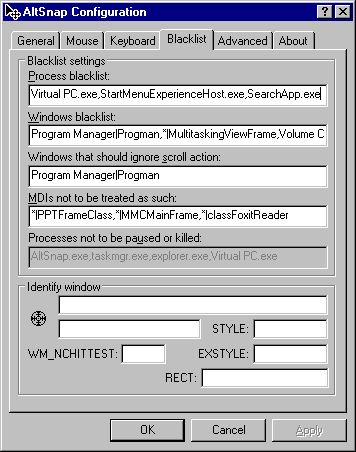
Sometime an AltDrag action interacts with a window you do not want. For example if you use Alt+Click on a specific window and you do not want AltDrag to move the window you can add the window name to the windows blacklist. more details below: All the list are coma separated and take no spaces before the coma. A space can be present in the item itself or before the item.
-
Process blacklist: List of programs names for which move/resize from
AltDrag as well as the scroll actions are disabled. Example:
Notepad.exe -
Windows blacklist: List of windows with the title|class format for which
move/resize actions from AltDrag will be disabled
Example:
Program Manager|Progman,|Shell_TrayWnd,*|Notepad -
Windows that should ignore the scroll action: List of windows with the
title|class format that for which the scroll action of AltDrag will not
apply. Example:
*|Photoshop -
MDIs not to be treated as such: List of windows for which AltDrag will not
try to find MDI subwindow. This only applies if the Support MDI is enabled
and by default contains
*|PPTFrameClass,*|MMCMainFramewhich correspond to the PowerPoint window and all the Microsoft Management application such as the services.msc windows or the device drivers window. - Process not to be paused or killed: Only applies for the Pause and kill action when enabled on Alt+Shift+Pause of Ctrl+Alt+F4, this are program names.
Program names are pretty straightforward to find. However a finer control can
be done using the window's title|class information; they can be found for a
specific window using the small target in the identify window section of the
Blacklist tab. You can include all the possible names by using the *|class
format. This is useful for most programs that have a non-constant title, for
example notepads title is actually the name of the file you are currently
editing.
The other way around can be used and you can specify title|* which means that
all the windows that have this title regardless of their class name will be
blacklisted. This is a much less common usage.
The title can also be empty for example: |Shell_TrayWnd corresponds to the
Windows task bar and has an empty title, just a class name.
Finally more blacklists can be found in the AltDrag.ini file:
-
Snaplist: List of windows with the
name|clasformat to which other windows should snap. By default windows that have no borders cannot be snapped to. -
MMBLower: List of windows that should not be lowered with mouse middle
click on the title bar. Default:
*|CASCADIA_HOSTING_WINDOW_CLASSthat corresponds to the Windows Terminal window. -
SSizeMove: List of windows to which the WM_ENTERSIZEMOVE / WM_EXITSIZEMOVE will not be sent. This is usefull for some buggy applications such as iTunes. Keep the default value (
*|iTunes), unless you know what you are doing.
List of issues in which blacklist was a solution:
- Question about scroll action: https://github.com/RamonUnch/AltDrag/issues/25
- Full screen application problems: https://github.com/RamonUnch/AltDrag/issues/32
- Problem with Foxit PDF reader (fake MDI): https://github.com/RamonUnch/AltDrag/issues/47
- More scroll problems: https://github.com/RamonUnch/AltDrag/issues/48
- Problems with Microsoft Windows Terminal: https://github.com/RamonUnch/AltDrag/issues/11

There are some known bugs that cannot be fixed by modifying AltDrag, as well as some bugs that I still have no no clues on how to fix. Here is a list of the most common problems encountered by my users and how to fix them.
If you are using complex shortcuts implying Alt+clicks or Alt+scroll wheel in a program you probably want to blacklist it so that AltDrag does not interact with it. See the above Blacklists section for more details. Also keep in mind that you can disable temporary AltDrag if you are playing a game, and you can use the Win Key as a hotkey or even a two key combo to minimize interactions with other programs shortcut.
This is a common issue and the reason is that with Windows Vista and later you can have a window in your current user desktop that is elevated to administrator privilege. Those windows will capture the input without AltDrag being informed. This is a very good idea because it means that all normal programs will be unable to check the passwords you type in your admin programs.
If you want to be able to move the elevated windows with AltDrag you need to run it elevated. You can do this temporarily by using the "Elevate" option in the tray menu (the UAC will prompt you). You can also do it automatically when AltDrag starts in the Geneal tab.
This is probably for the same reason as above. By default AltDrag will install in your %AppData% directory, but maby of you will prefer to install it in the Program Files (x86) directory. In this later case you need AltDrag tio be run Elevated yf you want to edit the config, because it is for now saved as AltDrag.ini in the AltDrag directory.
This may occur like with the original AltDrag, only with Windows 8 and below when you enabled the Scroll inactive windows option. I do not know a good way to fix the problem. however the beep sound can be removed using the following reg teak:
; Disables the system beep sound
; Copy paste this text in notepad,
; then save the file with the .reg extension and double-click it.
REGEDIT4

[HKEY_CURRENT_USER\Control Panel\Sound]
"Beep"="No"
You can also use this command in the command prompt (not admin):
REG add "HKCU\Control Panel\Sound" /v Beep /t REG_SZ /d No /f
By default since Windows XP Microsoft decided to hide the accelerators keys in all the menu and dialog boxes unless you press the Alt key. This is very annoying for all the options you did not learn by heart using older windows and this is also a problem for newer programs. If you want to be able to see the accelerator keys underlined in the action menu, the only way id to enable the global setting to see all accelerators underlined. You can use this reg:
; Enables the underline display of accelerators/shortcut keys.
; Copy paste this text in notepad,
; then save the file with the .reg extension and double-click it.
Windows Registry Editor Version 5.00

[HKEY_CURRENT_USER\Control Panel\Accessibility\Keyboard Preference]
"On"="1"
Or the following in the command prompt
REG add "HKCU\Control Panel\Accessibility\Keyboard Preference" /v On /t REG_SZ /d 1 /f
You will then see the shortcut keys with an underline:
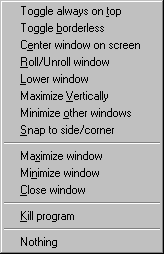 You then just have to hit the corresponding key to activate the option, ie: the 'T key' to toggle the Always on top state.
If you want a single click configuration there are two options:
- Set the Center resize mode to Move in the General config tab and set the action of your click to Resize. In this case the window will move when you Alt+click on its central fraction and will be resized on the sides/corners. You also probably want to increase the Center Fraction value in the Advanced tab.
- The other way is to use the Invert move and resize action with: option in the Keyboard tab. You can then for example use Alt and Win keys as hotkeys and set the invert key to Win key. In this case using Win+Click will resize and Alt+Click will move. This is just an example!
As seen previously you can set up AltDrag to start automatically, however with the default settings the User Account Control (UAC) will prompt you to authorize altdrag to run elevated. You can disable UAC if you really hate to be prompted but it is not necessary as you can solve the problem without disabling UAC by setting up a schedule task. As described in Issue #52.
SOLUTION 1: Use my config
- Download this AltDrag-task.zip file.
- Extract its content: AltDrag.xml (also included in AltDrag's directory since 1.43)
- In the Task Scheduler, select Action->Import Task... and select the AltDrag.xml file
- Go into the Actions tab, double click on the path to AltDrag.exe and Update it.
SOLUTION 2: Manual config Parameters for the task:
- Run as Users and highest privilege

- Enable AltDrag autostart even when disconnected from AC Poser:

- Do not kill AltDrag After 3 days!

- Add a 10s delay to startup to avoid AltDrag being lunched before the session fully initialized.
