Taste Review Reliability
- Verdict:
shipfor local staging/documentation evidence, not general-availability certification. - Winner: the compact native Fleet editor and collapsed comment-batch controls, captured from the actual 0.10 preview.
- Intended context: a bounded desktop window beside other client windows; README screenshots that show real work rather than a concept render.
- Confidence:
medium— one accountable reviewer, no independent panel or new human preference test.
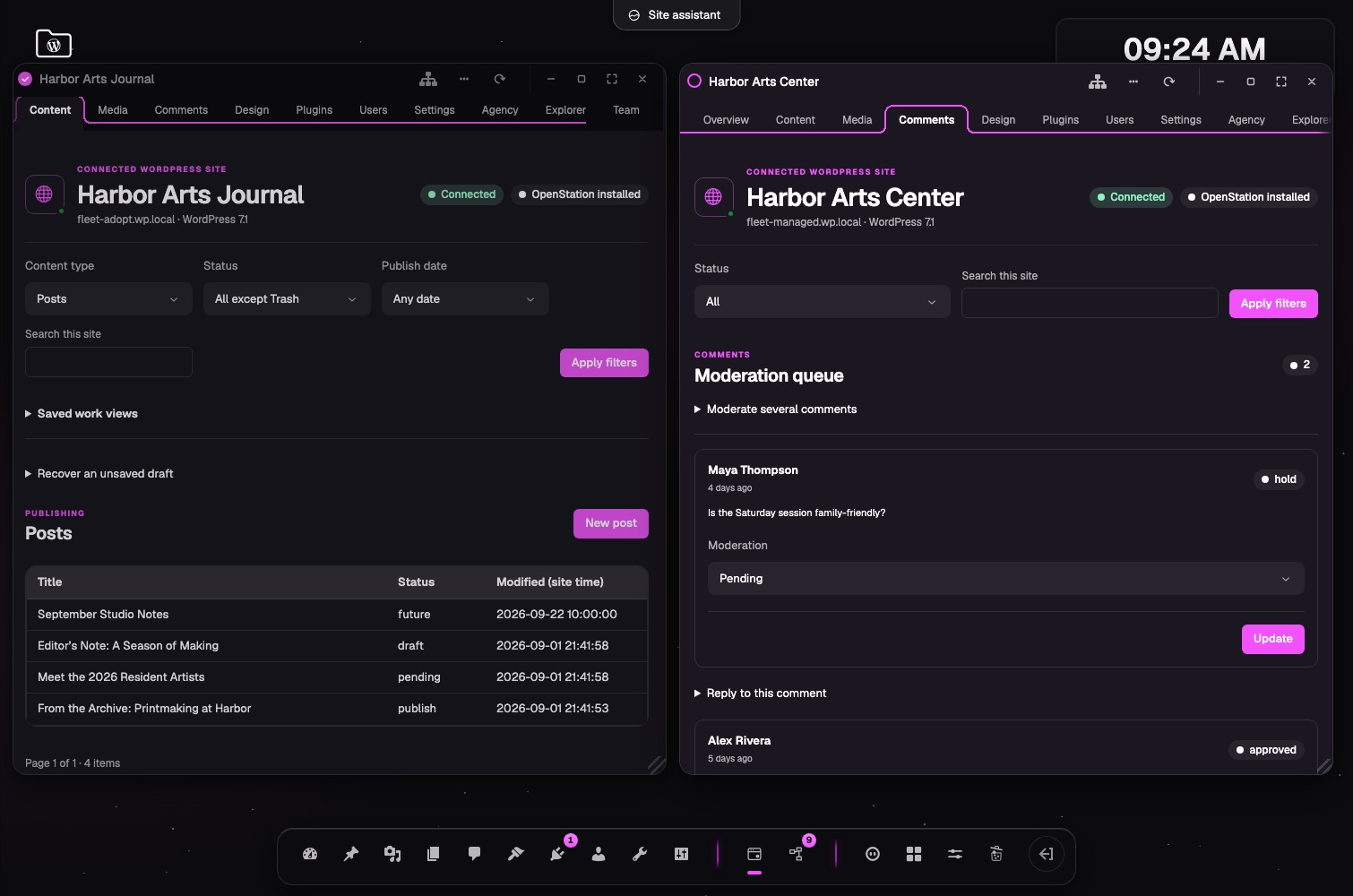
The site name stays the strongest landmark, with status nearby and one bright primary action per task. Secondary publishing options are disclosed instead of expanding every editor into a wall of fields. The same native forms, tables, buttons and window chrome carry the hub, editor, moderation and review screens. The two-window capture still communicates separate sites at thumbnail scale.
Keep the destination visible while working. Preserve bounded window widths, aligned native controls, explicit recovery opt-in, and the separation between an ordinary edit and a reviewed public write.
- Preserve the compact two-column secondary editor disclosures and the collapsed multi-comment review control.
- Before general availability, test a slightly larger gutter or narrower maximum width for the two hub site cards; the older baseline had marginally calmer breathing room. Keep the current aligned action row.
- In the agency pilot, evaluate long tab strips at narrow widths. They scroll in the framework; do not describe this as a mobile-optimized editor or visual block editor.
These are named review lenses applied by one reviewer, not independent agents or a blinded panel.
- First impression: destination identity and the active task lead; pink is concentrated on active chrome and primary actions.
- Blind pairwise comparison: current hub and two-site captures were randomized against the published 0.9 baseline at 500-pixel comparison width. The current two-site capture won clearly because both windows use the frame better and retain more useful task context. The older hub capture won narrowly on card breathing room. The current hub remains the honest preview image and its aligned controls are resolved; the spacing preference is recorded above rather than hidden.
- System coherence: native controls and shared spacing remain consistent across hub, content, comments and publishing review. Optional bulk work is subordinate to individual comment handling.
- Adversarial critique: source markup and many tabs remain dense. This is accurately presented as a source-based management tool, not a visual editing replacement. Real Studio loopback-health warnings were retained rather than replaced with invented healthy data.
- Context proof: actual authenticated Studio runtime, native-scale editor/hub/review and two-site images; 400/500-pixel thumbnail inspections. All ten captures were regenerated. Single windows use a 1510×1100 desktop viewport; the two-window overview uses 1510×1000.
- Meaningful disagreement: the older hub capture was preferred narrowly for spacing while the current two-window capture was preferred strongly. There is no separate panel evidence or new human approval. The preference ladder remains provisional: native OpenStation chrome/current Fleet multi-window view are the references; full-width admin layouts, expanded secondary controls, and dock-overlapped captures are the anti-examples.
None observed in the inspected final primary controls. Automated alignment and axe WCAG A/AA checks passed in Chromium, Firefox and WebKit in both Studio and the MySQL/MariaDB lab. That is not a complete accessibility audit. Long content/review areas and tab strips remain scrollable; screenshots do not prove every possible size/state. Site Health warnings in demo screenshots are real fixture findings, not rendering defects.
- Human choice: no new explicit approval; prior requests favored native OpenStation windows, bounded width and correct button alignment.
- Human reason: manage separate sites without another wp-admin, with clear site identity.
- Rejected alternatives: clipped/dock-overlapped editor captures; permanently expanded bulk moderation and secondary editing fields.
- Agent recommendation: use these authentic captures for the preview; validate task clarity with agency users before GA.
- Override:
nonew human override. - Reference examples to add or retire: add final editor/two-window capture as the preview baseline; retire previous lower-height editor captures from promotional use.
Recaptured September 5, 2026 from the 0.10 preview on WordPress 7.1. The capture script compares actual HTTP asset bodies to the working tree and fails on mismatch. The later OpenStation saved-instance correction changes restoration behavior, not Fleet's visible UI; the current CSS and JavaScript hashes match this capture set. No approval flow, credential callback, generated UI, or remote content write was used to make these screenshots.
- Fleet runtime ZIP:
e54d58121235706d565e63357f31e330e4d81821794d28846f27976b0c967f48 - CSS:
85810a48de77669408fab8a3d622e30a64b18545985d6a30120d78ba4af9cd8d - JavaScript:
6d97784f30f8fbbfac50d8aa9d930f8c435812d260a8d04f60fced781ba100bd - Editor JPEG:
8f7437c64a9010ab2d63324d78c304d2e5dcb3082361571b1f0201412afab291 - Two-window JPEG:
d54062a4c5ff2c49b854bc1bae43b9a00b6f208f6b3e855db27009416874e592
Files under the Fleet repository's assets/screenshots/ are the canonical launch set embedded by the README and screenshot gallery.