
Download Rivery data integration to build reliable cloud data flows, automate ingestion, and sync business sources into your warehouse faster. Explore a flexible Rivery ETL platform for teams that need scalable pipelines, monitoring, and streamlined analytics delivery from one place.
At a glance:
- Rivery helps teams automate cloud data movement, manage pipelines, and deliver analytics-ready data across warehouses and business tools.
- Rivery data integration connects business apps, databases, APIs, and cloud storage
- Rivery ETL platform workflows support ingestion, transformation, orchestration, and monitoring
- Rivery ELT platform design fits modern warehouse teams using Snowflake, BigQuery, and analytics stacks
- Rivery data pipeline automation reduces manual scripts while keeping delivery visible
Rivery is built for teams that need dependable cloud movement without maintaining a patchwork of fragile scripts. A Rivery data integration project can pull from SaaS tools, databases, file storage, and custom endpoints, then land structured data where analysts and engineers need it. The value is strongest when teams want Rivery automation for repeatable ingestion, scheduling, alerts, and operational visibility.
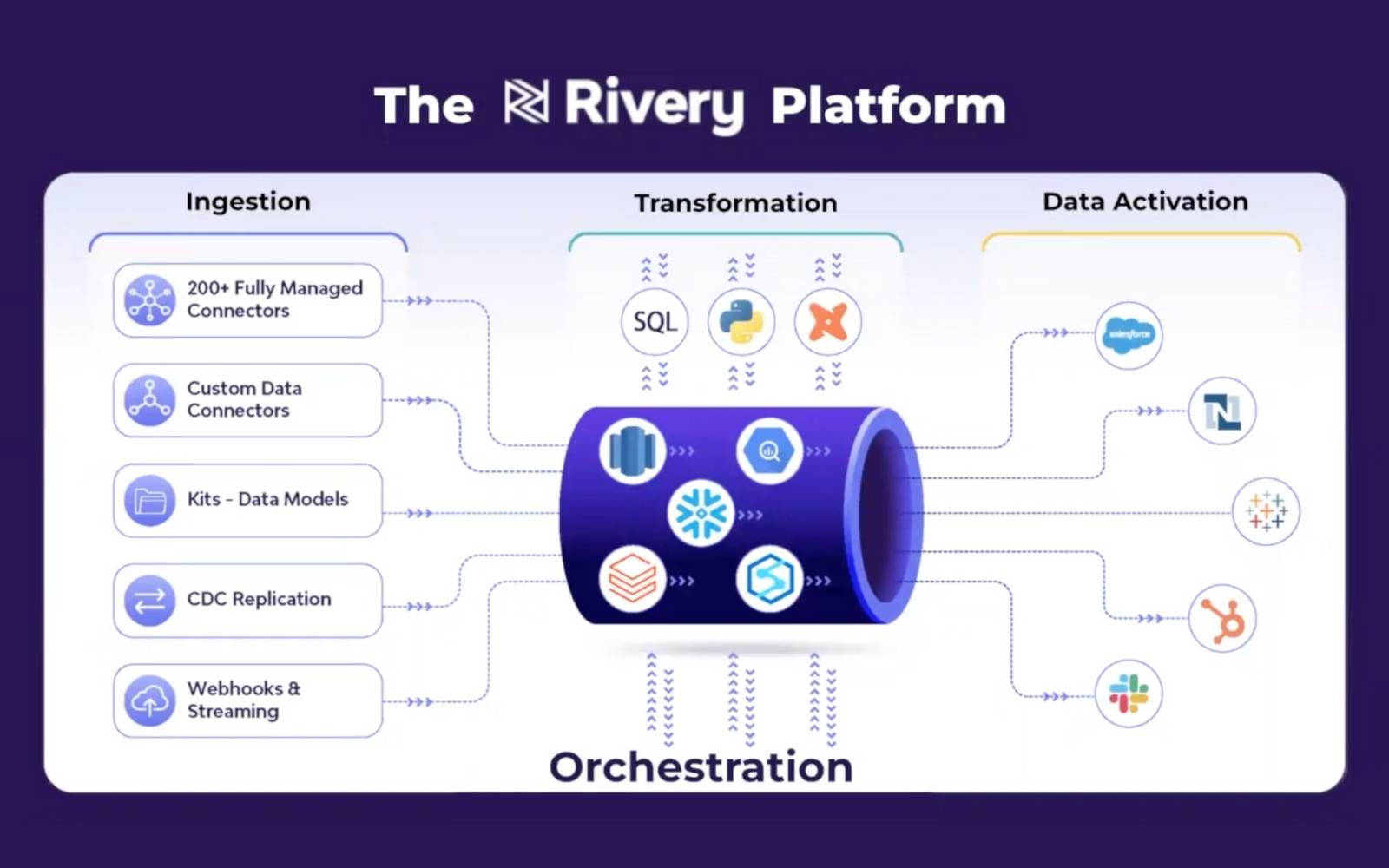
The platform works as a Rivery ETL platform for teams that still prepare data before loading, and as a Rivery ELT platform for organizations that prefer warehouse-first transformation. This flexibility matters because a modern Rivery data warehouse workflow may involve marketing data, product events, finance tables, and CRM records moving on different schedules. With Rivery connectors and Rivery API integration, teams can standardize how sources enter the analytics environment.
Rivery connectors cover many routine integration needs, but the platform also gives technical users room to handle specialized sources. Rivery REST API workflows help teams reach internal services, partner systems, and sources that do not fit a standard connector model. A Rivery data pipeline can combine those inputs with managed jobs, dependency control, and status tracking so teams see where each movement succeeds or fails.
For analytics teams, Rivery Snowflake integration and Rivery BigQuery integration are central use cases. Rivery data integration can push cleaned operational data into a warehouse, while Rivery automation handles recurring refreshes. Sales and operations teams often use Rivery Salesforce integration to keep account, opportunity, and activity data aligned with reporting models.
A reliable Rivery data pipeline is more than a scheduled transfer. Teams need retry behavior, logging, schema awareness, and readable alerts when a source changes. Rivery ETL platform features help users shape incoming data before delivery, while Rivery ELT platform patterns let warehouse teams transform with SQL and modeling tools after load.
Rivery API integration is useful when business systems expose data through endpoints instead of direct database access. In those cases, Rivery REST API jobs can organize pagination, authentication, and repeatable calls. Combined with Rivery automation, this approach helps replace one-off scripts with governed workflows that can be reviewed and maintained.
Rivery data warehouse projects usually start with a few high-value sources, then expand into broader operational coverage. Rivery Snowflake integration helps organizations centralize cloud data for dashboards, machine learning preparation, and finance reporting. Rivery BigQuery integration supports teams building Google Cloud analytics environments with scheduled ingestion and scalable warehouse storage.
The same model applies to Rivery Salesforce integration when sales data needs to join product usage, billing, or support metrics. Rivery data integration keeps these flows consistent, and Rivery documentation helps users understand connector setup, job behavior, and deployment patterns. Teams comparing Rivery alternatives should evaluate connector fit, pipeline monitoring, API flexibility, and warehouse support together.
| Step | Action |
|---|---|
| 1 | Review Rivery documentation and choose the initial warehouse target |
| 2 | Start with Rivery data integration for one priority source such as Salesforce or an API |
| 3 | Configure Rivery connectors, credentials, refresh schedules, and schema handling |
| 4 | Build a Rivery data pipeline with validation steps, alerts, and ownership notes |
| 5 | Extend the flow with Rivery automation, Rivery Snowflake integration, or Rivery BigQuery integration |

| Area | Team-facing value |
|---|---|
| Rivery data integration | Centralizes movement from apps, databases, APIs, and files |
| Rivery ETL platform | Supports pre-load preparation and managed transformation logic |
| Rivery ELT platform | Fits warehouse-first teams using SQL-centered analytics workflows |
| Rivery connectors | Reduces custom work for common business systems |
| Rivery API integration | Handles custom endpoints through repeatable pipeline jobs |
| Component | Minimum | Recommended |
|---|---|---|
| Browser | Current Chrome, Edge, Firefox, or Safari | Managed modern browser with SSO support |
| Warehouse | Active Snowflake, BigQuery, or compatible destination | Dedicated analytics warehouse with role-based access |
| Access | Source credentials and destination permissions | Service accounts, scoped secrets, and audited permissions |
| Network | Stable internet access for cloud services | Approved outbound access to required APIs and warehouses |
| Team process | Basic pipeline ownership | Documented Rivery automation standards and monitoring rules |
Rivery is useful for data teams that want a managed approach to ingestion but still need flexibility for technical workflows. A small analytics team can use Rivery data integration to avoid maintaining scripts for every source, while a larger platform team can standardize Rivery data pipeline patterns across departments. The strongest fit is a group that values automation, warehouse readiness, and operational transparency.
Teams focused on cloud analytics should evaluate Rivery Snowflake integration, Rivery BigQuery integration, and Rivery Salesforce integration early. These common paths show how Rivery connectors, Rivery ETL platform features, and Rivery ELT platform design work together. Developers can also explore Rivery GitHub resources and Rivery documentation when they need examples, templates, or integration references.
Why did a Rivery data pipeline stop loading? Check source permissions, schema changes, API limits, and destination write access first.
Can Rivery API integration replace a custom script? Yes, when the endpoint, authentication, pagination, and schedule can be modeled reliably.
Is Rivery ETL platform usage different from Rivery ELT platform usage? ETL prepares data before loading, while ELT loads first and transforms in the warehouse.
When should teams compare Rivery alternatives? Compare when connector coverage, pricing, monitoring, or warehouse fit does not match your operating model.
Where should setup questions start? Use Rivery documentation, then review Rivery GitHub materials if your workflow involves examples or reusable patterns.
A strong Rivery data integration rollout begins with clear source ownership. Teams should document who manages credentials, who validates warehouse tables, and who responds to failed jobs. This keeps Rivery automation from becoming invisible background work. When a Rivery data pipeline supports executive dashboards or finance reporting, alerting and review habits are as important as connector setup.
Rivery connectors are often the fastest way to begin, but custom needs still appear. Rivery REST API support gives engineers a controlled way to bring in data from internal tools or partner platforms. When that data lands through Rivery Snowflake integration or Rivery BigQuery integration, analysts can combine it with CRM information from Rivery Salesforce integration and build trusted models.
Organizations choosing between Rivery alternatives should test realistic use cases instead of only counting connectors. A useful trial includes Rivery ETL platform preparation, Rivery ELT platform warehouse loading, Rivery API integration for a nonstandard source, and Rivery data warehouse validation. The right decision depends on how easily the team can maintain the pipelines after launch.
Rivery documentation and Rivery GitHub resources can help technical users understand repeatable patterns. For long-term success, keep naming conventions consistent, record assumptions inside pipeline notes, and review Rivery automation schedules as business priorities change. A well-managed Rivery data pipeline should feel predictable, observable, and easy to extend.
Rivery data integration, Rivery ETL platform, Rivery ELT platform, Rivery data pipeline, Rivery API integration, Rivery connectors, Rivery automation, Rivery data warehouse, Rivery Snowflake integration, Rivery BigQuery integration, Rivery Salesforce integration, Rivery REST API, Rivery documentation, Rivery GitHub, Rivery alternatives