Repository navigation
Home
Fiji/ImageJ implementation of the single-acquisition sFRC/sFSC resolution-estimation framework.
Welcome to the srFRCj Wiki. This documentation provides an introduction to the method, an illustrated overview of the analysis workflow, and step-by-step guides to installation, example datasets, parameters, and interpretation of resolution estimates.
Explore: Getting started · Method overview · sFRC · sFSC and DRI · srFRC
Effective resolution in fluorescence microscopy depends on the sample, fluorophores, acquisition conditions and reconstruction procedure, creating a need for direct resolution assessment from acquired data. Fourier ring correlation (FRC) and Fourier shell correlation (FSC) provide image-based resolution estimates from the highest spatial frequencies shared by two observations, but repeated fluorescence acquisitions can be compromised by sample dynamics, photobleaching, drift and acquisition variability.
Three-dimensional fluorescence imaging presents an additional challenge because optical resolution is anisotropic, voxel spacings and array dimensions commonly differ across axes, and sequential z-stack acquisition can introduce inter-slice inconsistencies. These effects make direct axial-resolution estimation particularly sensitive to paraxial Fourier artifacts and acquisition-dependent changes.
The framework addresses these problems with single-frame FRC (sFRC) and single-volume FSC (sFSC). sFRC generates two complementary observations from one 2D image by exploiting local spatial redundancy and point-spread-function symmetry, followed by an analytical frequency-domain correction for the deterministic bias introduced by diagonal resampling. sFSC extends the same single-acquisition principle to 3D volumes and introduces directional resolution inference (DRI), which estimates axial resolution from reliable non-paraxial directional FSC information while accommodating anisotropic resolution and unequal sampling. The framework is further extended to spatially resolved analysis through srFRC.
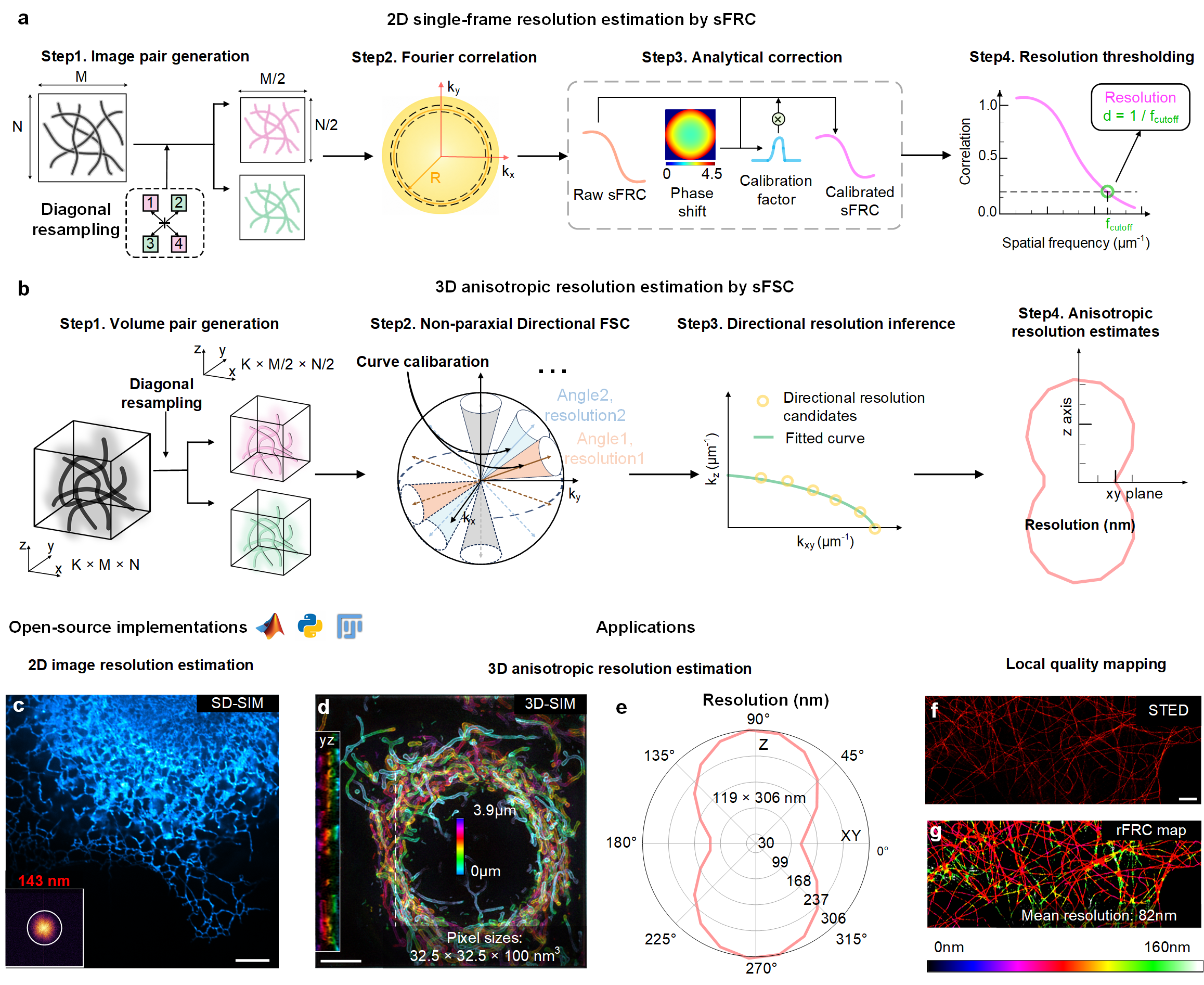
Figure 1 | Single-acquisition resolution assessment framework. (a) sFRC generates complementary 2D images by diagonal resampling, computes Fourier ring correlation, applies analytical correction, and determines a resolution cutoff. (b) sFSC generates complementary 3D observations and measures non-paraxial directional FSC cutoffs; DRI uses these measurements to infer anisotropic resolution. (c–g) Representative microscopy analyses and local-resolution mapping examples. The image is reproduced from img/fig1.png used in the project README. This Wiki includes its own copy at images/fig1.png.
Single-frame Fourier ring correlation (sFRC) measures effective lateral resolution without requiring a repeat acquisition of the same scene. It creates two complementary observations from one image using local spatial redundancy and point-spread-function symmetry. FRC is evaluated after diagonal resampling and a correction for sampling-induced correlation bias.
Typical output: an FRC curve with cutoff frequency and an estimated lateral resolution. For undersampled images, carefully distinguish direct cutoff measurements from estimates involving curve extrapolation.
Single-volume Fourier shell correlation (sFSC) extends complementary-observation sampling to 3D data. Three-dimensional frequency support is direction dependent, so a global FSC curve does not fully describe axial and lateral resolution. Directional resolution inference (DRI) uses relatively reliable non-paraxial cutoffs to estimate the axial cutoff instead of directly relying on artifact-prone paraxial measurements.
Typical output: lateral and inferred axial resolution estimates, directional FSC information, and the fitting indicator E_DRI. The latter describes model-fit consistency, not the error relative to ground truth.
Rolling FRC (srFRC) extends the analysis from one global estimate to a spatial-resolution map. The method evaluates local image windows and maps variations in effective resolution across the field of view. Background handling, local window size and step size affect how the resulting map should be interpreted.
Typical output: a spatial-resolution map and summary statistics over valid local estimates. Background or unavailable pixels must not be interpreted as a measured resolution of zero.
Fiji/ImageJ with a Java and native-library configuration matched to the platform. Consult the repository README for platform-specific JavaCPP, ND4J, and OpenBLAS requirements. Follow the project-specific installation and getting-started guide.
Install the platform-matched plugin and runtime JARs into Fiji, open a compatible image or stack, and launch the relevant analysis from the srFRC plugin menu. Confirm pixel sizes in the dialog before running. Example data are available from the shared example-data release.
Images and stacks open in Fiji. Pixel-size fields may be initialized from Image Properties, but the value entered in the plugin dialog takes precedence; sampling uses nm. Confirm the sampling convention and whether you are using the single-acquisition or paired-acquisition mode. Use the parameter reference for the available settings.
Choose the specified FRC/FSC threshold (1/7 or 3-sigma), check sampling adequacy, and review the results and interpretation guide before comparing outputs across experiments or implementations. For reproducible analysis, record settings, pixel sizes, software versions and any extrapolation or DRI fitting caveats.
Fiji installation and plugin guide · Parameter reference
| Topic | Documentation |
|---|---|
| Installation and example data | Getting started |
| How the method works | Scientific principles |
| Global 2D resolution | sFRC |
| Anisotropic 3D resolution | sFSC and DRI |
| Local resolution maps | srFRC |
| All parameters and defaults | Parameters |
| Output interpretation and limitations | Results and interpretation |
| Common installation and runtime issues | Troubleshooting |
| Reporting and reproducibility | Reproducibility |
Three implementations of the same underlying framework are maintained for different analysis environments:
This project accompanies the manuscript Single-acquisition estimation of anisotropic 3D resolution in super-resolution fluorescence microscopy. Final bibliographic details and DOI will be added after publication. The manuscript also discusses broader method developments; this Wiki documents the three currently exposed software analysis modes (sFRC, sFSC/DRI and srFRC), without implying that a standalone srFSC entry point is available in all repositories.
Development status: This repository is still in heavy development. If you encounter any issues or unexpected behavior, please file an issue.