
Microsoft-native climate risk reasoning and adaptation planning pipeline





Caribbean Climate Resilience Orchestrator is a multi-agent planning surface for climate adaptation in the Caribbean.
It helps resilience teams answer one high-stakes question:
Given a country, a planning horizon, and a budget, where is climate risk concentrated and which interventions should be funded first?
This is not positioned as a generic chatbot. It is a Microsoft-native climate decision tool that combines:
- a multi-agent reasoning chain,
- parish-level risk scoring,
- scenario simulation under budget constraints,
- grounded search-backed narrative output,
- and an operations dashboard designed for a ministerial demo.
- The Problem
- Our Solution
- Key Features
- System Architecture
- Technology Stack
- Demo Readiness
- Quick Start
- Demo Flow
- Screenshots
- Responsible AI
- Project Assets
- Roadmap
Climate adaptation planning is usually fragmented across static spreadsheets, PDF reports, disconnected dashboards, and intuition.
That creates four problems:
- risk data is hard to interpret at the regional level,
- trade-offs between interventions are difficult to explain,
- budget conversations are not grounded in modeled outcomes,
- and decision-makers rarely get a fast, narrative-ready brief they can act on.
For Caribbean governments and resilience teams, that gap is expensive.
Caribbean Climate Resilience Orchestrator turns climate and infrastructure stress into a usable planning workflow.
It does three things well:
- Diagnose risk: show which parishes or regions face the highest combined hurricane, flood, and sea-level pressure.
- Simulate action: test adaptation packages under real budget ceilings.
- Explain the result: produce grounded recommendations and an executive-ready brief.
The application is built around a clear agent chain:
IngestionAgentOntologyAgentRiskAssessmentAgentScenarioAgentRecommendationAgent
- Select a country, horizon, and hazard mix.
- Review high-risk regions, people at risk, critical facilities, and estimated losses.
- Inspect the atlas and click through regional hotspots.
- Assemble a ministerial adaptation package.
- Stay inside a configurable budget ceiling.
- Simulate how selected interventions change modeled exposure and loss.
- Rank the highest-leverage actions.
- Generate a brief that explains why those actions were prioritized.
- Show grounding references and audit-ready reasoning output.
- Inspect source freshness.
- Show ontology concepts.
- Display guardrails and agent trace output.
- Give judges a transparent view into the pipeline.
- Azure OpenAI powers narration and executive summaries.
- Azure AI Search knowledge-base content supports grounded retrieval.
- Azure Maps provides live or snapshot mapping infrastructure.
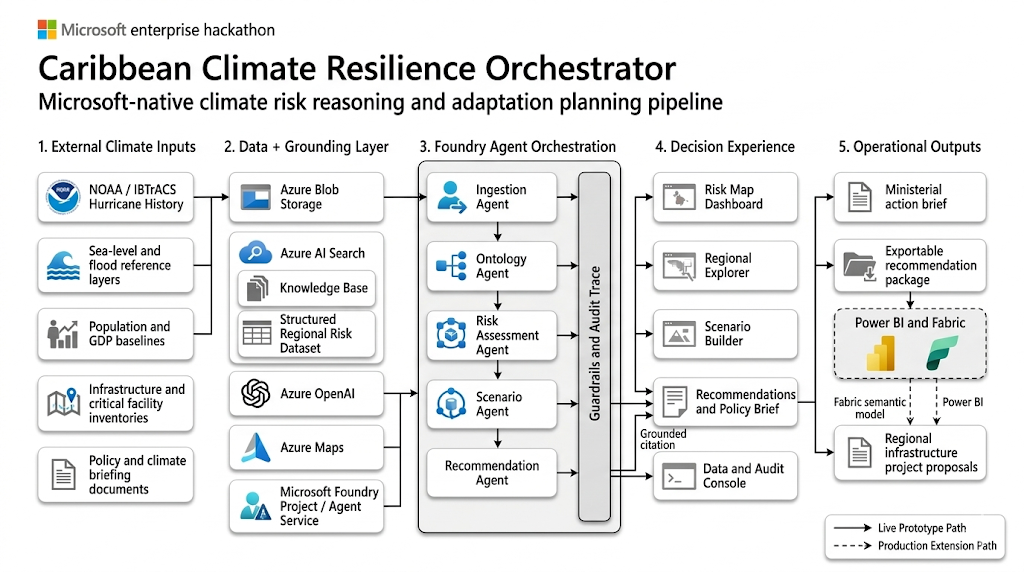
The editable Mermaid source lives in docs/architecture.mmd. GitHub-renderable Markdown version: docs/architecture.md.
To render it locally:
npx @mermaid-js/mermaid-cli -i docs/architecture.mmd -o docs/assets/architecture-diagram.svg| Category | Technology / Service |
|---|---|
| Frontend | React 18, TypeScript, Vite, Bootstrap, ApexCharts |
| Backend | Python, FastAPI, Pydantic, Uvicorn |
| Reasoning | Local orchestrator with Microsoft Foundry-ready configuration |
| Narration | Azure OpenAI |
| Grounding | Azure AI Search knowledge base |
| Knowledge Assets | Blob-backed seed documents and indexed climate references |
| Mapping | Azure Maps Web SDK + Azure Maps static snapshot fallback |
| Analytics Roadmap | Microsoft Fabric, Power BI |
- Azure OpenAI connection
- Azure AI Search connection and indexed knowledge-base documents
- Foundry project endpoint and agent registration
- Azure Maps snapshot imagery and Web SDK wiring
- Live reference refresh scripts using World Bank and NOAA inputs
- Parish-level operational dataset is still curated demo data
- Agent-service execution is still orchestrated locally rather than fully hosted in Foundry workflows
- Fabric semantic model is not wired into live app responses yet
- Power BI embed is not fully integrated yet
Yes, it is demo-video ready for a hackathon submission.
No, it is not yet fully production-ready end to end.
Best positioning for judges:
- present it as a working Microsoft-native prototype with live Azure integrations and a clear production path
- do not claim that every regional risk number is pulled live from a complete national source of truth
- Node.js 18+
- Python 3.10+
- Azure CLI
npm install
python -m pip install -r backend/requirements.txtnpm run dev:apiIn a second terminal:
npm run devThen open:
http://localhost:5173
curl http://127.0.0.1:8000/api/v1/healthUse this demo story:
- Open
Risk Map Dashboard. - Keep
Jamaicaselected and choose2050. - Click
Run Risk Lens. - Call out the highest-risk parish and the main drivers.
- Move to
Scenario Builder. - Select 3 to 4 interventions under budget.
- Run the scenario and show the delta versus baseline.
- Open
Recommendations. - Show the ranked actions and narrative brief.
- End on
Data & Auditto prove the pipeline is transparent and grounded.
Full demo notes are in docs/demo-runbook.md.

Risk Map Dashboard |

Regional Map Explorer |

Scenario Builder |

Recommendations Brief |

Scenario Comparison Analytics |

Scenario Outcome Detail |
Caribbean Climate Resilience Orchestrator is built around transparency-first reasoning:
- Grounding: generated narrative output is backed by indexed knowledge-base content and explicit citations.
- Guardrails: the system exposes budget overspend, does not hide fallback behavior, and surfaces operational mode clearly.
- Auditability: the UI includes agent logs, source freshness, ontology summaries, and pipeline status.
- Human decision support: the system prioritizes and explains; it does not replace ministerial judgment.
- Demo runbook: docs/demo-runbook.md
- Video script: docs/video-script.md
- User manual: docs/user-manual.md
- Azure setup guide: docs/azure-setup.md
- Architecture source: docs/architecture.mmd
- Improve the atlas into a fuller operational map experience
- Replace more seeded regional data with source-derived structured inputs
- Wire Power BI embed into the app
- Complete Fabric semantic model integration
- Automate ingestion from NOAA and other climate feeds
- Expand beyond demo countries to a broader Caribbean dataset
- Promote the orchestration path into managed Foundry agent execution
- Add deployment automation and operational monitoring