Repository navigation
Releases: TPMJB/K-UI-NeXT
Release list
K-UI V1.8.5 "Dáinsleif"

K-UI V1.8.5 "Dáinsleif" — release notes
Sonic Adventure, Grandia II and Skies of Arcadia now work in the owner's
hardware tests. Version 1.8.5 fixes the native reader's memory placement,
expands Games image formats, groups Original/2048 copies, and makes page
navigation responsive after the initial catalogue scan. Disc Ripper adds
selectable BIN/CUE and compressed exports. The splash and version display
identify 1.8.5, retaining the Dáinsleif artwork and name.
K-UI is an independent Dreamcast shell built on upstream KallistiOS, retaining
the GD-ROM and supporting exFAT/FAT32 storage. Update the runtime and Games
payloads together using the installation guide. Keep your
compatible independent K-UI boot CD; no reripping or conversion is required.
Development support: TPMJB on Ko-fi.
Native compatibility correction
The native reader previously occupied memory also used by startup stacks in
Sonic Adventure and Grandia II. Their GD command parameter arrays landed inside
that reservation and were correctly rejected. Moving the native reader and its
private stack below the IP image clears that conflict without changing either
game's instructions or stored image bytes.
The owner confirmed Grandia II, Sonic Adventure and Skies of Arcadia working
on build 5973741a6077. The same placement is now the normal native default.
Power Stone 1 and 2 were fixed earlier by GD command-contract corrections;
the owner reported fluid gameplay. A Japanese optimized BIN/CUE Dead or Alive 2
also booted in earlier testing. These are scoped owner observations, not full
playthroughs, all-region guarantees or proof that every supported image works.
Guest memory checks still protect firmware and the resident reader. Before
installation, the temporary stage checks retained BIOS service vectors and
rejects unsupported placement. Windows CE keeps its separate, existing layout.
Custom BIOS, every firmware scratch path and multidisc/GINSU behavior have not
all been validated. See the
hardware and placement evidence.
Time Stalkers remains unresolved. Its supplied screen reports GAME RETURN
with guard zero, rather than the Sonic/Grandia parameter rejection. That records
a menu-return path; it does not identify why the title chose it. No speculative
title patch is included in 1.8.5.
Games catalogue and Original/2048 selection
- Four recently visited folders share a bounded RAM catalogue. Background idle
work warms/Games; page navigation reuses discovered rows. - Rows appear before artwork. Only the selected game's cover loads, with a
bounded cache for both found and missing art. Stale requests cannot replace
the current selection's cover. - Matching
GameandGame-2048sibling folders collapse into one entry with
an Original / 2048-byte copy picker. Images that cannot be safely paired
remain individually accessible. - The batch GDI converter reports conversions, skips and failures, with an
optional JSON report. Originals remain unchanged. Keep those originals for
games requiring full raw data sectors.
The owner reports roughly 5–7 seconds for initial Games entry, followed by
fluid navigation. That is a collection-specific observation, not a launch-time
guarantee. First discovery and explicit Refresh still read storage. Shared
BIN/CUE prelaunch checks can take longer than ordinary GDI preparation; the
reported approximately 12-second case remains a preparation limitation.
See Games formats, conversion, and the
catalogue/format evidence.
Expanded image formats
| Format | Games in 1.8.5 |
|---|---|
| GDI | Direct launch; supported raw 2352-byte and cooked 2048-byte tracks |
| ISO | Direct launch; complete Dreamcast data session with valid boot metadata |
| BIN/CUE | Direct launch; supported shared/separate BINARY track layouts and sessions |
| CDI | Direct launch; supported DiscJuggler v2, v3 and v3.5 layouts |
| Standalone BIN/IMG | Direct launch; supported 2352-byte Mode 1/Mode 2 Form 1 data track |
| CSO/ZSO/CHD | Computer import using the supplied tool; no resident compressed boot decoding |
Native CD confirmation uses L/R triggers to choose Plain / Scrambled
boot encoding. CUE can provide a default; confirmation can override it. Track/session geometry,
file offsets and allocation are validated instead of inferred solely from
extensions. The supported data path extracts Mode 1/Mode 2 Form 1 payloads
from 2048/2336/2352/2448-byte backing where the descriptor supports them.
CDDA playback, Mode 2 Form 2, subchannel emulation, WAV/MP3 CUE tracks,
NRG, MDS/MDF, CCD and arbitrary archive loading are not implemented. The
formats guide records exact layout and import boundaries.
Disc Ripper output choices
GDI, BIN/CUE, CSO, DreamShell-LZO ZSO and CHDv4 can be selected for new
captures. GDI remains the default; existing checkpoints keep their format.
BIN/CUE describes the captured raw tracks. Compressed exports run after full
raw-file verification and are read back through their decoder against the
capture. Raw files, checkpoint records and .capture.gdi remain available for
resume, verification and independent catalogue comparisons. This adds export
time and requires space for both forms.
CSO/ZSO represent one cooked high-density data track; audio and other tracks
remain in the retained raw capture. CHD includes the captured data/audio
mainchannel tracks with declared synthetic padding. Missing physical gaps and
subchannels are not claimed captured. These formats expand output choices,
not compressed Games boot support.
Generated fixtures and FAT32/exFAT host jobs verify decoding, cancellation,
resume, damaged-export preservation and zero-write Verify. Independent zlib,
LZO and CHD readers validate the containers. The established raw acquisition
engine has hardware evidence; the new compressed export flows still need
their own console acceptance. See ripper controls and
capture format.
Windows CE and optical idle
Windows CE now defaults to its background SCI reader on confirmation with
A. The regular reader that blackscreened in recent tests is no longer
offered. A map too large for the background reader fails with an explanation
instead of silently selecting that broken path. CE remains SCI-only,
experimental and title-dependent; ARMADA and Worms Armageddon have run, with
imperfect audio/FMVs. The accepted 256-byte token-search allowance remains.
The boot/runtime screen requests optical STOP, and idle title detection stays
parked until observed media removal/insertion. Explicit optical applications
can start the drive normally. Updating the SD runtime applies the runtime
policy with an existing compatible CD; updating the CD's own first screen
requires the new CDI. Firmware behavior and physical spin-down timing are
not guaranteed by the command result alone. See
optical-idle evidence.
Established tools and supported hardware
The ten-app shell retains Games, Disc Ripper, VMU Manager, File Manager,
Music Player, GD Play, Memory Test, Network, Diagnostics and Settings. It
includes verified/resumable raw capture, salvage tools, catalogue comparison,
VMU backups/restoration, music and audio-CD playback, checked file operations,
and the graphical boot/recovery menu.
exFAT is the primary working-card setup; FAT32 remains supported. ext4 is a
read-only bootstrap capability, not runtime application or game-library
support. SCIF and SCI have separate readers. IDE/CF remains untested
synchronous PIO; ATA DMA and Windows CE on IDE/SCIF remain future work.
SCI Wi-Fi integration for XIAO ESP32-C5/C6 and its separate board firmware are
preserved from the current main branch. C5 supports 2.4/5 GHz band selection;
C6 uses 2.4 GHz. Network Start opens scan/join/band settings, and FTP uses
the board's sockets. Firmware is flashed from a computer over USB; K-UI does
not expose a console firmware-update workflow. SCI networking requires storage
on SCIF because SCI storage reserves that port. See Wi-Fi.
W5500 Ethernet/FTP remains available in the same SCI-network/SCIF-storage
arrangement. This release makes no new Wi-Fi or Ethernet throughput claim;
the separate Wi-Fi speed experiments are not evidence for this exact merged
build. See FTP and transport support.
The K-UI shell is GPL-3.0-only except where stated. The separate Wi-Fi firmware
and shared kwlink library are MIT; dependencies retain their own notices and
corresponding source records. See source and licenses.
Remaining compatibility limits and validation
- Time Stalkers: reported nonboot/menu return; cause unresolved.
- Some FMVs: repeated short audio followed by a stall/skip in both Original
and 2048 modes. No movie-specific skip logic is present; the underlying
read/completion/timing cause remains unproven. - Compressed Games: ...
K-UI V1.7 "Dáinsleif"
K-UI V1.7 "Dáinsleif" — release notes
Windows CE games running from SCI microSD, a much stronger SCI reader and
working W5500 FTP are the headline advances in 1.7. For readers coming from
the publicly announced DreamShell-based K-UI 1.0, this release introduces the
standalone K-UI foundation, familiar tools implemented for it, and new crimson
artwork for the runtime and graphical boot CD.
K-UI is built directly on upstream KallistiOS with its own shell, capture
engine and game loader. It runs with the original GD-ROM retained. Follow the
installation guide to update the runtime and game payloads
together. Existing exFAT/FAT32 cards and game dumps stay usable.
If you'd like to support K-UI development: TPMJB on Ko-fi.
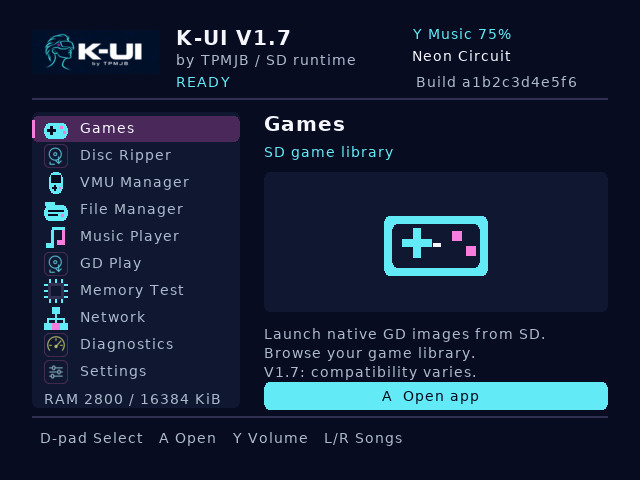
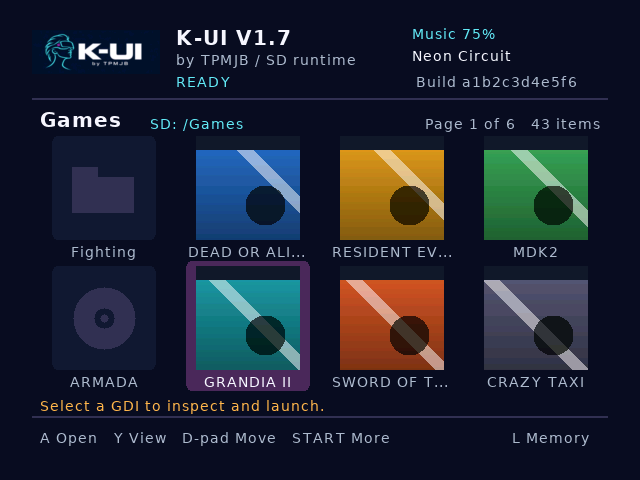
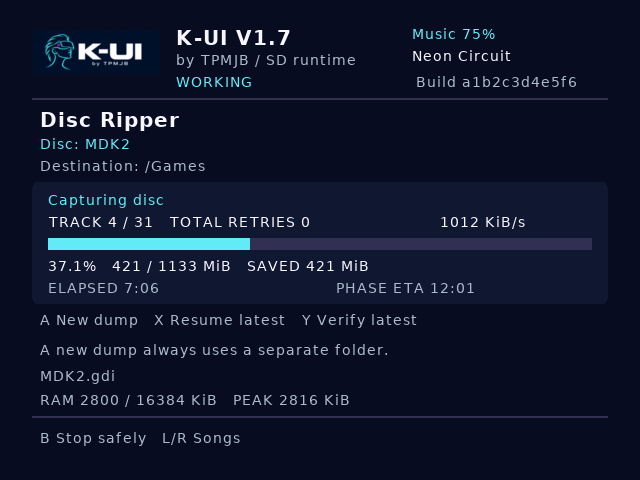
Interface previews
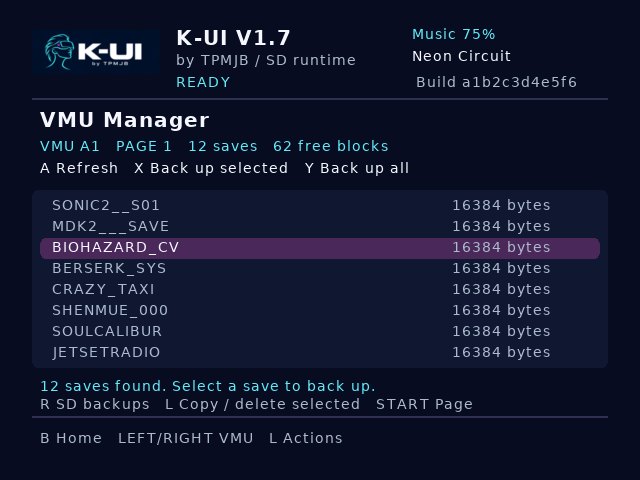
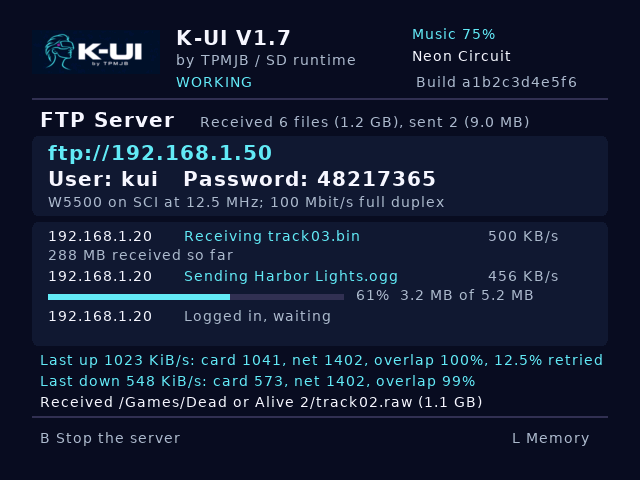
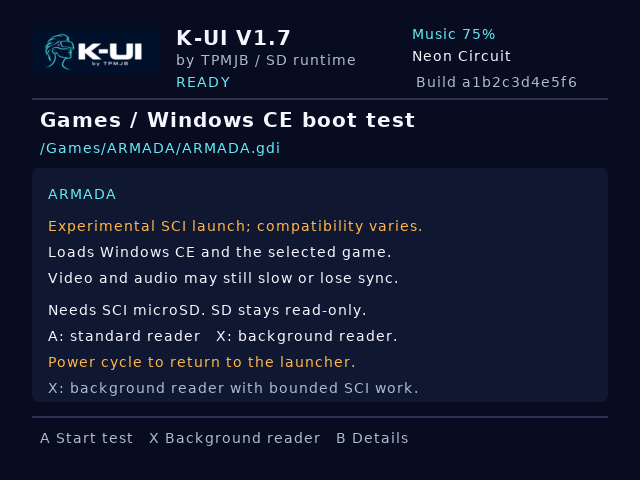
Rendered from the v1.7 release code with example titles, covers, saves,
counters and connection details. These use the release's UI renderer, fonts
and embedded assets. Hardware test results are listed below.
| Launcher: all ten apps, Games first | Games: Gallery view and disc titles |
|---|---|
 |
 |
| Disc Ripper: progress, saved bytes and ETA | VMU Manager: saves, free space and backups |
|---|---|
 |
 |
| FTP: clients, transfers and status | Windows CE: SCI reader selection |
|---|---|
 |
 |
From K-UI 1.0 to 1.7
K-UI 1.0 began as a DreamShell-based project. Version 1.7 lives in a standalone
repository built on upstream KallistiOS, with K-UI's own bootloader, shell,
capture engine and resident GDI game loader. Both projects use KallistiOS;
the change is the application and loader layer above it. K-UI's focused C
shell uses a fixed renderer and statically linked tools in place of the earlier SDL/Lua/XML app
framework. DreamShell was a valuable starting point; its framework and reader
are not inputs to this build.
Selected original K-UI branding, music and independently authored helpers and
policies carry forward with recorded provenance. KOS and other dependencies
retain their own credits and licenses. Familiar app names do not imply full
DreamShell feature or game compatibility: the independent loader has its own
tested limits, and BIOS programming and permanent region writes remain future
work. See source provenance and
prior-work reuse.
Coming from the DreamShell-based 1.0 CD? Burn the supplied 1.7 CDI to boot
this independent runtime. Reusing a boot CD applies to compatible independent
K-UI bootstraps; see the installation guide.
Windows CE reaches real games
- A separate CE loader places the kernel safely and serves CE's virtual-memory,
GD streaming and completion contracts. ARMADA has reached gameplay and Worms
Armageddon has booted and run on the owner's Dreamcast from SCI microSD. - The background reader integrates through CE's interrupt handler table,
receives blocks by SCI DMA and queues CRC-checked data while CE supplies
destination buffers. Physical and virtual destinations use their appropriate
delivery paths. - Long SD token searches can yield and resume at the same block, reducing the
amount of token polling in one CE service entry. 1.7 retains the 256-byte
allowance from6f14bc529472. The newer 512-byte experiment is rejected
following the owner's report of unclear audio. - The live CE speed overlay is suppressed during playback. Boot, error and
return reports remain available without the continuous overlay redraw.
Select a CE image in Games, open its CE confirmation and press X for this
background reader. A retains the standard-reader comparison. The separate
payload is still named ce-probe.kui. This path remains experimental,
SCI-only and title-dependent; it does not promise full-speed FMVs or exact
audio/video synchronization.
Faster SCI storage and background native-game reads
- Runtime storage adds an original bounded SCI DMA path, leaner receive-clock
feeding, word-level bit reversal and grouped CRC processing. Polling remains
available when DMA is unavailable or unsuitable. - A streaming SCI game reader starts receiving the next block while checking
and copying the previous one. Sequential requests can retain their CMD18
stream and reuse a block shared across requests. - Native games can choose the standard reader with A, background SCI with
20-block call batches using X, or 25-block batches using Y. The latter
is the owner's preferred tested DOA2 setting. Background-reader layout limits
and fallback to the standard reader remain explicit. - Standard game-read pacing now uses the actual programmed scanline period;
this fixes a video-mode-dependent defect that prevented larger batches from
activating in the captured DOA2 session. - The independent loader's launch maps allow 99 tracks, expanding its
earlier 16-track map. Image, allocation, payload and memory checks remain.
Storage throughput and game performance are different measurements. The
console results below document both without treating a storage benchmark as
a frame-rate or compatibility result.
One layout across SCIF, SCI and IDE/CF
- Bootstrap, runtime and native game loading select standalone external SCIF
SD, internal SCI microSD or IDE/CF. Each uses/KUIand/Games; only the
selected transport's reader stays resident during gameplay. - Automatic discovery tries SCIF, SCI, then IDE/CF. Manual source selection is
available in the graphical boot menu. A failed operation does not silently
continue on another device. - Experimental ATA PIO preparation adds bounded eight-sector reads,
whole-sector PIO copies and fixes to device selection and IDENTIFY capability
checks. It is included for future IDE/CF hardware work, with no measured
speed or compatibility claim.
ATA/IDE/CF remains untested on physical hardware. This release does not
implement ATA DMA or Windows CE on ATA/SCIF. The intended CF arrangement keeps
the GD-ROM master and adds an ATA slave; that board and coexistence still
require hardware validation.
W5500 Ethernet and FTP
- Network detects a W5500 wired to SCI, inspects its link and runs DHCP,
address-conflict, gateway ARP and ping checks. Existing BBA/LAN inspection
and test paths remain available. - The new FTP server browses, uploads, downloads, renames, moves and deletes
card files, with download resume, passive/active mode and up to three clients.
The status page shows clients, progress, rates and events. - Uploads use temporary files and take their final names only after completion.
Replacements preserve the previous file through finalization, and K-UI's
startup payloads are protected. - Network DMA and card I/O can overlap. A hardware-confirmed W5500 closing-state
workaround removes the prolonged transfer-start slowdown after directory
listings.
The tested setup uses W5500 on SCI and card storage on SCIF. SCI microSD owns
the same port and cannot be used simultaneously with W5500 here. FTP is plain
local-network FTP; uploads do not support resume. See FTP.
Boot menu, recovery, file tools and presentation
- A graphical crimson boot menu adds source selection, card retry, retained
recovery-image loading, diagnostics and optional card tools. Unchanged
screens avoid repeated redraws during normal runtime loading. - Compatible future boot-menu updates can be supplied as an optional card
image, while the built-in CD path remains available. The CD also has a
read-only clean-ext4 runtime loader; full ext4 app access is future work. - File Manager browses folders and opens games, music and pictures. Checked
copy/move/rename/delete operations preserve startup files; copies are read
back before finalization. Its console acceptance remains pending. - Diagnostics adds Quick, Compare and verified Soak storage tests, saved
baseline comparisons and asynchronous SCI diagnostics. - Clock edits synchronize the BIOS timestamp after confirmation, and new file
dates follow the console's clock. - New crimson cyberpunk artwork refreshes the runtime and boot presentation
while retaining the Dáinsleif name.
The complete K-UI toolkit
The release brings these advances alongside the established tools:
- ...
K-UI V1.5.1 "Dáinsleif"

K-UI V1.5.1 "Dáinsleif" — release notes
Version 1.5.1 is a point release of Dáinsleif. It updates the SD runtime
and the Games payload, and keeps the 1.5 boot CD, splash and optical capture
engine. Follow the installation guide to update an
existing FAT32/exFAT SD card.
Changes since 1.5.0
Games: loading and launching
- Longer reads on still screens. While a game shows an unchanging picture,
such as a black or static loading screen, the in-game reader serves each
request until shortly before the second vblank instead of stopping after two
sectors. While the game draws, requests stay at the 1.5 size. Every SD read
is now a single multi-block stream with the same per-block CRC checks.
Details. - Faster launches. Where each track lies on the card now comes from the
allocation table, instead of one SD read per allocation cluster. The two
handoff screens before a game pause for half a second instead of three. The
boot executable is read once, by the stage, which checks every sector's
sync, mode and address against its position.
Details. - Games with CD-audio music run silently. CD-audio play, pause and release
requests are accepted without sound instead of stopping the game. - Return to K-UI from a game. A+B+X+Y+Start makes most games ask for the
BIOS menu; the reader then shows its counters for about two seconds and
restarts the console, which boots the K-UI disc again.
Games: box art, titles and views
- Advanced > Scan box art records each game's disc title and cover in
KUI/covers: the owner's PNG or JPEG named after the game's folder, else
the disc's own0GDTEX.PVR, else the title alone. Later scans read only new
or changed games. Game folders are only read. - Y switches between List (names beside a large cover), Compact (two
columns of small covers) and Gallery (four covers across); the choice is
saved. Image details show the large cover. - The
.PVRtexture reader is independent K-UI code following KallistiOS's
documented texture format. Owner images are decoded by the pinned
stb_image2.30 (MIT).
Details.
Music
- The menu music and startup chime are stored as Ogg Vorbis, decoded by one
shared decoder, and Harbor Lights joins the menu rotation. A missing
.oggstill falls back to 1.5's.wavfile.
Games compatibility
Rows that changed since 1.5; all other requirements and limits are as in
the 1.5 notes.
| Requirement or limitation | 1.5.1 behavior |
|---|---|
| CD audio | Play requests are accepted without sound; music on CD-audio tracks is absent |
| Returning from a game | A+B+X+Y+Start restarts into K-UI when the game asks for the BIOS menu; otherwise power cycle |
| Box art | 16-bit disc textures (twiddled, stride or VQ) or owner PNG/JPEG up to 3 MB and 1.2 megapixels; other games show their title and a placeholder |
Passing preparation checks still means only that an image fits the reader.
Loading speed remains bounded by the serial SD interface.
Hardware evidence
| Area | Observation |
|---|---|
| Still-screen read pacing, DOA2 | Owner: "This actually worked really well." Some longer loads between fights; the first roughly ten seconds of a fight remain laggy |
| Still-screen read pacing, Evolution (first game) | Owner: mostly responsive; the few FMVs stutter |
| Faster launches, DOA2 | Owner: "DOA2 launch is near instant now, which is incredible on SCIF" |
| A+B+X+Y+Start | Owner: "ABXY+Start actually does reboot, which saves me time" |
| Box art | Owner: "Box art works" |
| Silent CD audio | Not yet tried on the console; covered by host tests only |
These are owner observations, not measured timings. The read-pacing
observations come from build 2072b489c378, whose reader this release
carries unchanged except for the CD-audio and restart handling above. See the
pin record.
The launch, restart and box art observations come from release candidate
cb508b2a4fe4, whose code this release carries unchanged; only these notes
differ.
For rollback, the 1.5.0 release remains available, and the tested pacing
build is preserved on branch baseline/doa2-pacing-2072b489c378. The earlier
baseline/doa2-cmd18-ed31d522c847 and baseline/doa2-sd-6c02bd8b22f4
branches are unchanged.
Package and source
kui-1.5.1-dainsleif-release.zip contains the normal runtime, Games payloads,
Ogg menu music, catalogues, optional boot CDI, splash preview and source and
license records. It excludes scan fixtures, demonstration Music files, box art
and SD preferences. Merge its supplied files without replacing the existing SD
directory wholesale.
Full corresponding source, dependency pins and license records accompany the
release in kui-1.5.1-dainsleif-source.zip, as identified by SOURCE.txt.
The 1.5.0 notes and installation guide remain in the repository.
Source commit: 3caaea7dc91f82c7a955d1316305d0531b2c2d42. Native build.
K-UI V1.5 "Dáinsleif"
K-UI V1.5 "Dáinsleif" — release notes
Version 1.5.0 promotes the tested independent K-UI launcher to a full
release. It adds broader native-GD game launching and the crimson Dáinsleif
startup splash while preserving the working boot CD and optical capture
engine. Follow the installation guide to update an existing
FAT32/exFAT SD card.
Changes in 1.5
- Games launches suitable native GD images without the former DOA2 title or
1ST_READ.BINfilename allowlists. The boot filename comes from IP metadata;
image, memory and allocation checks still apply. - Game inspection leads directly to launch confirmation. Read probes remain
available under Advanced diagnostics. - GETSCD command
0x22now provides bounded raw Q position, formatted Q
position and unavailable media-catalog responses. This fixes the request
rejection that prevented the tested Evolution 2 image from booting. - The SD runtime includes the new Dáinsleif splash. The original K-UI badge
beneath the SEGA logo and startup sound remain unchanged. - The release bundles the nine-app shell, menu music, reference catalogues,
normal Games payloads and an optional boot CDI. Existing game dumps and
settings are preserved when the supplied files are merged onto the card.
Games compatibility
Passing preparation checks means an image fits the current reader; it does
not establish that the title will play correctly.
| Requirement or limitation | 1.5 behavior |
|---|---|
| Image format | GDI with raw 2352-byte track files and zero file offsets |
| Filesystem | Existing FAT32 or exFAT SD card |
| Boot program | Native GD executable in a contiguous root ISO9660 file extent, 128 bytes to 12 MiB; filename taken from IP metadata |
| Image map | At most 16 tracks and 128 physical file extents across the image |
| Windows CE / Mode 2 boot data | Unsupported |
| Audio tracks | The usual low-density track 2 is normal; high-density CDDA playback is unsupported and may cause missing music or a failed game request |
| Subchannel responses | Synthesized index-1 Q position; no captured subchannels, pregap reconstruction or format-3 GETSCD response |
| Returning from a game | Power cycle the console |
Game reads are SD read-only. Normal game VMU save operations can still write
to the VMU. An incompatible layout or request may stop launch or gameplay;
broader title, streaming-audio and save/load compatibility remains unproven.
Ext4, GDEmu and IDE/CF support are outside this release. The tested optical
capture engine and bounded CMD18 retail SD reader remain unchanged.
Hardware evidence and known performance limits
| Area | Confirmed observation |
|---|---|
| 1.5 runtime | Owner reports successful boot of the release-candidate runtime |
| Dead or Alive 2 | Playable on the pinned CMD18 baseline; about 32 seconds from character selection to the first stage, with initial fight and FMV slowdown |
| Evolution 2 | Owner reports successful boot after the GETSCD fix, but describes performance as horribly slow |
These are owner observations, not measured frame timings. Evolution 2's
successful boot does not establish full-game completion or VMU save/load
compatibility. Broader game testing continues separately. Serial SD transport
remains a performance constraint, and speed optimization is deferred beyond
1.5. The final release does not claim universal game compatibility or
full-speed loading. Other app paths retain their documented acceptance limits;
see hardware evidence and the
app acceptance guide.
The preserved rollback branch is baseline/doa2-cmd18-ed31d522c847, packaged
commit ed31d522c8475b88bd40afa366fe3f7bdf143985. Its archived SD ZIP is
8,134,517 bytes with SHA-256:
a3c64bd3a6d70cc0369a32aaa04f563af9bea72ab8603e20307d3c5cb5b18bc4
That branch and ZIP, and the older baseline/doa2-sd-6c02bd8b22f4, remain
unchanged. Restore the archived KUI files to roll back the SD runtime and
Games payload together; keep the existing boot CD and game dumps.
Package and source
kui-1.5.0-dainsleif-release.zip contains the normal runtime, Games payloads,
menu music, catalogues, optional boot CDI, splash preview and source/license
records. It excludes scan fixtures, demonstration Music files and SD
preferences. Merge its supplied files without replacing the existing SD
directory wholesale.
The original boot badge is checked byte for byte and read back from the
generated CDI during packaging. The new splash is embedded in the runtime;
splash-preview.png shows its artwork. Your current working CD remains usable.
Full corresponding source, dependency pins and license records accompany the
release in kui-1.5.0-dainsleif-source.zip, as identified by SOURCE.txt. Historical RC1 documentation remains in
the repository for reference.
Source commit: f7b537647eea3b7408c57e9aea8455595cd12fc9. Native build.