Delay embedding (Takens' embedding) for multidimensional time series data in Python.
- Multivariate support — handles both univariate
(T,)and multivariate(T, d)time series natively - Inverse transform — reconstruct the original time series from the embedded matrix (averaging-based approximation)
- Automatic parameter optimization —
dimension="auto"anddelay="auto"estimate optimal parameters from data- Optimal delay via Auto Mutual Information (AMI) first minimum
- Optimal embedding dimension via False Nearest Neighbours (FNN)
- scikit-learn compatible —
BaseEstimator/TransformerMixinAPI, works inPipeline(optional dependency) - Lightweight — core dependency is NumPy only
- Fast — vectorized NumPy fancy indexing, faster than giotto-tda with numerically identical results
pip install git+https://github.com/Taiyou/delay-embedding.gitWith scikit-learn integration:
pip install "delay-embedding[sklearn] @ git+https://github.com/Taiyou/delay-embedding.git"import numpy as np
from delay_embedding import DelayEmbedding
# Automatic optimization (recommended)
t = np.linspace(0, 10 * np.pi, 1000)
ts = np.column_stack([np.sin(t), np.cos(t)])
emb = DelayEmbedding(dimension="auto", delay="auto")
embedded = emb.fit_transform(ts)
print(f"tau={emb.delay_}, m={emb.dimension_}")
# Manual parameters
emb = DelayEmbedding(dimension=3, delay=5)
embedded = emb.transform(ts)
# Inverse transform
reconstructed = emb.inverse_transform(embedded, d=2)from sklearn.pipeline import Pipeline
from sklearn.preprocessing import StandardScaler
pipe = Pipeline([
("embed", DelayEmbedding(dimension="auto", delay="auto")),
("scale", StandardScaler()),
])
result = pipe.fit_transform(ts)| Parameter | Type | Default | Description |
|---|---|---|---|
dimension |
int or "auto" |
2 |
Embedding dimension m. "auto" estimates via FNN |
delay |
int or "auto" |
1 |
Time delay tau. "auto" estimates via AMI |
Methods:
| Method | Description |
|---|---|
fit(X) |
Estimate "auto" parameters from data. Sets dimension_ and delay_ attributes |
transform(X) |
Apply delay embedding. Returns shape (T-(m-1)*tau, d*m) |
fit_transform(X) |
fit + transform |
inverse_transform(embedded, d=1) |
Reconstruct original time series |
Select optimal delay via first minimum of Auto Mutual Information.
Select optimal embedding dimension via False Nearest Neighbours.
All results are documented in the project wiki:
- Verification — Lorenz attractor reconstruction, inverse transform roundtrip, optimal parameter selection
- Multivariate Validation — 6 diagnostic tests for multidimensional data
- Comparison with giotto-tda — numerical identity and performance comparison
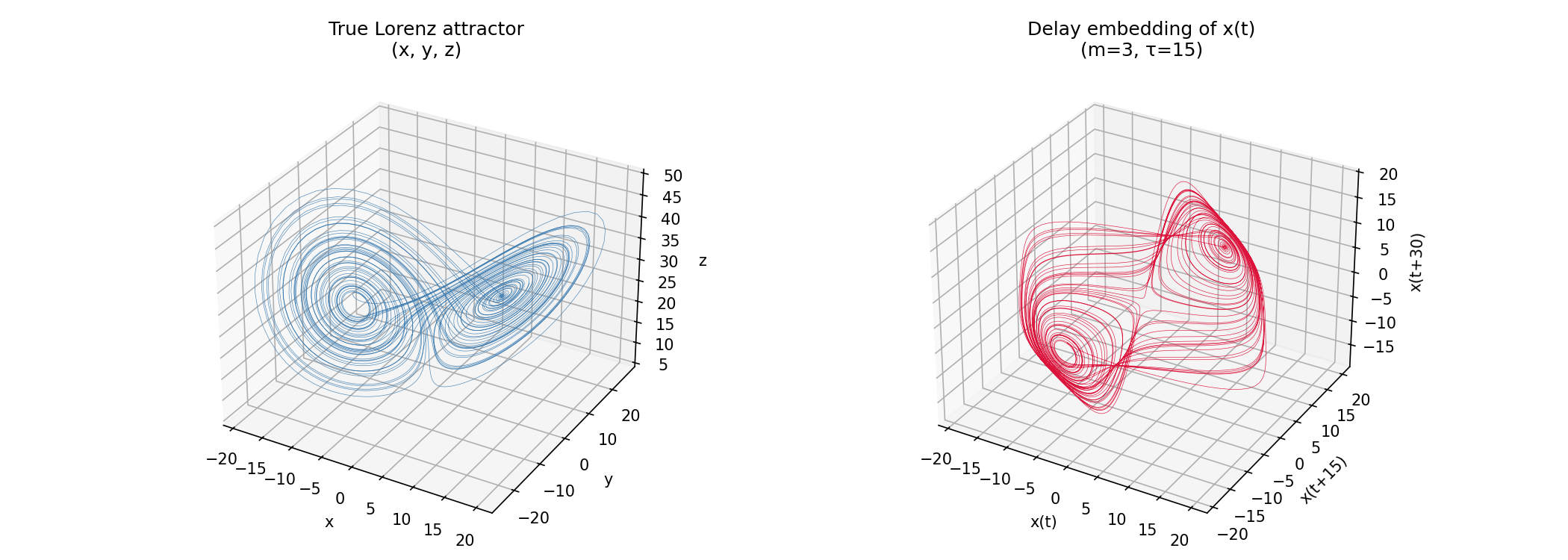
| # | Test | Result | Status |
|---|---|---|---|
| 1 | Channel ordering | Interleaved as expected | PASS |
| 2 | Cross-channel correlation | Max diff 0.000023 | PASS |
| 3 | Lorenz structure preservation | Butterfly structure recovered | PASS |
| 4 | Noise robustness | Distance corr 0.79 at sigma=0.5 | PASS |
| 5 | Scale invariance | Roundtrip error ~1e-13 | PASS |
| 6 | Univariate vs multivariate consistency | Diff = 0 (exact match) | PASS |
PYTHONPATH=src python3 -m pytest tests/ -v50 tests covering core functionality, edge cases, scikit-learn compatibility, and automatic optimization.
Takens' embedding theorem (1981) guarantees that a dynamical system's state space can be reconstructed from delay coordinates with sufficient embedding dimension m and appropriate delay tau:
y(t) = [x(t), x(t+tau), x(t+2*tau), ..., x(t+(m-1)*tau)]
For a d-dimensional time series, the output is a d*m dimensional vector at each time step.
MIT