Up-to-date docs for AI agents — local, instant, plug and play.



AI agents are trained on outdated docs. When libraries release new versions, your AI doesn't know — and confidently gives you wrong answers.
// Your AI, mass-trained on AI SDK v5 docs, will suggest:
import { Experimental_Agent as Agent, stepCountIs } from 'ai';

// But v6 changed the API entirely:
import { ToolLoopAgent } from 'ai';
The fix isn't better prompting. It's giving your AI the right docs.
Context is an MCP server backed by a community-driven package registry with 100+ popular libraries already built and ready to use. When your AI agent needs documentation, it searches the registry, downloads the right package, and queries it locally — all automatically.
Install once. Configure once. Then just ask your AI.
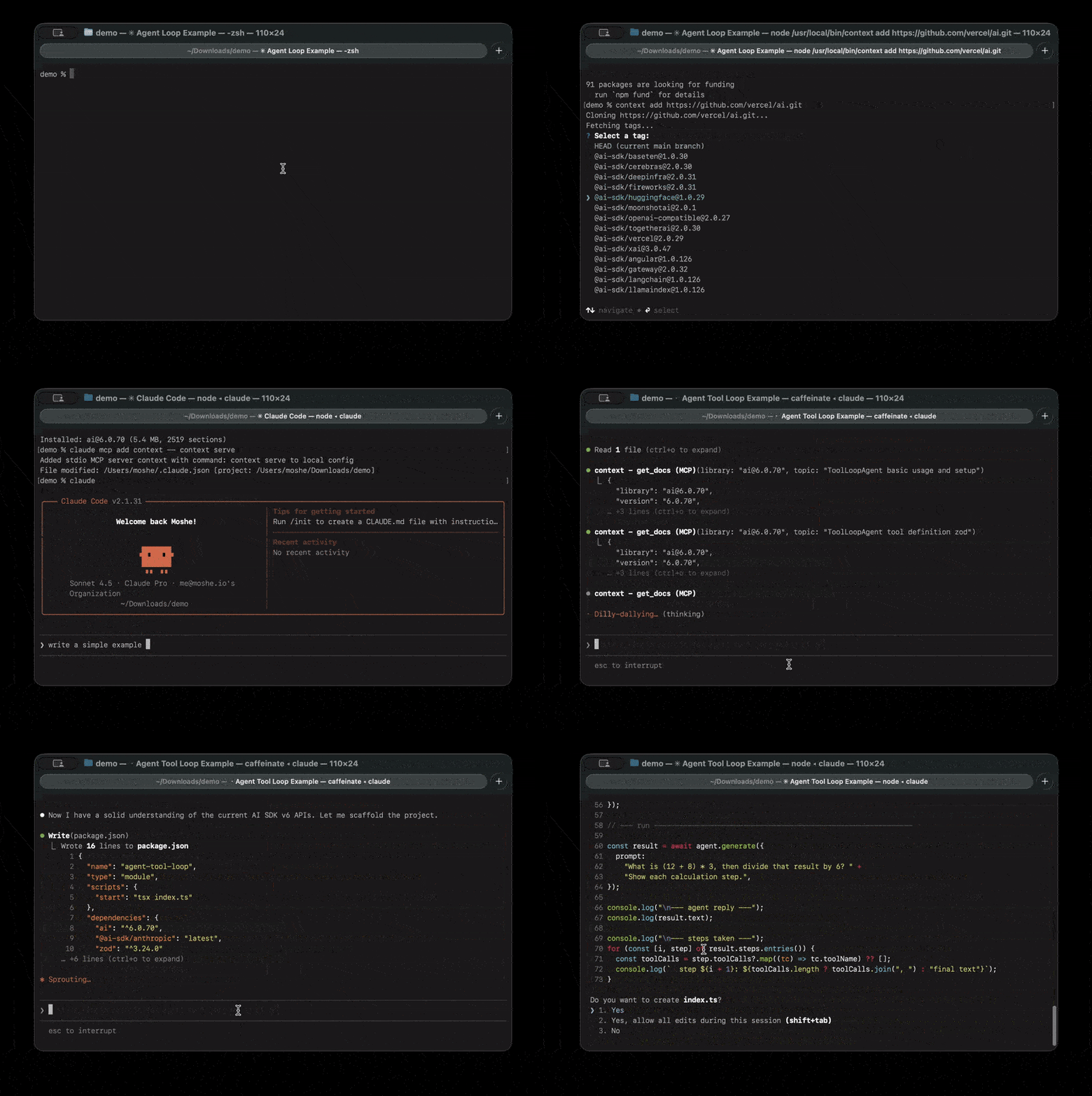
npm install -g @neuledge/contextContext works with any MCP-compatible agent. Pick yours:
Claude Code
claude mcp add context -- context serveClaude Desktop
Add to your config file:
- Linux:
~/.config/claude/claude_desktop_config.json - macOS:
~/Library/Application Support/Claude/claude_desktop_config.json - Windows:
%APPDATA%\Claude\claude_desktop_config.json
{
  "mcpServers": {
    "context": {
      "command": "context",
      "args": ["serve"]
    }
  }
}
Restart Claude Desktop to apply changes.
Cursor
Add to ~/.cursor/mcp.json (global) or .cursor/mcp.json (project-specific):
{
  "mcpServers": {
    "context": {
      "command": "context",
      "args": ["serve"]
    }
  }
}
Or use Settings > Developer > Edit Config to add the server through the UI.
OpenAI Codex
Either use the CLI
codex mcp add context -- context serveOr add to ~/.codex/config.toml (global) or .codex/config.toml (project-specific):
[mcp_servers.context]
command = "context"
args = ["serve"]
Restart OpenAI Codex to apply changes.
VS Code (GitHub Copilot)
Requires VS Code 1.102+ with GitHub Copilot
Add to .vscode/mcp.json in your workspace:
{
  "servers": {
    "context": {
      "type": "stdio",
      "command": "context",
      "args": ["serve"]
    }
  }
}
Click the Start button that appears in the file, then use Agent mode in Copilot Chat.
Windsurf
Add to ~/.codeium/windsurf/mcp_config.json:
- Windows:
%USERPROFILE%\.codeium\windsurf\mcp_config.json
{
  "mcpServers": {
    "context": {
      "command": "context",
      "args": ["serve"]
    }
  }
}
Or access via Windsurf Settings > Cascade > MCP Servers.
Zed
Add to your Zed settings.json (press cmd+, or ctrl+, twice):
{
  "context_servers": {
    "context": {
      "command": {
        "path": "context",
        "args": ["serve"]
      }
    }
  }
}
Check the Agent Panel settings to verify the server shows a green indicator.
Goose
Run goose configure and select Command-line Extension, or add directly to ~/.config/goose/config.yaml:
extensions:
  context:
    type: stdio
    command: context
    args:
      - serve
    timeout: 300
OpenCode
Add to ~/.config/opencode/opencode.json:
{
  "mcp": {
    "context": {
      "command": ["context", "serve"],
      "enabled": true,
      "type": "local"
    }
  }
}That's it. Just ask:
"How do I create middleware in Next.js?"
Your agent searches the community registry, downloads the docs, and answers with accurate, version-specific information. Everything happens automatically — no manual context install needed for registry packages.
The registry is what makes Context plug and play. It's a growing collection of 100+ pre-built documentation packages maintained by the community. Think of it like a package manager, but for AI-ready docs.
Popular packages available today:
| Category | Libraries |
|---|---|
| Frameworks | Next.js, Nuxt, Astro, SvelteKit, Remix, Hono |
| React ecosystem | React, React Router, TanStack Query, Zustand, Redux Toolkit |
| Databases & ORMs | Prisma, Drizzle, Mongoose, TypeORM |
| Styling | Tailwind CSS, shadcn/ui, Styled Components |
| Testing | Vitest, Playwright, Jest, Testing Library |
| APIs & Auth | tRPC, GraphQL, NextAuth.js, Passport |
| AI & LLMs | LangChain, AI SDK, OpenAI, Anthropic SDK |
Anyone can contribute. If a library you use isn't listed, submit a PR to add it — your contribution helps every Context user.
Context runs entirely on your machine. Docs are downloaded once and stored as compact SQLite databases in ~/.context/packages/. After that, everything is local.
- Fast — Local SQLite queries return in under 10ms
- Offline — Works on flights, in coffee shops, anywhere
- Private — Your queries never leave your machine
- Free — No subscriptions, no rate limits, no usage caps
- Reliable — No outages, no API changes, no service shutdowns
The registry covers popular open-source libraries, but Context also works with any documentation source. Use context add to build packages from private repos, internal libraries, websites with llms.txt, or anything not yet in the registry.
# Build from a git repository
context add https://github.com/your-company/design-system

# Build from a local directory
context add ./my-project

# Specific version tag
context add https://github.com/vercel/next.js/tree/v16.0.0

# Build from a website's llms.txt
context add https://svelte.dev
Once built, share packages with your team — they're portable .db files that install instantly:
# Export a package
context add ./my-project --name my-lib --pkg-version 2.0 --save ./packages/

# Teammate installs it (no build step needed)
context add ./packages/my-lib@2.0.dbRun Context as a containerized HTTP server for multi-client or Kubernetes deployments.
Pre-built linux/amd64 images are published to GitHub Container Registry by the Docker workflow:
docker run --rm -p 8080:8080 \
  --mount source=context-data,target=/home/node/.context \
ghcr.io/teejs/context:latest| Tag | Moves when |
|---|---|
latest, <version> |
the package version changes on main, which is the commit each npm release is published from |
main, sha-<short> |
every push to main that touches the package |
To build the image yourself:
# Run from the repository root (required for the monorepo lockfile)
docker build -t context:local -f packages/context/Dockerfile .
docker run --rm -p 8080:8080 \
  --mount source=context-data,target=/home/node/.context \
  context:local
The image runs as the unprivileged node user. Mount /home/node/.context to
persist downloaded documentation packages and server configuration across
container replacements. The built-in healthcheck verifies that the HTTP server
is accepting requests on port 8080.
For a bind mount instead of the named volume above, make the host directory
writable by UID/GID 1000:1000 (for example, with chown 1000:1000) before
starting the container.
The container starts Context with HTTP transport on port 8080, accessible at http://localhost:8080/mcp. The image uses a multi-stage build with node:22-bookworm-slim for native module compatibility.
Search for packages available on the registry server.
# Browse by registry/name
context browse npm/next

# Output:
#   npm/next@15.1.3           3.4 MB  The React Framework for the Web
#   npm/next@15.0.4           3.2 MB  The React Framework for the Web
#   ...
#
#   Found 12 versions. Install with: context install npm/next

# Browse with just a name (defaults to npm)
context browse reactDownload and install a pre-built package from the registry server.
Registry downloads are limited to 512 MiB by default so a broken or
compromised registry cannot fill local storage. Set
CONTEXT_MAX_DOWNLOAD_BYTES to a positive byte count to choose a different
limit. The declared Content-Length and the bytes actually streamed are both
checked. An unset or blank value uses the default.
# Install latest version
context install npm/next

# Install a specific version
context install npm/next 15.0.4

# Install from other registries
context install pip/djangoBuild and install a documentation package from source. Use this for libraries not in the registry, or for private/internal docs. The source type is auto-detected.
From git repository:
Works with GitHub, GitLab, Bitbucket, Codeberg, or any git URL:
# HTTPS URLs
context add https://github.com/vercel/next.js
context add https://gitlab.com/org/repo
context add https://bitbucket.org/org/repo

# Specific tag or branch
context add https://github.com/vercel/next.js/tree/v16.0.0

# SSH URLs
context add git@github.com:user/repo.git
context add ssh://git@github.com/user/repo.git

# Custom options
context add https://github.com/vercel/next.js --path packages/docs --name nextjs
From local directory:
Build a package from documentation in a local folder:
# Auto-detects docs folder (docs/, documentation/, doc/)
context add ./my-project

# Specify docs path explicitly
context add /path/to/repo --path docs

# Custom package name and version
context add ./my-lib --name my-library --pkg-version 1.0.0| Option | Description |
|---|---|
--pkg-version <version> |
Custom version label |
--path <path> |
Path to docs folder in repo/directory |
--name <name> |
Custom package name |
--save <path> |
Save a copy of the package to the specified path |
Saving packages for sharing:
# Save to a directory (auto-names as name@version.db)
context add https://github.com/vercel/next.js --save ./packages/

# Save to a specific file
context add ./my-docs --save ./my-package.db
From website (llms.txt):
Many websites publish an llms.txt file with AI-ready documentation. Context auto-detects and fetches it. When the site only provides llms.txt (an index of links rather than the inlined llms-full.txt), Context follows each link and fetches the linked document:
# Auto-fetches llms-full.txt or llms.txt from the site
context add https://svelte.dev
context add https://mui.com/material-ui

# Direct URL to a specific llms.txt file
context add https://svelte.dev/docs/svelte/llms.txt

# Custom package name
context add https://react-aria.adobe.com --name react-aria
From an arbitrary URL (blog posts, articles, raw Markdown):
If no llms.txt is found, Context falls back to fetching the page directly. HTML pages are run through a readability extractor (defuddle) so subscribe CTAs, navigation, and comment widgets don't end up in the package:
# A blog post
context add https://overreacted.io/things-i-dont-know-as-of-2018/

# Raw Markdown from GitHub
context add https://raw.githubusercontent.com/neuledge/context/main/README.md --name context-readme
For subscriber-only content on platforms you have a paid account for, see context auth below.
From URL:
context add https://cdn.example.com/react@18.dbFrom local file:
context add ./nextjs@15.0.dbFinding the right documentation repository:
Many popular projects keep their documentation in a separate repository from their main codebase. If you see a warning about few sections found, the docs likely live elsewhere:
# Example: React's docs are in a separate repo
context add https://github.com/facebook/react
# ⚠️  Warning: Only 45 sections found...
# The warning includes a Google search link to help find the docs repo

# The actual React docs repository:
context add https://github.com/reactjs/react.dev
Common patterns for documentation repositories:
project-docs(e.g.,prisma/docs)project.devorproject.io(e.g.,reactjs/react.dev)project-website(e.g.,expressjs/expressjs.com)
When the CLI detects few documentation sections, it will show a Google search link to help you find the correct repository.
Show installed packages.
$ context list

Installed packages:

  nextjs@16.0              4.2 MB    847 sections
  nextjs@15.5              3.9 MB    790 sections
  react@18                 2.1 MB    423 sections

Total: 3 packages (10.2 MB)
Several versions of the same package can be installed side by side; each name is listed newest first. Commands that take a bare name (context query react, context serve --libs react) use the highest installed version.
Remove a package. Pass name@version to remove a specific version. A bare name
is only accepted when a single version of that package is installed — otherwise
the command lists the installed versions and asks you to pick one, so nothing is
deleted by guesswork.
context remove nextjs
context remove nextjs@16.0Store per-platform cookies or headers so context add <url> can fetch subscriber-only content you have a legitimate account for (e.g., a paid Substack or Medium subscription). Credentials are stored in ~/.context/auth.json with 0600 permissions, and matched by domain (with one level of parent-domain fallback for subdomains).
# Store cookies for a domain
context auth add substack.com --cookies "substack.sid=YOUR_SID"

# Add a custom header too
context auth add medium.com --cookies "sid=..." --header "x-frontend: web"

# List configured auth
context auth list

# Remove auth
context auth remove substack.comStart the MCP server (used by AI agents).
# Stdio transport (default, for single-client MCP integrations)
context serve

# HTTP transport (for multi-client access over the network)
context serve --http
context serve --http 3000
context serve --http 3000 --host 0.0.0.0

# Restrict the session to a subset of installed packages
context serve --libs react next@15.0.4| Option | Description |
|---|---|
--http [port] |
Start as HTTP server instead of stdio (default port: 8080) |
--host <host> |
Host to bind to (default: 127.0.0.1) |
--libs <names...> |
Restrict the session to a fixed set of installed libraries. Each entry is a name (react, exposing every installed version) or name@version (react@18.3.1, exposing only that version). When set, search_packages and download_package are hidden so the session is locked to that list. Useful for per-project scoping when you have many packages installed globally. |
The HTTP transport uses the MCP Streamable HTTP protocol, enabling multiple clients on the local network to connect to a single server instance. The endpoint is available at http://<host>:<port>/mcp.
The HTTP server bounds its own resource use so clients that disappear without closing their session cannot exhaust it. Tune the limits with environment variables (positive integers; an invalid value is a startup error):
| Variable | Default | Description |
|---|---|---|
CONTEXT_MAX_SESSIONS |
64 |
Maximum concurrent MCP sessions. New sessions beyond this get HTTP 503 with a Retry-After header. |
CONTEXT_SESSION_IDLE_TIMEOUT |
1800 |
Seconds a session may sit with no requests and no open SSE stream before the server closes it. A client whose session was closed gets HTTP 404 and must re-initialize. |
The HTTP server bounds its own resource use so clients that disappear without closing their session cannot exhaust it. Tune the limits with environment variables (positive integers; an invalid value is a startup error):
| Variable | Default | Description |
|---|---|---|
CONTEXT_MAX_SESSIONS |
64 |
Maximum concurrent MCP sessions. New sessions beyond this get HTTP 503 with a Retry-After header. |
CONTEXT_SESSION_IDLE_TIMEOUT |
1800 |
Seconds a session may sit with no requests and no open SSE stream before the server closes it. A client whose session was closed gets HTTP 404 and must re-initialize. |
Query documentation directly from the command line. Useful for testing and debugging.
# Query a package (use name@version format from 'context list')
context query 'nextjs@16.0' 'middleware authentication'

# A bare name queries the highest installed version
context query nextjs 'middleware authentication'

# Returns the same JSON format as the MCP get_docs tool┌─────────────────────────────────────────────────────────┐
│ Your Machine │
│ │
│ ┌──────────┐ ┌──────────────────┐ ┌────────────┐ │
│ │ AI │ │ Context MCP │ │ ~/.context │ │
│ │ Agent │───▶│ Server │───▶│ /packages │ │
│ │ │ │ │ └────────────┘ │
│ └──────────┘ └────────┬─────────┘ │ │
│ │ ┌──────────┐ │
│ │ │ SQLite │ │
│ │ │ FTS5 │ │
│ │ └──────────┘ │
└───────────────────────────┼─────────────────────────────┘
│ (first use only)
▼
┌────────────────┐
│ Community │
│ Registry │
└────────────────┘
First time you ask about a library:
- The MCP server searches the community registry
- Downloads the pre-built documentation package (a SQLite
.dbfile) - Stores it locally in
~/.context/packages/
Every time after:
- FTS5 full-text search finds relevant sections locally
- Smart filtering keeps results within token budget
- Your AI gets focused, accurate documentation in under 10ms
SQLite engines: Context uses the native better-sqlite3 engine, which reads packages straight from disk. If the native binding cannot be loaded, it falls back to sql.js (WebAssembly), which reads each whole package into memory and is slower. The fallback prints a warning, and context serve reports the engine in use at startup. For deployments that must never run the in-memory engine, set CONTEXT_REQUIRE_NATIVE_SQLITE=1: startup then fails with the load error instead of falling back.
Yes! Context is language-agnostic. It natively supports Markdown (.md, .mdx), AsciiDoc (.adoc), reStructuredText (.rst), and HTML — no conversion needed.
# Python - FastAPI (Markdown)
context add https://github.com/fastapi/fastapi --path docs/en/docs

# Python - Django (reStructuredText)
context add https://github.com/django/django --path docs

# Java - Spring Boot (AsciiDoc)
context add https://github.com/spring-projects/spring-boot --path spring-boot-project/spring-boot-docs/src/docs

# Rust - The Rust Book
context add https://github.com/rust-lang/book --path src
Point Context at the docs folder with --path and it handles the rest.
Yes! The registry/ directory has YAML definitions organized by package manager:
registry/npm/— JavaScript/TypeScript (Next.js, React, Tailwind, etc.)registry/pip/— Python (FastAPI, Flask, Django, Pydantic)registry/maven/— Java (Spring Boot, JUnit, Micrometer)
To add a package, create a YAML file. Two source types are supported:
Git source — clone a repo at a version tag:
# registry/pip/my-library.yaml
name: my-library
description: "Short description of the library"
repository: https://github.com/org/my-library

versions:
  - min_version: "2.0.0"
    source:
      type: git
      url: https://github.com/org/my-library
      docs_path: docs
    tag_pattern: "v{version}"
ZIP source — download HTML docs from a URL (supports {version} placeholder):
# registry/python/python.yaml
name: python
description: "Python programming language official documentation"

versions:
  - versions: ["3.14", "3.13", "3.12"]
    source:
      type: zip
      url: "https://docs.python.org/3/archives/python-{version}-docs-html.zip"
      docs_path: "python-{version}-docs-html"
      exclude_paths:
        - "whatsnew/**"
        - "changelog.html"
Version discovery is supported for npm, PyPI, and Maven Central. See existing definitions for examples.
# Install dependencies
pnpm install

# Build
pnpm build

# Test
pnpm test

# Lint
pnpm lint