With the current SteamVR beta 1.7.12 and mesa git, vrcompositor is (almost) able to run comfortably on igpus, at least with the resolution of the first Vive.
I'm trying it on a laptop with a 3550H with "Vega 8" Picasso igpu and an RX 560X dgpu.
Running steamvr and hellovr_opengl both on the igpu works of course, but when I run hellovr_opengl on the dgpu with DRI_PRIME=1 hellovr_opengl, the output in SteamVR is corrupted:
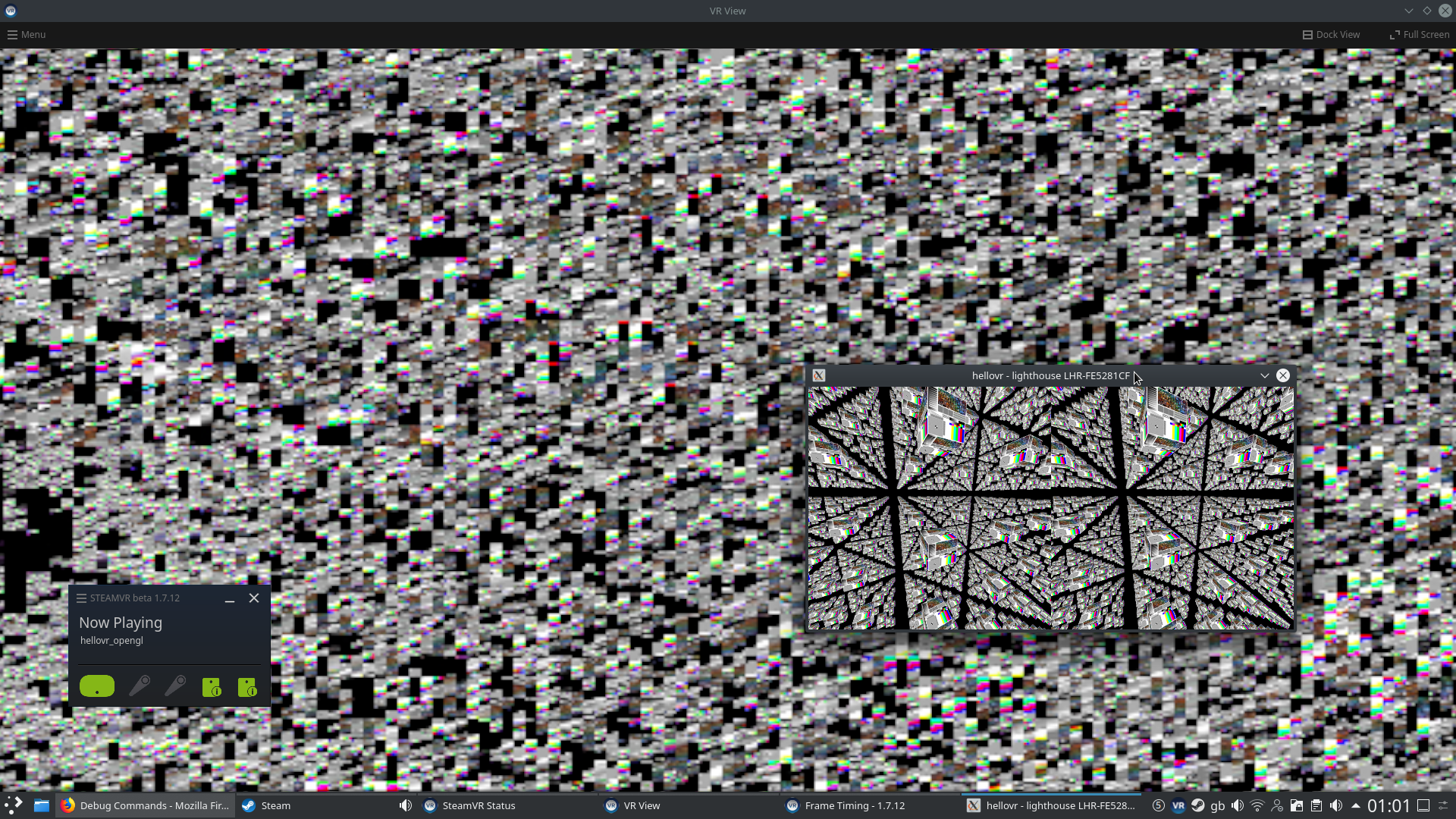
R600_DEBUG=notiling has no effect and the same corruption happens when running hellovr_vulkan on the dgpu (using the device-select vulkan layer).
Hypothesis: SteamVR creates a vkImage and exports it with external memory, but uses optimal tiling which breaks importing a texture from another GPU (even though both are AMD GPUs).
It would be great if steamvr could automatically detect if the client vr application runs on another GPU and use linear buffers in this case. If that's not possible, a setting or environment variable would be a good start.

With the current SteamVR beta 1.7.12 and mesa git, vrcompositor is (almost) able to run comfortably on igpus, at least with the resolution of the first Vive.
I'm trying it on a laptop with a 3550H with "Vega 8" Picasso igpu and an RX 560X dgpu.
Running steamvr and hellovr_opengl both on the igpu works of course, but when I run hellovr_opengl on the dgpu with

DRI_PRIME=1 hellovr_opengl, the output in SteamVR is corrupted:R600_DEBUG=notiling has no effect and the same corruption happens when running hellovr_vulkan on the dgpu (using the device-select vulkan layer).
Hypothesis: SteamVR creates a vkImage and exports it with external memory, but uses optimal tiling which breaks importing a texture from another GPU (even though both are AMD GPUs).
It would be great if steamvr could automatically detect if the client vr application runs on another GPU and use linear buffers in this case. If that's not possible, a setting or environment variable would be a good start.