Protocol
Protocols are an essential part for the Univeral Space Operation Center. They define the way in which the incoming data is interpreted.
Protocols are declared using .xml files. These files have the benefit of being both human- and machine-readable through the use of tags and attributes. An example of an xml file is shown below.
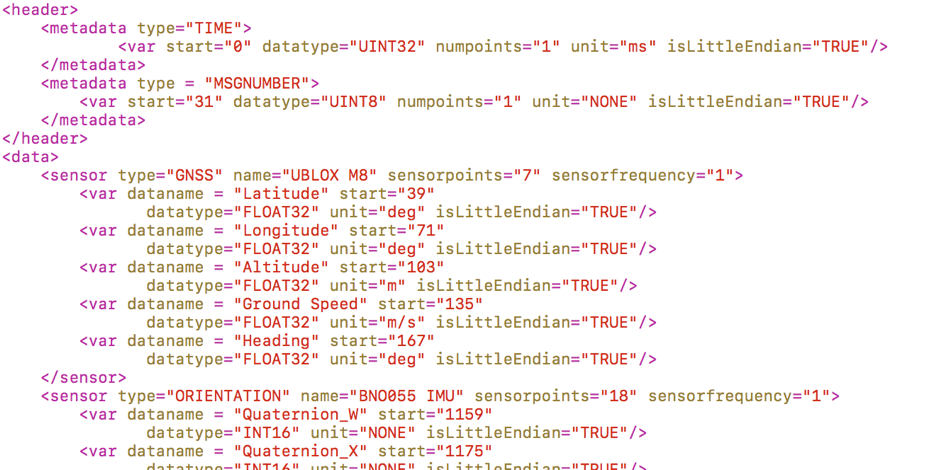
The protocol files used for the ground station has the following structure and key words:
| Tag | Attribute | Description |
|---|---|---|
| sbd340message | specifies the base element of the data structure. | |
| protocol | specifies the protocol type that is encoded in this xml file. This tells the MessageController how the incoming data should be treated. Currently only the protocol type ‘SEQUENTIAL’ is supported, further updates will be added in future iterations. | |
| header | This is a wrapper for all data that is not necessarily shared with the user. | |
| metadata | Metadata specifies a particular set of header data. | |
| type | This sets the MetadataType, currently the following options are available:
|
|
| name | This allows to set a name for the specific meta data. | |
| var | All ground station data is stored in variables. The var tag allows to specify a specific variable that can be handled internally. An unlimited amount of var tags can be placed inside a metadata tag. | |
| dataname | Name of the variable as String. | |
| start | startposition in bit of the variable in the respective data package. | |
| datatype | Datatype of the variable. Currently available options are with length in brackets:
|
|
| unit | Unit of the variable as String, currently this is only used for visualization. | |
| numpoints | Number of variables per data packet as Int. These data points must be next to each other. If this is not set it is automatically set to 1. | |
| frequency | If numpoints is greater than 1, frequency must be set. This is used to determine the time values for every data point. | |
| isLittleEndian | Boolean value to determine whether the incoming data is in little or big endian format. | |
| data | ||
| sensor | ||
| type | sensor type | |
| name | Name of the sensor. | |
| sensorpoints | Number of variables packs per data packet as Int. These data points must be next to each other. If this is not set it is automatically set to 1. If sensor points is not 1, all variables are read in their sequential order for the number of times stated. | |
| sensorfrequency | If sensorpoints is greater than 1, frequency must be set. This is used to determine the time values for every data point. | |
| var | same as var for metadata All ground station data is stored in variables. The var tag allows to specify a specific variable that can be handled internally. An unlimited amount of var tags can be placed inside a sensor tag. |
The XMLReader class is implemented using the Java stax library. The protocol file is parsed using the XMLStreamReader class. If new tags are added to the protocol file they need to be added to the XMLReader either within the XMLStreamConstants.START_ELEMENT and/or the XMLStreamConstants.END_ELEMENT case.
The XMLWriter class is implemented using the Java JAXB library. The writeXML method uses the JAXB.marshal(o, f); to write the current internal data structure to a xml file. This can be used in future iterations to automatically write protocol files.