msa import menu
The Import menu provides tools for bringing congregation, publisher, and speaker information into Meeting Schedule Assistant from a variety of external sources. These options help you migrate data, coordinate with other congregations, and keep your records consistent across different applications.
Importing does not replace the normal use of the Congregations or Publishers databases. Instead, it provides a quick way to populate or update them using information you already have.
The Import menu is organised into three groups:
See the full overview: Congregation Importers
Used to import basic congregation information such as the congregation name, meeting details, and talk coordinator. Some importers can also populate memo fields.
See the full overview: Publisher Importers
Used to import publisher lists from supported applications. Depending on the source, this may include roles, notes, assignment eligibility, and other optional fields.
See the full overview: Speaker Importers
Used to import public speakers and the outlines they can give. Some importers also include notes or privilege information.
Each importer is designed for a specific application or file format. The required fields vary depending on the source, and each importer has its own dedicated help page with full details.
Two additional publisher importers — CLM Explorer and Assignment History — are available only from within the Publishers Database window. Their help topics are titled Importing Data from CLM Explorer and Generic Importing . These importers do not appear in the main Import menu.
Importing congregations is useful when:
- You are setting up Meeting Schedule Assistant for the first time
- You are migrating from another scheduling application
- You receive congregation lists from neighbouring congregations
- You want to keep your congregation and speaker databases aligned
- You need to add multiple congregations quickly without entering them manually
Some importers can automatically create congregations if they do not already exist. This is especially helpful when importing speakers, as speakers must belong to a congregation.
Some publisher importers will ask how you want to handle your existing publisher database before importing.
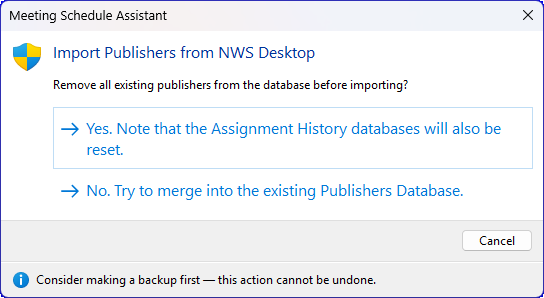
Figure 1: Reset or merge the Publishers Database before importing.
| Option | What It Does | When to Use It |
|---|---|---|
| Yes — Reset Database | Removes all publishers, memo fields, group assignments, assignment eligibility settings, and resets assignment history databases before importing. | Use when you want a completely fresh publisher list from the import file. |
| No — Merge | Preserves existing publishers and assignment history while adding or updating records from the import file. | Use when you want to add or update publishers without losing your current list. |
| Cancel | Stops the import with no changes. | Use if you selected the wrong file or want to review your data first. |
This prompt appears only for importers that modify the Publishers Database.
Although each importer has its own details, the general workflow is the same:
- Choose the import source
- Select the CSV or export file
- Map any optional memo fields (if supported)
- Review the summary
- Complete the import
After the import finishes, a summary is displayed showing how many items were added, updated, or skipped.
Not all steps apply to every importer; each importer’s help page explains its specific workflow.
- Back to: Menu Bar
- Previous: Database Menu
- Next: Options Menu