notes and code from free code camp's youtube tutorial creted by William Fiset
Graph Theory is the mathematical theory of thr properties and application of graphs (network).
-
Undirected Graph: a type of graph in which edges have no orientation, i.e, the edge (u, v) is identical to edge (v, u)

-
Directed Graphs: (aka: diagraph) a type of graph in which edges have orientation, i.e, (u, v) is the edge from node u to node v

-
Weighted Graph: graphs with weights assigned to its edges that represent some arbitrary value such as cost, distance, quantity, etc...
(note: edges of weighted graph will be denoted as (u, v, w))


- Tree: a tree is a undirected graph with no cycles. Equivalently, it is a connected graph with N nodes and N-1 edges

- Rooted Tree: it is a tree with a designated root node, where every edge either points away from or towards the root node. When edges point away from the root, the graph is called an arborescence (out-tree) and anti arborescence (in-tree) otherwise

- Directed Acyclic graphs: (aka: DAG) directed graphs with no cycle. These graphs play an important role in representing structures with dependencies (eg: sceduler, build system, compiler, uni class pre-requisites), Several efficient algorithms exist to operate in DAGs. (eg: topological ordering of nodes)
 (cool fact: all out trees are DAGs, but not all DAGs are out trees)
 - Bipartide Graph: it a graph whose vertices can be split into two independent groups U, V such that every edge connects between U and V.

other definations:- two-colorable graph
- no odd length cycle
- complete graph: a graph where there's a unique edge between every pair of nodes. A complete graph with n vertices is denoted as the graph Kn


- Adjacency Matrix: m[i][j] represents the edge weight of going from node i to j


| Pros | Cons |
|---|---|
| Space efficient for representing dense graph | Requires Θ(V²) space |
| Edge Weight Look up is O(1) | Iterateing over all edges take Θ(V²) time |
| Very Simple Structure |
- Adjecency List: represent a grpah as a map from nodes to list of edges


| Pros | Cons |
|---|---|
| Space efficient for representing sparse graph | Less space efficient for dense graphs |
| Iterating over all edges is efficient | Edge weight look up os O(E) |
| Slightly more complex grph representation |
- Edge List: unordered list of edges (in form of triplets (u, v, w))

Note: this form of representation is seldomly used because of its lack of structure. However it is conceptually simple and practical in a handful of algorithms

| Pros | Cons |
|---|---|
| Space efficient for representing sparse graph | Less space efficient for dense graphs |
| Iterating over all edges is efficient | Edge weight look up os O(E) |
| Very Simple Structure |
before begining any problem, ask yourself:

- open graphInputs.griff file
- add test case as:
[(from,to,weigt),(from,to,weight),...] - use # for comments

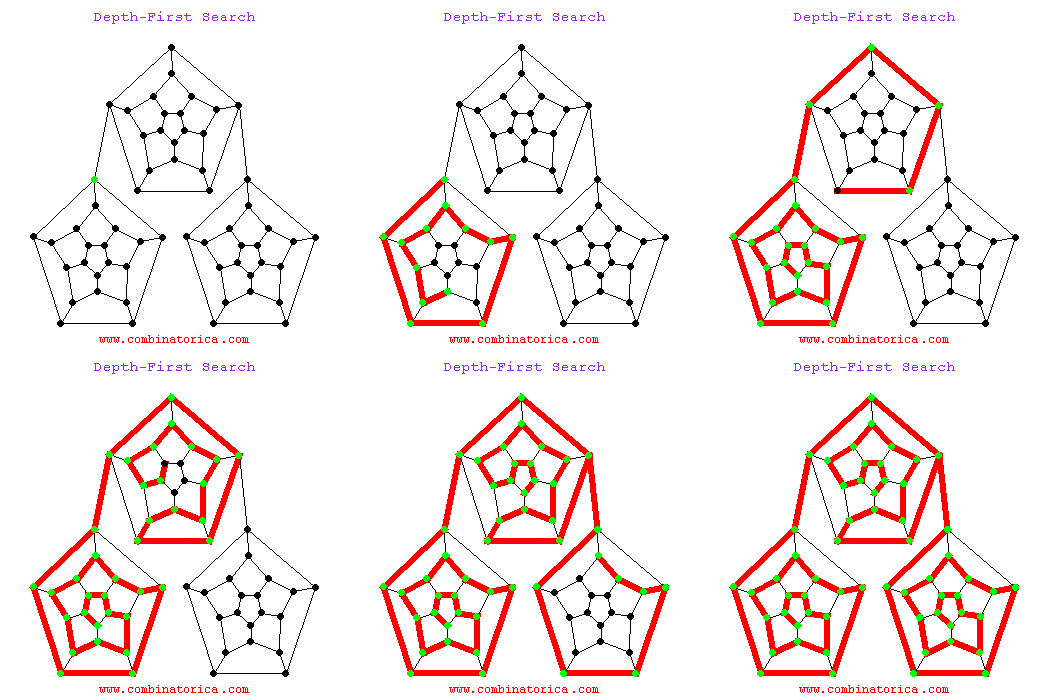
a dfs plunges depth first search into a graph without regard for which edge it takes next until it cannot go any further at which point it backtracks and continues