A contribution graph tells you that work happened. It never tells you what happened.
Paste a public GitHub repo. Snowflake fetches its own commit history, finds the one story hiding in it with plain SQL, and narrates that single thread with Cortex. You get a card you can drop into a README.




Live: commitchronicles.anchildress1.dev · Write-up: Your obsession leaves a trail. Mine gives it a plot. · Prize target: Best Use of Snowflake
Judging scope:
v1.0.0is the challenge submission. It was cut for the DEV Weekend Challenge deadline and is the only thing that should be judged. The repo was created on 10 Jul 2026 and everything in the entry was built inside the challenge window — the badges above are the receipt. Any commit or release afterv1.0.0is post-deadline work and is not part of the entry.
- About
- Examples
- Features
- Tech Stack
- Architecture
- The Snowflake case
- Project Structure
- Getting Started
- Configuration
- Security
- How to Contribute
- What's Next
- License
- Author
Buried in a repo's commit history there is usually exactly one story worth telling. A project that went dark for 107 days and came back at 3:32am. A repo built entirely after midnight whose last commit landed at 3:53 and never got another. A week where every commit was a revert.
Commit Chronicles finds that story with SQL, narrates it with Cortex, and renders it as a 1200×630 SVG sized for a README and a social preview.
The scope is one repository, not a whole profile. A year-in-review across a profile turns to mush. A repo has a clean arc: commits start, cluster, pause, restart, or stop.
Two rules hold the product together:
- Cortex interprets the shape. It never invents the facts. Every timestamp, count, gap, and quoted message on the card is real and derived from ingested commits. Reading the arc is the product; asserting the author's motivation is not.
- A repo with no real story says so. Sparse histories get an honest grey template card, not manufactured drama.
Two real repos, two storylines the detector found unaided — a binge and a nocturne. Every dot, timestamp, and quoted commit is real:
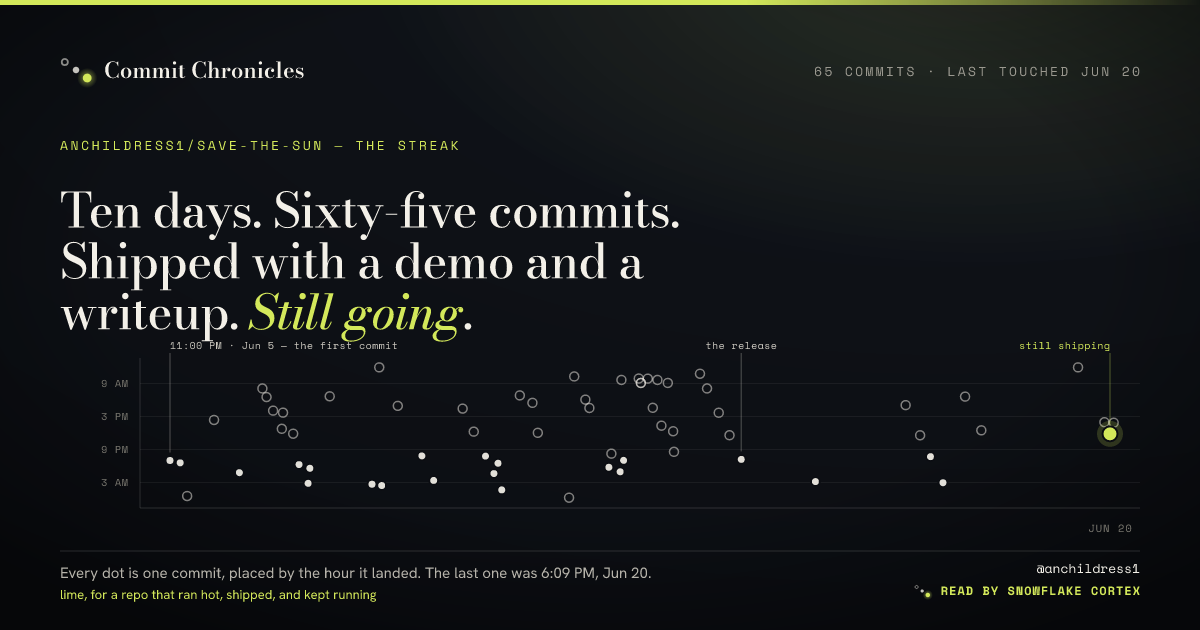
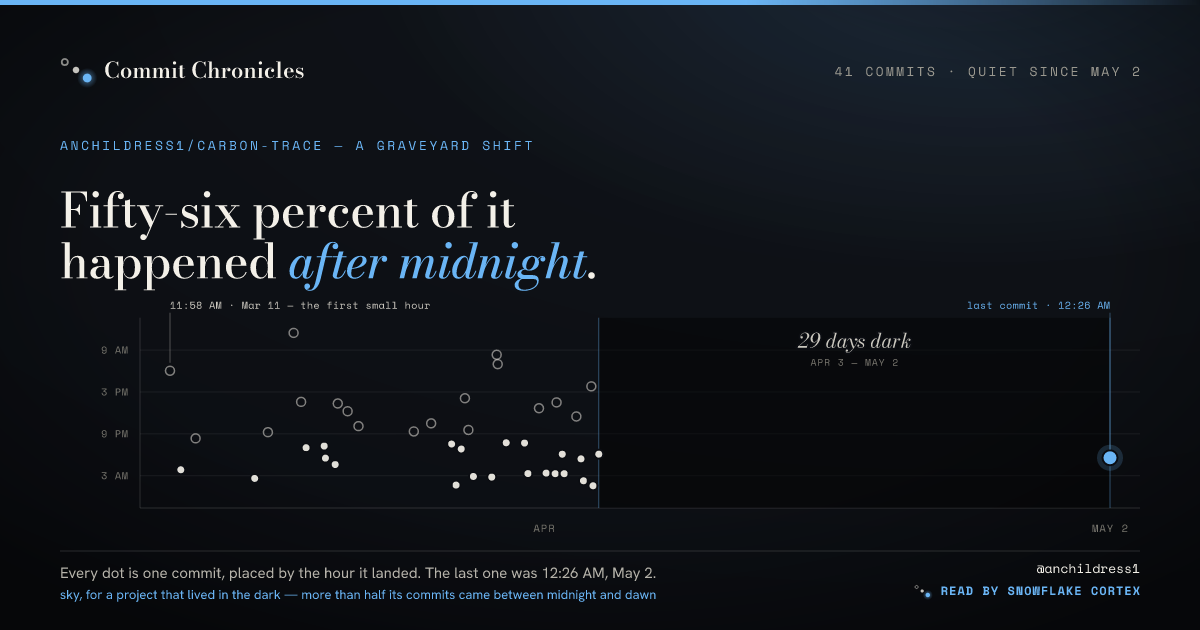
And a third, which is the one that proves the other two. forem/forem has 463 commits and no story — a team repo with continuous CI has no personal arc to find. It says so, in grey, and Cortex is never called:

A product that cannot return nothing will invent something. This one returns nothing.
| Feature | What it does |
|---|---|
| Repo-first flow | Enter a public owner/repo, submit once. Generation is keyed by the slug. |
| Durable generation | Work runs on a Cloud Tasks worker request, so closing the tab doesn't kill the job. Come back later to /{owner}/{repo} and re-attach. |
| Six-storyline SQL detector | relapse, nocturne, binge, collapse, fight, resurrection — scored deterministically, exactly one winner, plus a none fallback. |
| One Cortex call | The winning thread's evidence only, never the whole history. Schema-constrained output. |
| Cortex picks the palette | The accent hex is a reading of the arc, chosen from five muted neons, with the reason recorded on the card row. |
| Copyable README embed | The card is a public bucket object. Hotlink it from anywhere. |
| Cost guards by construction | Daily cap, in-flight dedupe, cached failures, queue-level concurrency ceiling, ingest cap. |
| Layer | Choice |
|---|---|
| Data + AI engine | Snowflake — external access integration, plain-SQL detector views, AI_COMPLETE via a hand-written UDF (claude-sonnet-4-5) |
| Deploy tooling | snow CLI — every warehouse object is SQL in this repo |
| Backend | Node 24 (ESM), TypeScript strict, Hono |
| Frontend | React 19 + Vite (path-driven SPA, no router library) |
| Compute | Cloud Run (scale-to-zero, request-billed) |
| Queue | Cloud Tasks (OIDC-signed worker callbacks) |
| Cache of record | Public GCS bucket |
| Tests | Vitest + Testing Library, Playwright for E2E |
Snowflake does the work. Cloud Run guards the request, calls one stored procedure, turns the returned payload into an SVG, and writes it to the bucket. It computes no analysis of its own.
flowchart TD
    accTitle: Commit Chronicles architecture
    accDescr: The SPA posts to Cloud Run, which claims quota and enqueues a Cloud Tasks job. The worker calls one Snowflake procedure. Inside the warehouse, a Python stored procedure reaches api.github.com through an external access integration to ingest commits; plain SQL views score six storylines and pick one winner; only that winner's evidence is selected and passed to Cortex, whose output is validated in SQL before a JSON card payload is returned. Cloud Run renders that payload to SVG and writes it to a public GCS bucket, which serves the card to READMEs.

    GH[("GitHub<br/>api.github.com")]

    SPA["SPA"]
    API["Cloud Run<br/>POST /api/generate"]
    Q["Cloud Tasks<br/>max 2 concurrent"]
    W["Cloud Run worker<br/>POST /internal/generate"]

    subgraph SF["Snowflake — CALL READ_REPO"]
        direction TB
        EAI["External Access Integration<br/>GITHUB_API_ACCESS"]
        ING["ingest<br/>INGEST_REPO_COMMITS, cap 500"]
        DET["detector.sql<br/>gaps, streaks, night hours"]
        SCORE["storyline scoring<br/>six candidates, one winner"]
        EV["evidence selection<br/>CARD_EVIDENCE, the winner only"]
        CTX["Cortex<br/>CHRONICLE_CARD, one AI_COMPLETE"]
        VAL["validation<br/>hex, labels, kicker, in SQL"]
        JSON["JSON card payload"]

        EAI --> ING --> DET --> SCORE --> EV --> CTX --> VAL --> JSON
        SCORE -.->|"storyline none, Cortex skipped"| JSON
    end

    REN["Cloud Run<br/>renders the SVG"]
    GCS[("Public GCS bucket<br/>the cache of record")]
    OUT["SVG<br/>README embed, social preview"]

    SPA -->|"repo slug"| API
    API -->|"guard, claim, enqueue"| Q
    Q -->|"survives the tab closing"| W
    W --> SF
    GH <-.->|"the warehouse gets its own data"| EAI
    JSON --> REN
    REN -->|"only writer"| GCS
    GCS --> OUT
    GCS -->|"GET /api/state"| SPA
The none path is not an error branch — it is the honest answer for a history with no arc, and it skips Cortex entirely.
The card's existence in the bucket is the ready state. There is no Firestore, no status column, no separate database. readState checks for card.json; if it's there, the repo is ready.
sequenceDiagram
    accTitle: Generation sequence
    accDescr: The browser reads state first and only posts to generate on a miss. Cloud Run claims a quota slot and a generating marker, then enqueues a Cloud Tasks job. The worker calls Snowflake, renders the SVG, and writes it to the bucket. The browser polls state until ready.

    actor U as Browser
    participant R as Cloud Run
    participant B as GCS bucket
    participant Q as Cloud Tasks
    participant S as Snowflake

    U->>R: GET /api/state
    R->>B: does card.json exist?
    B-->>R: no
    R-->>U: unknown

    U->>R: POST /api/generate
    R->>B: claim daily quota
    R->>B: claim generating, create-only
    Note over R,B: two racing requests cannot<br/>both start a Cortex call
    R->>Q: enqueue, OIDC-signed
    R-->>U: 202 generating

    Q->>R: POST /internal/generate
    R->>S: CALL READ_REPO
    S->>S: ingest if cold, detect, narrate
    S-->>R: card payload

    R->>R: render SVG
    R->>B: card.png, then card.json, then clear state
    Note over R,B: card.json last: a crash leaves it<br/>retryable, never ready-with-no-card

    loop every 2.5s
        U->>R: GET /api/state
    end
    R-->>U: ready + cardUrl
The queue is a cost decision. Cloud Tasks calls back into the service, so the pipeline runs inside a request — CPU is billed only while it works and the service still scales to zero. Detaching the work instead would need --no-cpu-throttling, which bills the container for sitting there doing nothing.
This is the part that matters for the prize. The warehouse is the editor, not a bucket the LLM reads from.
An EXTERNAL ACCESS INTEGRATION lets a Python stored procedure call api.github.com from inside the warehouse. There is no ingestion service, no ETL job, no Cloud Function shovelling JSON.
| Object | Type | Job |
|---|---|---|
GITHUB_API_RULE |
NETWORK RULE (EGRESS) |
Let the warehouse out to api.github.com |
GITHUB_TOKEN |
SECRET |
The GitHub token, created out-of-band (setup docs) |
GITHUB_API_ACCESS |
EXTERNAL ACCESS INTEGRATION |
Binds the rule to the secret |
INGEST_REPO_COMMITS(owner, repo) |
PROCEDURE (Python) |
Paginates the REST Commits API into COMMITS, classifies bot/AI-assisted rows in SQL |
Ingest caps at 500 commits by default (hard cap 2000). A longer history sets windowed, and the card says so out loud — last 500 commits · quiet since Feb 25 — because reporting a slice as the repo's whole life is simply false.
detector.sql is 15 views and zero AI calls. It scores every candidate storyline and keeps exactly one.
flowchart LR
    accTitle: The SQL detector
    accDescr: COMMITS_CLEAN feeds six storyline views, each gated on a minimum commit count. Their scores union into STORYLINE_SCORES, and REPO_STORYLINE picks the single highest score, breaking ties by drama rank. CARD_EVIDENCE then selects only the winning thread's commit lines for Cortex.

    C["COMMITS_CLEAN<br/>merges and bots dropped"]

    subgraph SC["STORY views — scored, gated, free"]
        direction TB
        R["relapse<br/>gap 30d or more"]
        N["nocturne<br/>half the commits at night"]
        B["binge<br/>streak of 7d or more"]
        X["collapse<br/>a spike, then 90d silent"]
        F["fight<br/>4 reverts inside 7d"]
        S["resurrection<br/>a relapse that shipped"]
    end

    W["REPO_STORYLINE<br/>highest score, ties by drama"]
    E["CARD_EVIDENCE<br/>the winner's lines only"]
    AI["CHRONICLE_CARD<br/>the one Cortex call"]
    NONE["none<br/>grey template card<br/>Cortex never runs"]

    C --> SC --> W
    W -->|"a winner"| E --> AI
    W -->|"nothing clears its floor"| NONE
Every storyline gates on MIN_COMMITS = 15 so bot noise can't win, and scoring is deterministic — the same repo always yields the same story. Thresholds live in one DETECTOR_CONFIG view:
CREATE OR REPLACE VIEW DETECTOR_CONFIG AS SELECT
    15 AS MIN_COMMITS,           30 AS RELAPSE_MIN_GAP_DAYS,
    90 AS ABANDONED_AFTER_DAYS,   7 AS BINGE_MIN_STREAK_DAYS,
     4 AS FIGHT_MIN_COMMITS,     22 AS NIGHT_START_HOUR,
     5 AS NIGHT_END_HOUR,        25 AS EVIDENCE_SHARE_PCT,
    20 AS EVIDENCE_MIN_LINES,   140 AS EVIDENCE_MAX_LINES;
The winner is picked with one window function:
QUALIFY ROW_NUMBER() OVER (
    PARTITION BY f.REPO_OWNER, f.REPO_NAME
    ORDER BY s.SCORE DESC NULLS LAST, s.DRAMA_RANK
) = 1
Surveying a whole history produces a report. Picking one story produces an argument.
CHRONICLE_CARD is a hand-written SQL UDF wrapping AI_COMPLETE — one schema-constrained call. Model claude-sonnet-4-5, temperature 0.4, max_tokens 2048.
It is fed CARD_EVIDENCE: the winning thread's commit lines, budgeted at 25% of the history, floored at 20 and capped at 140 — plus the first 5 and last 8 regardless, because the opening and the ending are the shape of the story. Never the whole repo. Squash-merge bodies are exploded into individual lines first, so work hidden inside a merge is still visible.
The selection is deterministic: lines are ranked by distance from the pivot and tie-broken on SHA and PART, so the same repo hands Cortex the same evidence in the same order every time.
The response schema constrains exactly nine keys:
{
  "kicker": "the death of a side project",
  "headline_upright": "Born in daylight. Last touched at",
  "headline_accent": "3:53 in the morning",
  "headline_trail": ".",
  "label_first": "it begins",
  "label_pivot": "",
  "label_last": "",
  "accent": "#e8a04a",
  "accent_reason": "amber, for a repo that ran hot and went out"
}
That is the entire surface area of the writing. Everything else on the card is composed by the renderer from facts — the commit count, the status verb, the anchor timestamps, the void-panel gap, the caption. Cortex is never taught to produce a number.
The output is then verified in SQL before it is stored. A bad accent hex, a digit smuggled into a poetic label, or a kicker that just echoes the storyline name gets rejected with cortex_rejected — the card is not written.
Detection costs nothing. The LLM sees ~20–140 lines, not twenty thousand. CHRONICLES_WH is an XSMALL that auto-suspends after 60 seconds with a 300-second statement timeout. Every Cortex query ID is stored on the card row for cost audit.
Not built with Cortex AI Function Studio — deliberately. The Studio registers functions through
SNOWFLAKE.CORTEX.CREATE_AI_FUNCTION, which Snowflake documents as internal and subject to change without notice, and its entry points are a Snowsight wizard and the Cortex Code CLI — neither leaves the function in this repo. It emits an ordinary UDF aroundAI_COMPLETEanyway, so we wrote that ourselves. You can read it.
snowflake/            # the app. Every object is SQL, deployed with `snow`.
  schema.sql          #   warehouse, tables, COMMITS_CLEAN, PIPELINE_VERSION
  ingest_pipeline.sql #   network rule, external access integration, ingest proc
  detector.sql        #   15 views: facts, gaps, the six storylines, the winner, the evidence
  ai_functions.sql    #   CHRONICLE_CARD — the AI_COMPLETE wrapper
  read_repo.sql       #   READ_REPO — the single entry point Cloud Run calls
src/
  server/
    app.ts            #   routes
    generate.ts       #   claim → enqueue → run → render → write
    bucket.ts         #   GCS: card.png, card.json, state.json, quota counters
    queue.ts          #   Cloud Tasks + OIDC verification (inline fallback for laptops)
    snowflake.ts      #   the driver wrapper
    rerender.ts       #   CLI: redraw stored cards, no Cortex spend
    card/             #   SVG renderer — layout, text fitting, formatting
  client/             #   React SPA: Landing, Loading, Result, Failed
  shared/             #   slug parsing, error taxonomy (shared by both sides)
docs/                 # the spec, the build plan, Snowflake account bootstrap
scripts/              # gcp-bootstrap.sh — one-off GCP resources
Requires Node ≥ 24 and, for the warehouse half, the snow CLI.
make install     # deps + git hooks
cp .env.example .env
make dev         # API on :8080, SPA on :5273
make ai-checks   # format, lint, typecheck, test, build — the full gate
Without a Cloud Tasks queue configured, generation runs in-process. A laptop needs no queue.
See docs/snowflake-setup.md for minting the Snowflake PAT (it's role-locked at creation — that trips everyone once) and the GitHub token.
make snowflake-deploy   # every warehouse object, in dependency order
make gcp-bootstrap      # bucket, image repo, service accounts, secret, queue (one-off)
make deploy             # build the image, deploy to Cloud Run, prune to 3 revisions
SNOWFLAKE_PAT lives in Secret Manager and is mounted at run time. .env is local-only; nothing in it is baked into an image.
| Variable | Required | Default | Purpose |
|---|---|---|---|
CARD_BUCKET |
yes | — | The public GCS bucket. Cards, state, quota counters. |
SNOWFLAKE_ACCOUNT |
yes | — | Account identifier |
SNOWFLAKE_USER |
yes | — | |
SNOWFLAKE_PAT |
yes | — | Programmatic access token; role-locked at creation |
SNOWFLAKE_WAREHOUSE |
no | CHRONICLES_WH |
|
SNOWFLAKE_DATABASE |
no | CHRONICLES |
|
SNOWFLAKE_SCHEMA |
no | RAW |
|
SNOWFLAKE_ROLE |
no | ACCOUNTADMIN |
|
PORT |
no | 8080 |
|
PUBLIC_ORIGIN |
no | https://commitchronicles.anchildress1.dev |
Used to build the page URL in the README embed |
DAILY_GENERATION_CAP |
no | 100 |
Hard ceiling on live generations per day |
GENERATING_TTL_SECONDS |
no | 600 |
After this, an in-flight job is presumed dead and re-admitted |
TASKS_QUEUE |
no | — | All-or-nothing. Set it and GOOGLE_CLOUD_PROJECT, TASKS_LOCATION, WORKER_URL, TASKS_INVOKER_SA all become required. Unset ⇒ in-process generation. |
GITHUB_TOKEN |
no | — | Only used to mint the Snowflake SECRET. Cloud Run never calls GitHub. |
- Cloud Run is the only writer to the bucket. Client writes are forbidden. The bucket is public-read because hotlinked cards are the product.
/internal/generatespends Cortex credits, so it verifies OIDC — the task's token is checked against the invoker service account's email before anything is billed. No token, no work.- Path handling denies by default.
parseSlugrejects.., enforces GitHub's own owner/repo grammar, and runs on both the client and the server. An unparseable slug never reaches the warehouse. - Cortex's accent hex is re-verified before it reaches the SVG (
safeAccent), even though the response schema already constrains it. The card is public; the hex is untrusted output. - Secrets never land in the repo.
SNOWFLAKE_PATis mounted from Secret Manager; the GitHub token exists only as a SnowflakeSECRETobject..envis local-only and git-ignored. - Abuse controls: daily generation cap counted in the bucket (so it holds across instances), create-only claim so two racing requests can't both bill a Cortex call, cached failures for terminal errors, and a queue
max-concurrent-dispatches=2ceiling on the warehouse spend rate.
- Branch and PR always. Nothing lands directly on
main. - Conventional Commits, GPG-signed, one logical change per commit.
- AI-authored commits carry a
Generated-by:footer naming the model that wrote the diff, plus a humanSigned-off-by:. Commitlint enforces both. make ai-checksis the gate. Warnings are errors.- New components and utilities ship with positive, negative, and edge-case tests.
- Embedded font subset. GitHub proxies README images through camo, so webfonts don't load in the card. The fix is a base64-embedded Didone subset; today the card falls back through a serif stack.
- A gallery route. Cut for the deadline — the landing page ships three example chips instead.
- Auto-regeneration of stale cards.
STALE_CARDSalready reports which cards were written by a pipeline version that no longer exists. It reports rather than acts, because acting costs a Cortex call each.
Read it, learn from it, fork it, run it yourself. The one thing you can't do is sell it as a competing product. Poking at the SQL is fine; relabelling this as your own commit-storytelling product is not.
Ashley Childress — @anchildress1