NIFI-5875 Improve docs around the PriorityAttributePrioritizer - #3205
NIFI-5875 Improve docs around the PriorityAttributePrioritizer#3205emilyselwood wants to merge 5 commits into
Conversation


Clear up the documentation around the PriorityAttributePrioritizer to make it clearer that if the attributes are both number the largest wins but if they are not numbers they sort the other way around.

I had to go and look at the code to work out what was going on after reading the existing documentation.

 ijokarumawak
left a comment
ijokarumawak
left a comment
ijokarumawak
left a comment
There was a problem hiding this comment.
@wselwood Thanks for clarifying docs! Although I agree with the idea of adding more details, the proposed updated doc could be too specific for some users.
I'd suggest leaving the original sentence as it is, and add some notes for detailed behavior. Thoughts?
| - *NewestFlowFileFirstPrioritizer*: Given two FlowFiles, the one that is newest in the dataflow will be processed first. | ||
| - *OldestFlowFileFirstPrioritizer*: Given two FlowFiles, the one that is oldest in the dataflow will be processed first. 'This is the default scheme that is used if no prioritizers are selected'. | ||
| - *PriorityAttributePrioritizer*: Given two FlowFiles that both have a "priority" attribute, the one that has the highest priority value will be processed first. Note that an UpdateAttribute processor should be used to add the "priority" attribute to the FlowFiles before they reach a connection that has this prioritizer set. Values for the "priority" attribute may be alphanumeric, where "a" is a higher priority than "z", and "1" is a higher priority than "9", for example. | ||
| - *PriorityAttributePrioritizer*: Given two FlowFiles, an attribute called “priority” will be extracted. If only one has that attribute it will go first. If the attributes can be parsed as a long, they will be ordered largest number first. For example 9 will come before 1 and 100 will be selected before 99. If only one of them parses as a long that one will be considered to have the higher priority. Otherwise, they will be ordered in alphanumeric order, where "a" is a higher priority than "z", and "1" is a higher priority than "9", for example. |
There was a problem hiding this comment.
If the attributes can be parsed as a long, they will be ordered largest number first. For example 9 will come before 1 and 100 will be selected before 99
Is this true? As following test case shows, if 1 and 2 are compared, 1 goes first.
https://github.com/apache/nifi/blob/master/nifi-nar-bundles/nifi-framework-bundle/nifi-framework/nifi-standard-prioritizers/src/test/java/org/apache/nifi/prioritizer/PriorityAttributePrioritizerTest.java#L91
There was a problem hiding this comment.
Ouch. Good spot. The old docs got me spun around there. I'll update.
Simplify the main section of documentation for PriorityAttributePrioritzer and then add a notes section with more details about the ordering.

|
@wselwood Thanks for the update, looks much better! For the even better readability, can we improve structure a little bit more organized? How about something like this? Example output:
(As plain text)
|
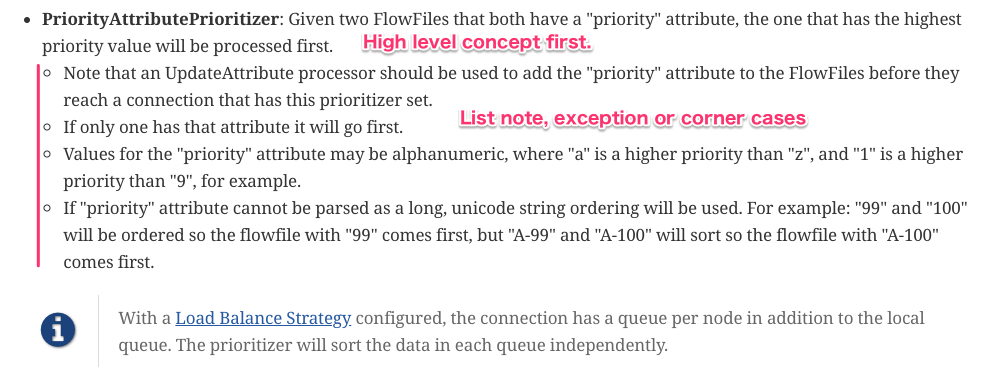
|
Looks perfect, +1 merging. Thanks @wselwood ! |


2 participants


Clear up the documentation around the PriorityAttributePrioritizer to make it clearer that if the attributes are both number the largest wins but if they are not numbers they sort the other way around.
I had to go and look at the code to work out what was going on after reading the existing documentation.
Thank you for submitting a contribution to Apache NiFi.
In order to streamline the review of the contribution we ask you
to ensure the following steps have been taken:
For all changes:
Is there a JIRA ticket associated with this PR? Is it referenced
in the commit message?
Does your PR title start with NIFI-XXXX where XXXX is the JIRA number you are trying to resolve? Pay particular attention to the hyphen "-" character.
Has your PR been rebased against the latest commit within the target branch (typically master)?
Is your initial contribution a single, squashed commit?
For documentation related changes:
Note:
Please ensure that once the PR is submitted, you check travis-ci for build issues and submit an update to your PR as soon as possible.